

What Does Mission-Ready Gear Mean for Hunters and Shooters
Mission-ready gear is equipment that can perform its intended function reliably, safely, and without fault under the exact conditions you expect to face. That definition comes straight from U.S. Department of Defense operational readiness standards, and it applies just as cleanly to a hunter’s rifle case as it does to a military aircraft.
- DoD-grounded standard: Equipment is operationally ready when it operates within its designed configuration and offers high assurance of effective, reliable, safe performance.
- Tiered classification: Gear falls into three priority levels — Mission Essential, Mission Critical, and Mission Enhancing — each with different replacement and inspection rules.
- Pre-mission inspection habit: Readiness is not a purchase decision; it is a process confirmed by a physical check before every deployment.
Table of Contents
- What mission-ready gear looks like in practice
- How the three-tier classification helps you prioritize
- How to spot genuinely durable construction
- Pre-mission inspection and packing checklist
- Training with your gear keeps it truly ready
- Mistakes that quietly defeat mission-readiness
- Key Takeaways
- The manufacturer’s view on what readiness actually demands
- Fs9tactical gear built for the field, ready when you need it
- Sources and further reading
What mission-ready gear looks like in practice
For hunters, shooters, and survivalists, mission-readiness translates into five observable criteria: reliability under expected conditions, fit-for-purpose design, maintainability in the field, compatibility with the rest of your kit, and proven performance you have personally tested.
Hunters must verify that rifle cases seal against moisture, optics are zeroed and protected, and field-dressing tools are sharp and accessible. A case that pops open on a rough ATV trail is not mission-ready regardless of its price tag.
Shooters need magazines that seat and drop free consistently, hearing protection that fits under a helmet or hat, and a range bag organized so every item has a fixed home. Fumbling for a chamber flag during a stage costs time and focus.
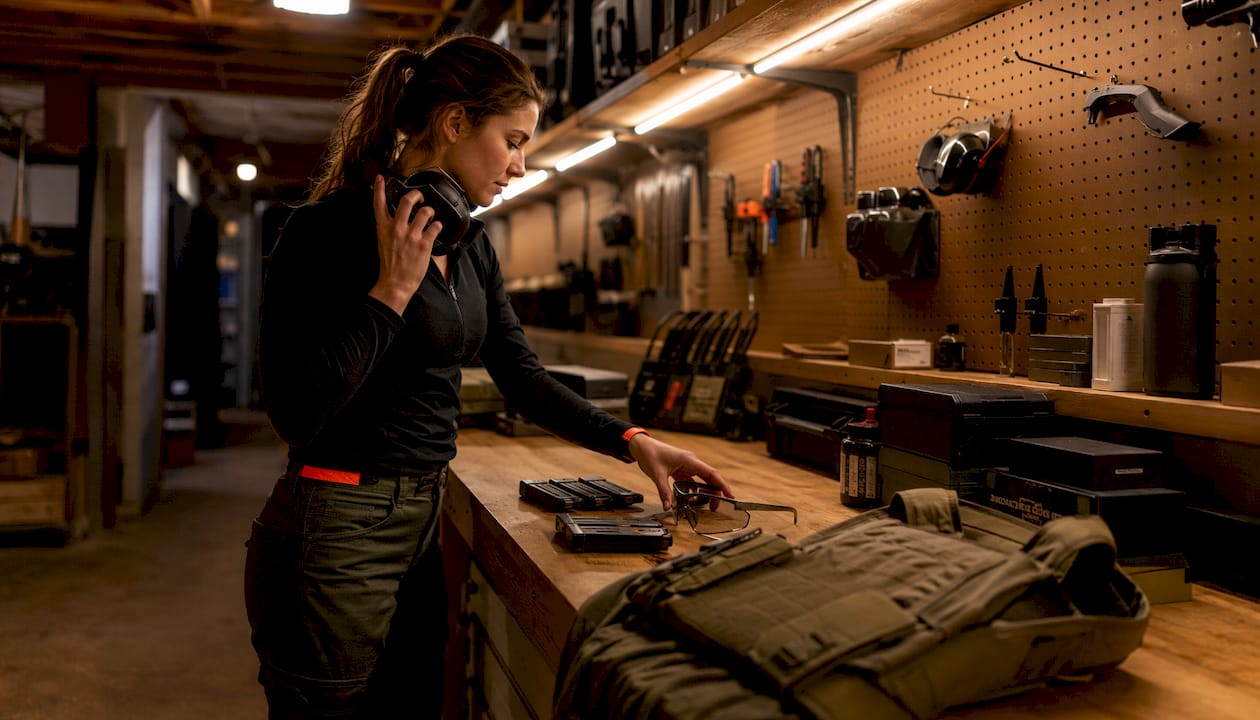
Survivalists carry the most interdependent kit, so compatibility checks matter most. A hydration bladder that leaks into a med pouch, or a fire-starter stored where it cannot be reached with one hand, defeats the whole system.
Field-readiness signals to look for:
- Consistent function across at least three dry runs before the mission
- Spare parts or consumables for anything with a failure mode (batteries, O-rings, lube)
- Clear labeling on every pouch and compartment
- Tested interfaces between items (holster to belt, pouch to MOLLE, case to vehicle mount)
How the three-tier classification helps you prioritize
Tactical experts consistently recommend defining the mission first, then building the kit outward from a reliable baseline. The three-tier framework makes that concrete.
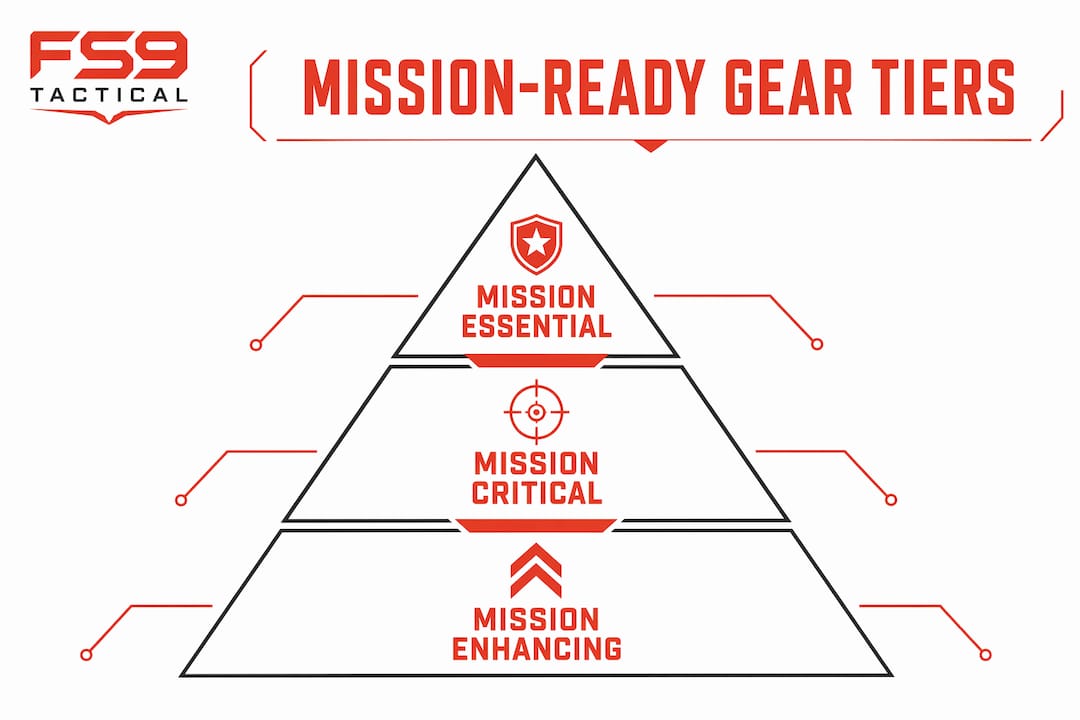
Mission Essential items are non-negotiable. If they fail or go missing, the mission cannot proceed. Mission Critical items significantly degrade performance if absent but do not fully stop the mission. Mission Enhancing items improve comfort, speed, or capability but can be left behind under weight or cost constraints.
| Tier | Definition | Hunter example | Shooter example | Survivalist example |
|---|---|---|---|---|
| Mission Essential | Cannot complete mission without it | Rifle + ammunition + license | Firearm + magazines + ear protection | Water filter + fire-starter + shelter |
| Mission Critical | Serious degradation if missing | Optics + field-dressing kit | Cleaning kit + range bag | First-aid kit + navigation tool |
| Mission Enhancing | Improves performance, not required | Rangefinder + game calls | Shot timer + extra targets | Solar charger + comfort layers |
Prioritization rules:
- On a short day hunt, Mission Enhancing items are optional; on a multi-day backcountry trip, some shift to Mission Critical.
- When weight is the constraint, cut Mission Enhancing first, then trim Mission Critical to minimum viable versions.
- Never compromise Mission Essential items to save weight or money.
How to spot genuinely durable construction
Material and build quality predict field performance better than brand marketing. The signals that matter are specific and verifiable.
- Fabric denier: High-denier fabrics like 1000D Cordura or ballistic nylon resist abrasion and puncture far longer than standard polyester. Ask the manufacturer for the denier rating before buying.
- Stitching patterns: Bar-tacks at stress points (handle bases, zipper ends, strap attachments) indicate the manufacturer anticipated load forces. Double or triple stitching on seams is the baseline; anything less on a load-bearing item is a red flag.
- Zippers and closures: YKK or equivalent-rated zippers with oversized pulls hold up to gloved hands and cold temperatures. Plastic buckles should be rated for the load they will carry.
- Hardware coatings: Anodized aluminum or stainless steel hardware resists corrosion in wet environments; uncoated zinc alloy does not.
To verify claims, ask the manufacturer for abrasion test results or denier specs. A company that cannot answer those questions probably cannot back the durability claim either. Warranty terms matter too: a lifetime repair policy signals the manufacturer expects the product to outlast normal wear cycles.
Pro Tip: Lighter materials are acceptable for Mission Enhancing items carried occasionally. For Mission Essential and Mission Critical gear, prioritize rugged construction over weight savings — a torn rifle case or a failed med pouch in the field costs far more than the ounces you saved.
Pre-mission inspection and packing checklist
Run this checklist in under 10 minutes before any deployment.
- Function test every Mission Essential item — cycle actions, check optics, test closures.
- Verify consumables — batteries, medical dressings, fuel, hydration, lubricant.
- Check labels — every pouch and compartment should be labeled so someone else can find what they need.
- Test interfaces — attach every item to its carrier and confirm fit and retention.
- Confirm spare parts — at minimum, one spare for any item with a known failure mode.
- Review packing order — most-needed items go in outermost pockets; bulk and weight go low and close to the body.
Packing order priority:
- Outer/quick-access pockets: med kit, navigation, communication
- Hip belt or chest pouches: snacks, small tools, fire-starter
- Main compartment top: rain gear, extra layers
- Main compartment bottom: shelter, bulk food, spare ammo
For core gear categories and how to group them by priority, Fs9tactical’s field guides break this down by scenario type.
Replacement intervals for high-wear consumables:
| Item | Replacement interval |
|---|---|
| Batteries (flashlight, optic) | Every 6 months or after heavy use |
| Medical dressings / tourniquets | Annually or if packaging is compromised |
| Hydration bladder / tubing | Annually or if taste/odor develops |
| Firearm lubricant | Every outing in wet or dusty conditions |
| Fire-starter fuel | Before every multi-day trip |
Training with your gear keeps it truly ready
Gear that has never been used under stress is not mission-ready. A deployment packing guide recommends building kit around at least 24 hours of self-sufficiency, but that standard only holds if you have practiced retrieving and using every item under realistic conditions.
Weekly check: Cycle every closure, test every battery-powered item, and confirm your med kit is sealed and labeled. Five minutes, same day each week.
Seasonal inspection: Full disassembly and cleaning of load-bearing gear, replacement of any consumable past its interval, and a full dress rehearsal with the complete kit before the season opens.
During training runs, test specifically for: fit under layered clothing, one-handed retrieval of critical items, and how the kit behaves after exposure to rain or dust. Common tactical training errors include skipping these stress tests entirely and only discovering problems in the field.
Maintenance tasks and cadence:
- Clean and re-lubricate firearms after every range session
- Inspect stitching and hardware after any trip involving water or heavy brush
- Re-zero optics at the start of each season and after any hard impact
- Rotate medical consumables on a fixed calendar, not on memory
Mistakes that quietly defeat mission-readiness
The most common failure mode is buying for appearance rather than function. A fully mission-capable asset in military terms requires every integrated subsystem to work within tolerances. One failed subsystem drops the whole asset to non-mission-capable. The same logic applies to your kit.
Common mistakes:
- Purchasing gear based on aesthetics rather than tested performance
- Failing to run all items together before the mission (individual tests miss interface failures)
- Skipping consumable replacement because “it still works”
- Poor labeling — an unlabeled med kit in a dark pack under stress is nearly useless
- Overpacking Mission Enhancing items at the expense of weight and mobility
A concrete example: a hunter carries a well-stocked first-aid pouch but never labels the compartments. At the moment it matters, finding the tourniquet takes 40 seconds instead of 5. That gap is entirely preventable with a label maker and 10 minutes of organization. The importance of pre-planned organization for retrieval speed under stress is one of the most underestimated factors in field readiness.
On cost: budget for replacement intervals, not just the initial purchase. Gear that costs less upfront but fails after one season costs more over a three-year cycle than a durable item bought once.
Key Takeaways
Mission-ready gear requires reliability, correct tiering, regular inspection, durable construction, and trained use — not just a quality purchase.
| Point | Details |
|---|---|
| Core definition | Gear is mission-ready when it performs its intended function reliably and safely under expected conditions. |
| Three-tier rule | Sort every item as Mission Essential, Mission Critical, or Mission Enhancing — never sacrifice the first tier for weight or cost. |
| Inspection habit | Run a physical function-and-consumables check before every deployment; replace consumables on a fixed calendar. |
| Construction cues | Look for high-denier fabrics, bar-tacked stitching, rated hardware, and manufacturer-backed specs. |
| Fs9tactical option | Fs9tactical builds mission-focused survival kits with ballistic fabrics and reinforced stitching, used by over 20,000 hunters, shooters, and survivalists. |
The manufacturer’s view on what readiness actually demands
There is a gap between what most buyers think makes gear mission-ready and what actually determines it in the field. Buyers focus on features. Manufacturers who build for real use focus on failure modes.
At Fs9tactical, the design process starts with the question: where does this fail, and what happens when it does? That is why the brand uses ballistic fabrics and reinforced stitching rather than lighter materials that photograph well but degrade under repeated field use. As the second-largest soft rifle case manufacturer in the U.S., with over 20,000 users and thousands of five-star reviews, Fs9tactical has accumulated enough field feedback to know which construction decisions hold and which ones do not.
Customer feedback drives specific changes: zipper pull size, compartment labeling systems, drainage port placement. None of those details appear in a spec sheet, but all of them affect whether the gear performs when it counts. That feedback loop is what separates a product designed for a catalog from one designed for a mission.
Fs9tactical gear built for the field, ready when you need it
Fs9tactical’s product line is built around the same readiness principles this article covers: ballistic fabrics, reinforced construction, and organized compartmentalization so critical items are accessible under stress. The 60-in-1 Lifeline Emergency Survival Kit is a concrete example — a pre-organized, mission-focused kit with consumables selected for 24-hour self-sufficiency, packaged so hunters, shooters, and survivalists can deploy it without sorting through gear under pressure.
Check the full kit lineup at Fs9tactical and find the option that fits your mission type and environment.
Sources and further reading
- U.S. DoD definition of “equipment operationally ready” — the primary authority on operational readiness status
- ESD WHS Directive: Fully Mission Capable (FMC) guidance — DoD-level readiness criteria and subsystem thresholds
- Law Insider: “Fully Mission Capable” definition — legal and regulatory framing of FMC standards
- NRA Shooting Illustrated: The Importance of Mission Readiness — practitioner perspective on defining mission-essential baselines
- Fs9tactical: Field-Ready Gear Design for Hunters — manufacturer guidance on materials and construction for field use
- Fs9tactical: Tactical Field Care and Gear Maintenance Best Practices — maintenance cadence and replacement-interval guidance
- Fs9tactical: Defensive Gear Survivalist Kit — survivalist kit composition and packing order
