

Outdoor Emergency Scenarios Gear: 7 Core Categories
Common outdoor emergency scenarios gear is defined as a structured set of equipment addressing seven core survival priorities: water, fire, navigation, first aid, cutting tools, lighting, and weather protection. These categories come from FEMA guidelines and wilderness survival frameworks, not personal preference or marketing trends. The difference between a bad day in the backcountry and a life-threatening situation often comes down to whether you packed the right gear and practiced using it. This guide covers each category with specific items, redundancy strategies, and practical tips drawn from field-tested survival standards.
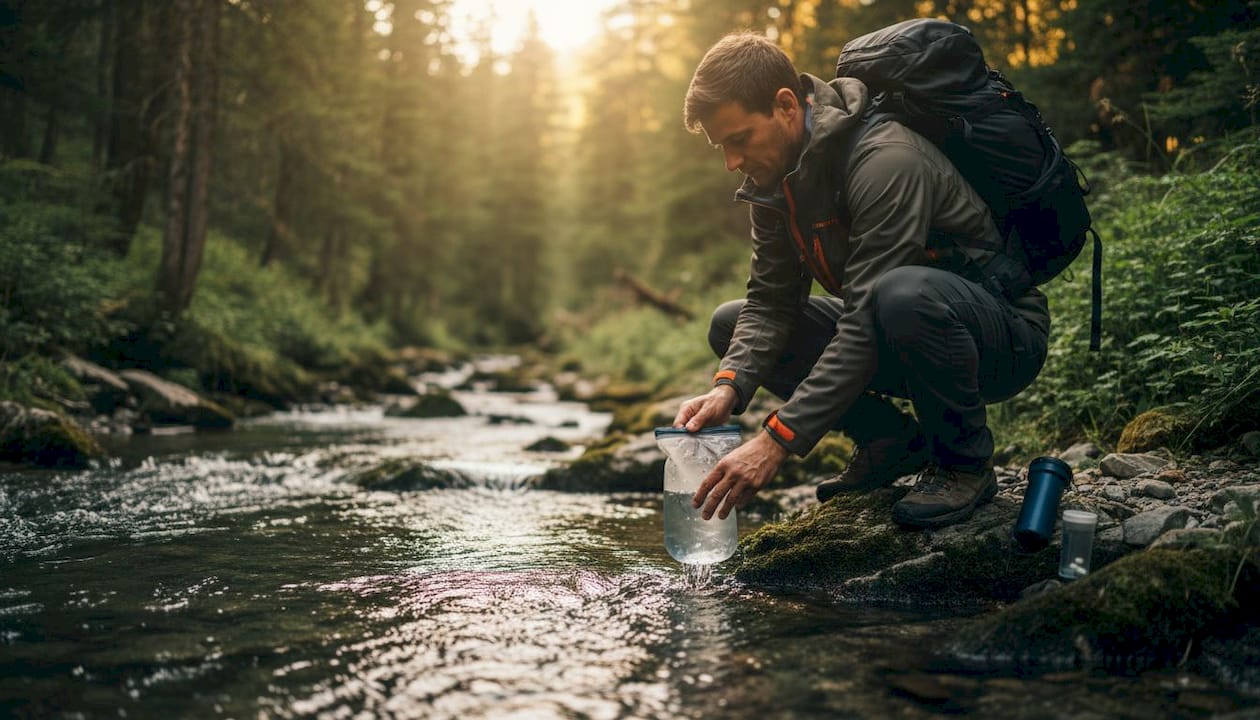
1. Common outdoor emergency scenarios gear: water storage and purification
Water is the highest priority in any outdoor emergency. FEMA recommends 1 gallon of water per person per day for a minimum of 72 hours. That standard shapes how you pack, not just how much you carry.
A single water source or container is not enough. Layered water treatment means pre-filtering through a bandana or coffee filter, running water through a pump or squeeze filter, and then using chemical tablets or boiling as a backup. Each step covers a different failure mode.
- Stainless steel water bottle: Doubles as a boiling vessel when filtration fails
- Pump or squeeze filter: Removes bacteria and protozoa from natural water sources
- Iodine or chlorine tablets: Lightweight chemical backup that fits in a shirt pocket
- Collapsible water reservoir: Adds carry capacity without permanent bulk
Pro Tip: Pack your water tablets in a waterproof pill case and clip it to the outside of your filter pouch. When your hands are cold and shaking, you want zero searching.
Store your primary water container in an outer pocket of your pack for immediate access. Treat refills before you need them, not after your filter is already buried at the bottom of your bag.
2. Fire-making gear for wet, cold, and windy conditions
Fire solves four problems at once: warmth, water disinfection, cooking, and signaling. Carrying at least three ignition sources is the recognized standard among survival practitioners. Each source covers a different failure mode, which is the actual definition of redundancy.
A windproof lighter fails when the fuel runs out. Waterproof matches fail when the striker strip gets wet. A ferrocerium rod works in rain, wind, and cold because it has no moving parts and no fuel to deplete. Carry all three.
- Ferrocerium rod: Reliable in wet and freezing conditions, lasts thousands of strikes
- Waterproof matches: Sealed in a watertight case, useful for quick ignition in moderate conditions
- Windproof lighter: Fast and convenient in calm weather, keep it as your first-reach option
- Commercial tinder cubes: Burn long enough to catch damp wood, far more reliable than natural tinder in rain
- Petroleum-soaked cotton balls: Homemade, cheap, and they burn for several minutes even when partially wet
Store all three ignition sources in separate locations. If you lose your pack, you still want one source on your body. A small fire kit in a belt pouch is not overkill. It is the kind of decision that pays off at 2:00 AM in a rainstorm.
3. Navigation and signaling tools that work without batteries
Navigation gear for emergencies must function without cell service, GPS signal, or charged batteries. Reliable navigation requires a printed topographic map of your area, a compass with adjustable declination, and a waterproof system for recording notes and bearings.
GPS devices are useful supplements, not replacements. Battery failure and signal loss are common in canyons, dense forest, and bad weather. A compass and map never run out of power.
| Tool | Primary use | Failure risk |
|---|---|---|
| Topographic map | Route planning and terrain reading | Physical damage from water |
| Adjustable declination compass | Accurate directional bearings | Magnetic interference near metal |
| GPS device | Precise coordinates and tracking | Battery failure, signal loss |
| Pace beads | Distance tracking without electronics | User error in rough terrain |
Signaling gear gets you found when navigation fails. Carry a loud whistle (the Fox 40 Pealess is a widely recognized standard), a signal mirror for line-of-sight rescue contact, and reflective tape on your pack or jacket. Three whistle blasts is the universal distress signal in North American wilderness rescue.
- Whistle: Audible at distances where shouting fails, no batteries required
- Signal mirror: Visible to aircraft at distances exceeding 10 miles in clear conditions
- Reflective tape: Passive signaling that works even when you are unconscious or incapacitated
4. Wilderness first aid supplies built around the 4 B’s
Wilderness first aid kits are organized around four injury categories. The 4 B’s framework covers Bleeding, Breaks (fractures and sprains), Burns and Blisters, and Bites and Stings. Every item in your kit should map to one of these categories. If it does not, it probably does not belong.
Bleeding control is the most time-critical need. Hemostatic gauze stops severe bleeding faster than standard gauze by accelerating clotting. Elastic bandages handle sprains and secure splints for fractures. Antiseptic wipes and blister care items address the injuries that are most common on long hikes.
- Hemostatic gauze: Stops severe bleeding in wounds where direct pressure alone is insufficient
- Elastic bandages: Wrap sprains, secure improvised splints, and apply compression
- Antiseptic wipes and antibiotic ointment: Clean wounds before infection sets in
- Moleskin and blister pads: Blisters become serious problems on multi-day trips without treatment
- Nitrile gloves: Protect you and the patient during wound care
- 90-day personal prescription supply: Non-negotiable for anyone managing a chronic condition
Pro Tip: Audit your first aid kit every six months. Antiseptic wipes dry out, medications expire, and you may have used items without restocking. A kit you haven’t checked in two years is not a kit. It’s a false sense of security.
Keep your first aid supplies in a trauma-ready pouch that opens with one hand. Color-code it or mark it clearly so anyone in your group can find it fast.
5. Cutting tools and lighting gear for hands-on emergencies
Fixed-blade knives outperform multitools in field durability, ease of cleaning, and reliability under stress. Hinges on multitools can fail under heavy use. A fixed blade has no moving parts to break and is faster to deploy when your hands are cold or shaking.
A good fixed-blade knife handles shelter building, cutting cordage, food preparation, and gear repair. Carry a folding saw as a second cutting tool if your trips involve building debris shelters or processing firewood. The two tools cover different tasks without significant weight overlap.
Headlamps provide hands-free lighting that is critical for nighttime first aid, camp setup, and navigation. A durable handheld flashlight serves as a backup and doubles as a signaling device. LED models outperform older bulb types in brightness and battery life.
- Fixed-blade knife: Primary cutting tool, durable and fast to access
- Folding saw: Handles larger cutting tasks that a knife cannot manage efficiently
- Headlamp with spare batteries: Hands-free light for tasks requiring both hands
- Compact LED flashlight: Backup light source and emergency signal tool
Carry spare batteries for both lighting tools. Cold temperatures reduce battery performance significantly. Lithium batteries outperform alkaline in freezing conditions and are worth the extra cost for winter or high-altitude trips.
6. Weather protection gear for temperature regulation
Body temperature regulation determines survival outcomes in cold and wet conditions more than almost any other factor. Mylar emergency blankets reflect up to 90% of body heat, making them the most weight-efficient thermal layer available. One blanket weighs under two ounces and fits in a shirt pocket.
Weather protection gear works as a system, not as individual items. A Mylar blanket stops heat loss. A tarp or emergency bivy blocks wind and rain. Dry socks and insulating gloves prevent the extremity heat loss that leads to impaired judgment and fine motor failure.
- Mylar emergency blanket: Reflects body heat, weighs almost nothing, packs to the size of a deck of cards
- Emergency bivy or compact tarp: Blocks wind and rain when a blanket alone is insufficient
- Dry wool or synthetic socks (spare pair): Wet feet accelerate heat loss and cause blisters
- Insulating hat: A significant portion of body heat escapes through the head in cold conditions
- Windproof rain jacket: Stops convective heat loss and keeps insulating layers dry
| Condition | Primary threat | Key gear response |
|---|---|---|
| Cold and dry | Conductive heat loss | Mylar blanket, insulating hat |
| Cold and wet | Convective and conductive loss | Rain jacket, bivy, dry socks |
| Hot and sunny | Dehydration, heat stroke | Sun hat, extra water capacity |
| High wind | Rapid convective cooling | Windproof shell, gloves |
Pack weather gear at the top of your bag or in an outer pocket. You should be able to pull out your emergency blanket in under 30 seconds without removing your pack. If it takes longer, reorganize.
Key takeaways
Effective outdoor emergency preparedness requires seven gear categories, each built around redundancy and usability under stress rather than novelty or convenience.
| Point | Details |
|---|---|
| Seven core categories | Water, fire, navigation, first aid, cutting tools, lighting, and weather protection cover every common outdoor emergency. |
| Redundancy means variety | Carry different tool types for the same need, not duplicates of the same item. |
| Access determines effectiveness | Gear buried in your pack fails when you need it most. Organize by urgency. |
| First aid follows the 4 B’s | Build your kit around Bleeding, Breaks, Burns and Blisters, and Bites and Stings. |
| Practice beats gear quality | Tools you have never used under stress are unreliable regardless of their price or specs. |
What I’ve learned from carrying gear that actually gets used
Most outdoor enthusiasts build their kits around gear they read about, not gear they have tested under pressure. I have made that mistake myself. The ferrocerium rod that looks great on a product page becomes useless if you have never practiced striking it with cold, wet hands in the dark.
The 8 Essential Kits framework introduced me to a concept I now use every time I pack: organize gear into immediate use (on your body), rapid access (top of pack or outer pocket), and sustained use (main compartment). That single organizational shift changed how fast I can respond to an actual problem. Emergencies don’t give you time to dig.
I also stopped chasing gadgets. Simple, reliable tools that solve common failure points under stress are worth more than any multi-function device with a dead battery. My current kit has fewer items than it did five years ago, and it performs better because every item earns its weight.
The mindset shift that matters most: treat your gear list as a living document. After every trip, audit what you used, what you reached for and couldn’t find, and what stayed untouched. That audit tells you more about your real preparedness than any checklist.
— Cody
Fs9tactical gear built for real outdoor emergencies
Fs9tactical designs gear for the conditions that actually test equipment: cold mornings, wet hands, and situations where you need something to work the first time.
The 60-in-1 Tactical Emergency Kit covers all seven core survival categories in a single organized package, built for outdoor enthusiasts who want a field-ready kit without assembling one from scratch. For adventurers who prefer to build their own system, Fs9tactical’s tactical gear bag and multi-field tool pouch give you the organizational structure to layer gear by access priority. Over 20,000 satisfied users trust Fs9tactical gear because it holds up when conditions get hard.
FAQ
What are the 7 core categories of outdoor emergency gear?
The seven categories are water, fire, navigation, first aid, cutting tools, lighting, and weather protection. FEMA and wilderness survival experts recognize these as the foundation of any field-ready emergency kit.
How much water should I carry for an outdoor emergency?
FEMA recommends at least 1 gallon of water per person per day for a 72-hour emergency period. Pair stored water with a filtration system and chemical backup tablets for longer trips.
Why is a fixed-blade knife better than a multitool for survival?
Fixed-blade knives have no hinges to fail and are faster to deploy under stress. They outperform multitools in heavy cutting tasks like shelter building and cordage work in field conditions.
What does redundancy mean in a survival kit?
Redundancy means carrying different types of tools that solve the same problem through different mechanisms. Three fire-starting tools (lighter, matches, ferro rod) each fail under different conditions, so carrying all three covers every scenario.
How should I organize my emergency gear in my pack?
Layer gear by urgency: keep critical items like a whistle, knife, and emergency blanket on your body or in outer pockets. Place first aid and fire gear at the top of your pack for access within seconds.
