
Tactical Gear for Hunting: What It Is and Why It Works
Tactical gear for hunting is purpose-built equipment adapted from military and law enforcement standards to meet the specific demands of the field. Think MOLLE/PALS webbing, ballistic fabrics, silent-closing hardware, and ergonomic load systems, all engineered for hunters who need durability, quick access, and stealth in one package. Unlike standard outdoor gear, tactical hunting equipment prioritizes modularity so you can configure your loadout for the exact terrain and species you’re after.
Key characteristics that define tactical hunting gear:
- Modularity: MOLLE/PALS attachment systems let you add or remove pouches, holsters, and accessories on the fly
- Durability: Ballistic and ripstop fabrics resist abrasion, moisture, and hard use across multiple seasons
- Silent operation: Magnetic closures and silent snaps replace noisy Velcro and plastic buckles
- Ergonomic design: Load distribution systems reduce fatigue on long treks and multi-day outings
- Organizational efficiency: Dedicated pockets and attachment points keep critical tools instantly accessible
How does tactical gear differ from traditional hunting gear?
Both gear types share a foundation in ruggedness and weather resistance. Where they split is in how they handle organization, noise, and adaptability.
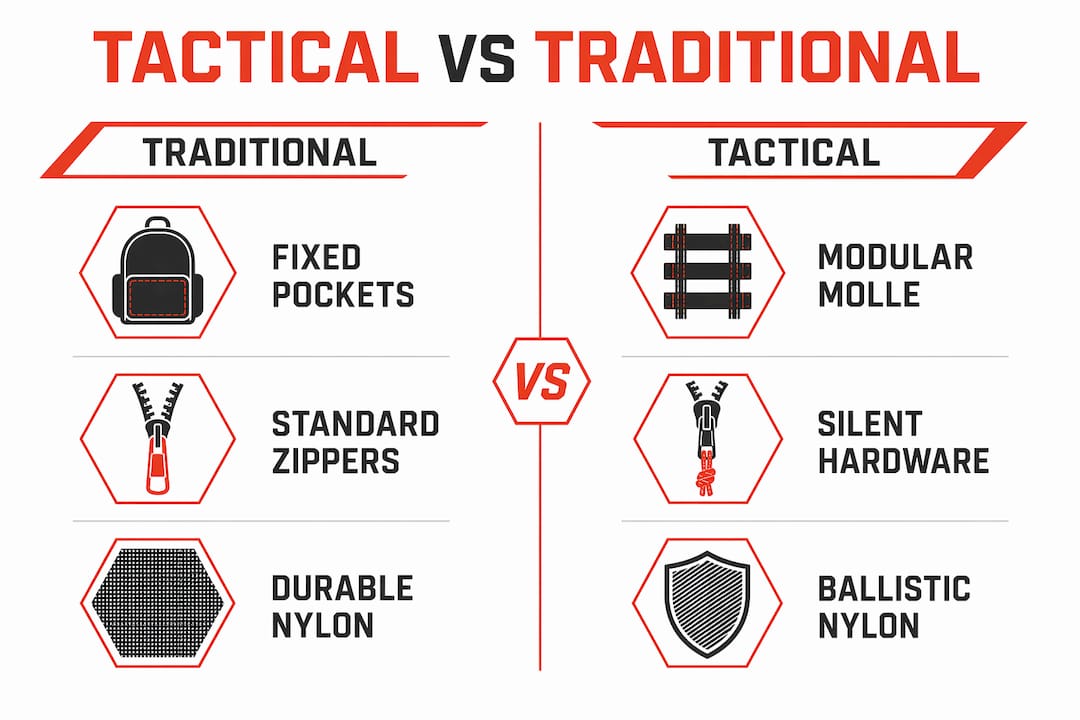
Traditional hunting gear relies on fixed pockets and standard zippers. Tactical hunting equipment uses modular attachment points that let you reconfigure your setup between a morning tree stand sit and an afternoon spot-and-stalk. The noise difference is just as stark: a standard zipper or Velcro closure can carry far enough to spook game, while silent-closing hardware eliminates that risk entirely.
| Feature | Traditional hunting gear | Tactical hunting gear |
|---|---|---|
| Material strength | Durable nylon or canvas | Ballistic and ripstop fabrics |
| Organizational system | Fixed pockets | MOLLE/PALS modular webbing |
| Noise management | Standard zippers, Velcro | Silent snaps, magnetic closures |
| Ergonomics | Basic shoulder straps | Mil-spec suspension systems |
| Terrain versatility | Environment-specific | Multi-environment adaptable |
Tactical gear also tends to travel well across environments. A pack built for a desert patrol works just as well in a snowy elk basin or a dense Southern hardwood bottom.
What features in tactical gear actually help you hunt better?
The functional gap between tactical and traditional gear shows up most clearly in a handful of specific design choices.
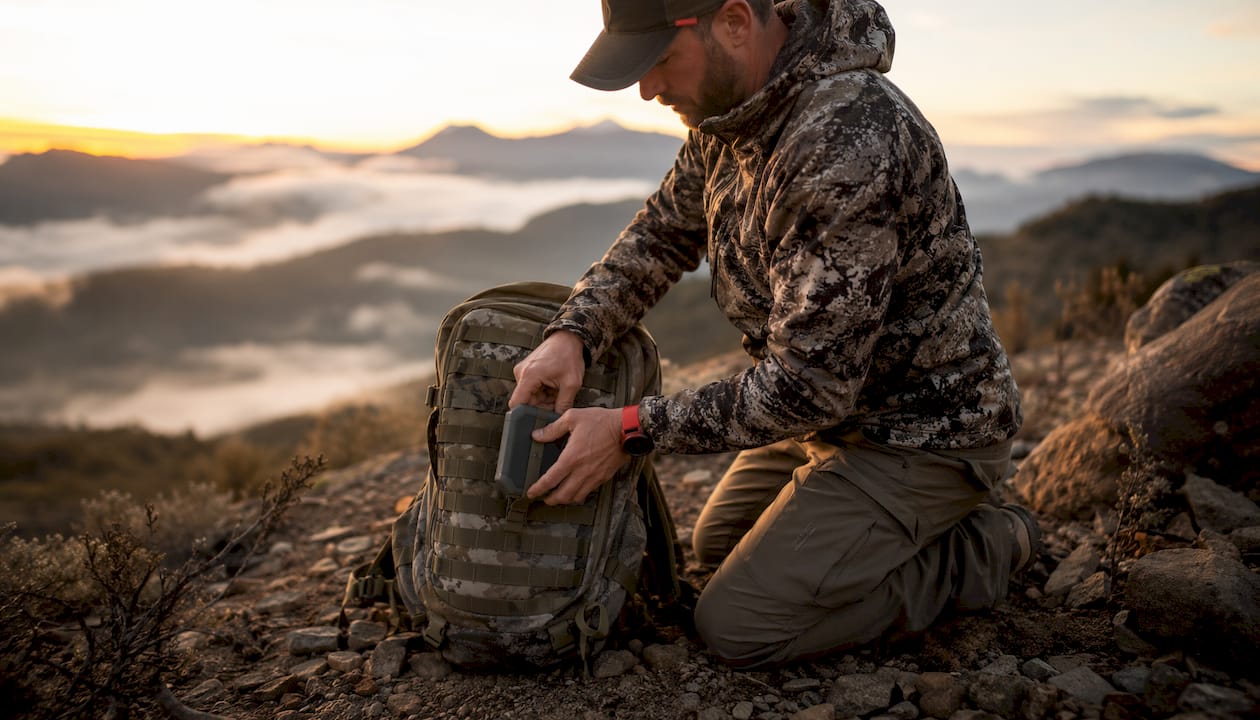
MOLLE/PALS systems let you attach rangefinder pouches, game call holders, and first-aid kits exactly where you want them, without digging through a main compartment. Ballistic and ripstop fabrics handle brush, rock, and wet conditions without wearing through. Silent hardware, specifically magnetic closures and rubberized snaps, means you can reach for a call or adjust a strap without broadcasting your position.
Ergonomic suspension matters more than most hunters realize. Mil-spec load distribution systems spread weight across the hips and shoulders rather than concentrating it on one point, which directly reduces fatigue on long days. Advanced camouflage patterns, originally developed for military use, break up the human outline across woodland, desert, and snow environments. Some high-end options incorporate infrared-defeating technology to mask body heat from thermal detection.
Where does tactical gear give you a real edge in the field?
The advantages of tactical hunting equipment show up across a wide range of scenarios, not just one specific hunt type.
- Long treks and backcountry hunts: Ergonomic packs with hip belt attachments and hydration compatibility handle miles of rough terrain
- Tree stand setups: Modular vests keep calls, rangefinders, and release aids within reach without requiring you to stand or shift weight
- Fast-paced bird hunting: Quick-release rifle carries offer a decisive speed advantage when reaction time is everything, though they require practice to prevent accidental disengagement
- Stealth situations: Sound-dampening materials and silent closures let you adjust gear without alerting nearby animals
- Precision shooting: Bipods, muzzle brakes, and enhanced optics improve stability and target identification, especially in low-light conditions
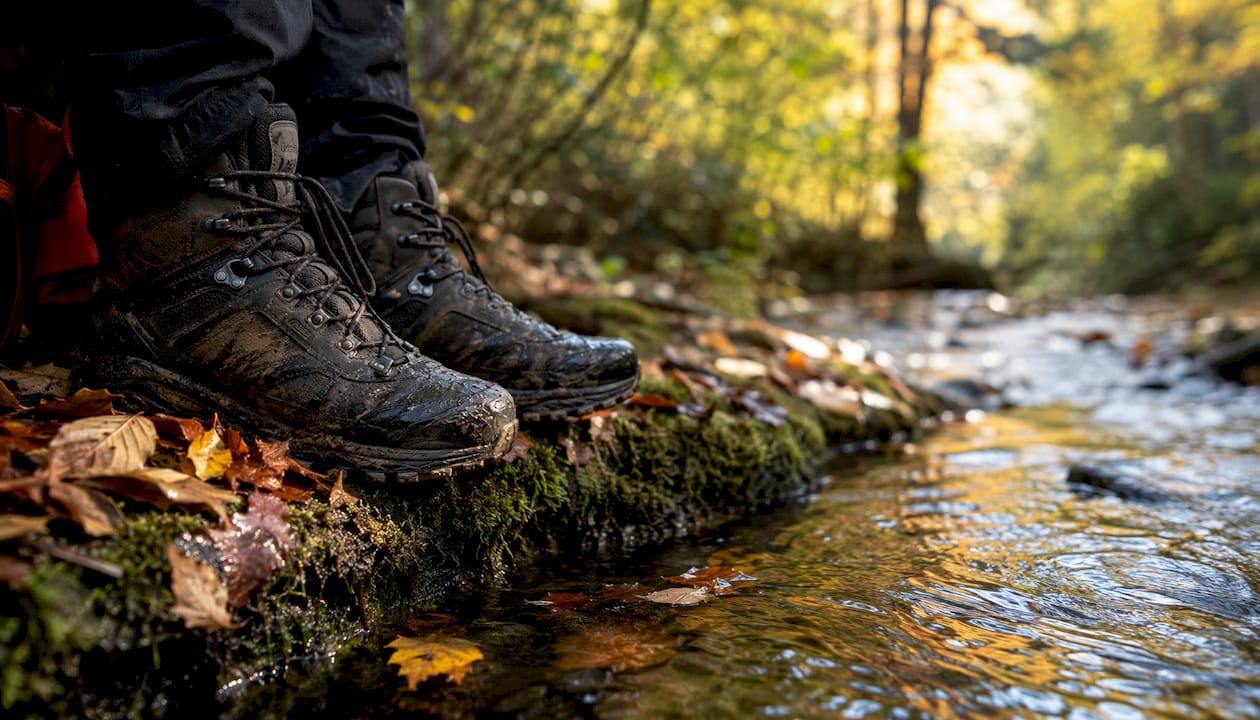
Tactical footwear crosses over just as effectively. Boots designed for all-terrain military use offer the same waterproofing, ankle support, and slip resistance that hunters need moving through muddy creek bottoms or rocky ridgelines.
What gear designers and industry experts say about tactical hunting gear
Kryptek built its entire brand around the battlefield-to-backcountry principle, taking what worked in hostile combat environments and adapting it for hunting. Their approach centers on testing gear with both military professionals and hunters before releasing it, which produces designs that hold up under real field pressure rather than just looking the part.
Muley Freak’s Game Changer R bino harness illustrates the engineering philosophy well. It uses no snaps, no Velcro, and no magnets, just a whisper-quiet closure system with true one-handed access and full optics enclosure. The whole system weighs 14 oz with the yoke. That kind of weight-to-function ratio comes directly from military gear design priorities.
Pro Tip: When evaluating any tactical hunting pack or vest, test every closure and zipper before you buy. Silent hardware that works in a store parking lot should also work with cold, gloved hands at 5 AM.
Fs9tactical reinforces this standard from the manufacturing side. Recognized as the second-largest soft rifle case manufacturer in the U.S., with a large satisfied user base and thousands of five-star reviews, Fs9tactical builds gear around ballistic fabrics and reinforced stitching specifically because field conditions punish anything less. Veterans who rely on tactical clothing for comfort and weight distribution in the field consistently point to the same features hunters need: reduced fatigue, reliable access, and materials that don’t quit.
How to care for and maintain your tactical hunting gear
Tactical gear lasts longer when you treat it right between seasons. Ballistic fabrics and ripstop nylon hold up well, but dirt, salt, and moisture work against coatings and stitching over time.
After each outing, shake out debris and wipe down hard surfaces with a damp cloth. For fabric components, hand wash or machine wash on a gentle cycle with a technical fabric cleaner, never standard detergent, which strips DWR waterproof coatings. Re-apply a DWR spray after washing to restore water repellency. Inspect MOLLE webbing, buckles, and silent-closure hardware for wear or damage before storing, since a failed buckle in the field is far worse than catching it at home.
How to choose tactical gear based on your hunting environment and species
The right tactical gear for a whitetail hunter in the Midwest looks very different from what a backcountry elk hunter in Colorado needs. Match your gear to the actual conditions you’ll face, not the most extreme scenario you can imagine.
For dense timber and close-range hunting, prioritize silent hardware and scent-control treatments over load capacity. For open-country and long-range pursuits, focus on ergonomic pack selection and optics integration. Hot-weather hunters should look for lightweight ripstop fabrics with ventilation; cold-weather hunters need layering compatibility and insulated boot options. Species matters too: fast-reaction bird hunting rewards quick-release carry systems, while slow, deliberate big game stalking calls for maximum noise suppression above all else.
Why tactical gear gives hunters a genuine advantage
The core benefits of tactical hunting equipment come down to three things: durability, speed of access, and adaptability. Gear built to military-grade construction standards simply outlasts standard hunting gear in abrasive, wet, and high-use conditions. Modular organization means you spend less time searching for tools and more time focused on the animal. And because tactical gear is designed for multiple environments, one well-chosen kit covers more hunting situations than a collection of single-purpose pieces.
Weather resistance adds another layer. Waterproof coatings, sealed seams, and wind-resistant outer shells keep hunters functional in conditions that would cut a standard outing short. That reliability compounds over a season, and over years of use.
What materials make tactical hunting gear so durable?
Ballistic nylon, originally developed for body armor applications, resists cuts, abrasion, and puncture far better than standard nylon. Ripstop fabric weaves a reinforcing grid into the base material so that small tears stop rather than spread. 500D and 1000D Cordura nylon are common benchmarks in quality tactical gear, with higher denier numbers indicating thicker, heavier-duty weaves suited for packs and cases.
Reinforced stitching at stress points, bar-tacked seams, and YKK zippers are the construction details that separate gear built to last from gear built to look good on a shelf. Weatherproof coatings like DWR treatments add water repellency without adding weight. Together, these materials produce gear that handles seasons of hard use without the failures that cost hunters opportunities in the field.
Key Takeaways
Tactical gear adapted from military standards gives hunters measurable advantages in durability, organization, and stealth across demanding field conditions.
| Point | Details |
|---|---|
| Modularity drives adaptability | MOLLE/PALS systems let you configure your loadout for any terrain or species without buying new gear. |
| Silent hardware changes the game | Magnetic closures and silent snaps replace noisy Velcro, keeping you undetected when it counts. |
| Material quality determines lifespan | Ballistic nylon and ripstop fabrics outlast standard hunting gear in abrasive, wet conditions. |
| Match gear to your specific hunt | Species, terrain, and weather should drive every gear decision, not generic “best” lists. |
| Fs9tactical sets the durability standard | As the second-largest soft rifle case manufacturer in the U.S., Fs9tactical builds to ballistic-fabric standards backed by thousands of five-star reviews and a large base of satisfied users. |
Fs9tactical builds every piece of gear for the hunter who can’t afford a failure in the field. From the 60-in-1 Lifeline Survival Kit to modular tactical bags and carry systems, every product uses ballistic fabrics and reinforced construction tested by thousands of hunters and shooters. If your current kit isn’t keeping up, it’s time to upgrade to gear that will.