

What Is Military Spec Gear Standard? A Buyer's Guide
When a product tag says “military spec” or “military grade,” it almost never means the U.S. Department of Defense tested or approved that item. For most consumer gear, those phrases are marketing shorthand, not proof of compliance with a traceable MIL-STD or MIL-SPEC document.
Before you buy, run three quick checks:
- Named standard: Does the listing cite a specific document like MIL-STD-810 or MIL-C-43455? Vague claims with no number are styling, not certification.
- Verifiable test report: Can you find the spec on ASSIST or confirm a lab tested this exact product lot?
- Field reviews: Do real users in demanding conditions back up the durability claim?
For outdoor and survival use, concrete specs — high-denier fabric, reinforced bartack stitching, documented environmental test results — tell you far more than any “mil-spec” badge.
Table of Contents
- What does “military spec” actually mean according to the DoD?
- Why “military grade” on a retail tag is not DoD certification
- Common military standards you’ll see on gear tags
- How to evaluate a “mil-spec” claim before you buy
- When does genuine MIL-SPEC actually matter for civilians?
- How to verify a mil-spec claim and find official documents
- Key Takeaways
- The gap between the label and what actually holds up
- Fs9tactical builds gear you can actually verify
- Authoritative sources for military specifications
What does “military spec” actually mean according to the DoD?
The U.S. Department of Defense draws a clear line between two document types, and the Government Accountability Office puts it plainly: military specifications “describe the physical and/or operational characteristics of a product,” while military standards “detail the processes and materials to be used to make the product.”
In practice:
- MIL-SPEC (Defense Specification): Describes essential technical requirements for military-unique items or substantially modified commercial products. Think dimensions, materials, performance thresholds.
- MIL-STD (Defense Standard): Establishes uniform engineering and process requirements. There are five subtypes: interface standards, design criteria standards, manufacturing process standards, standard practices, and test method standards.
The Defense Standardization Program (DSP) administers both, and the Defense Logistics Agency (DLA) manages the documents operationally. The DLA currently manages roughly 12,500 of more than 27,000 active departmentwide standardization documents, covering everything from parachute cord to aircraft electrical load analysis.
“Military specifications describe the physical and/or operational characteristics of a product, while military standards detail the processes and materials to be used to make the product.” — Government Accountability Office
The key takeaway: a MIL-SPEC is a product requirement document; a MIL-STD is a process or method document. Neither is a consumer quality seal.
Why “military grade” on a retail tag is not DoD certification
The phrase “military grade” has no official definition in procurement law. Any manufacturer can print it on packaging without meeting a single government requirement. That gap between the label and the reality is where most consumer confusion lives.
A few specific misconceptions worth clearing up:
- “Mil-spec means indestructible.” It means the item met a narrow benchmark for a specific military mission. A spec written for desert vehicle components may say nothing useful about a hiking pack’s rain resistance.
- “Mil-spec is always better for civilians.” Specifications are tailored to military mission needs and sometimes mandate features that add weight or cost with zero benefit to a hunter or survivalist. Aerospace fuel resistance on a rifle sling, for example, is irrelevant on a deer stand.
- “Any product using MOLLE webbing is mil-spec.” Consumer products frequently copy modular features like MOLLE without inheriting the verification or lifecycle testing a true military supplier applies.
Marketers typically use the term in one of three ways: referencing a real standard selectively (citing MIL-STD-810 for one drop test while ignoring 28 other test methods in the same document), applying military aesthetics without any testing, or using it as a cost justification for premium pricing. None of those uses constitute DoD-level third-party verification.
Common military standards you’ll see on gear tags
| Standard | What It Covers | Civilian Relevance |
|---|---|---|
| MIL-STD-810 | Environmental engineering: temperature, humidity, shock, vibration, salt fog, altitude | High — tests map directly to outdoor durability |
| — | Picatinny rail interface tolerances for weapon accessories | High for shooters; irrelevant otherwise |
| — | Parachute cord tensile and construction requirements | Moderate — useful survival cordage benchmark |
| — | Anodizing processes for aluminum components | Moderate — relevant for hardware corrosion resistance |
| MIL-C-43455 | Field jacket (now inactivated) | Low — historical reference only |
MIL-STD-810 is the one you’ll see most often on consumer gear. The full standard runs through more than two dozen individual test methods. A product that “passed MIL-STD-810” may have been tested against only one or two of those methods. Always ask which specific test procedures were run and at what severity level.
How to evaluate a “mil-spec” claim before you buy
- Find the specific standard number. “Military grade” with no document number is unverifiable. A real claim names the spec: “MIL-STD-810H, Method 516.8, Shock.”
- Search ASSIST. Go to ASSIST and enter the document number. If the spec exists and is active, you can download it and confirm what it actually requires. If the vendor’s claimed spec isn’t indexed there, treat the claim as styling.
- Request a test report or lot certification. Legitimate MIL-SPEC compliance involves lot testing and formal acceptance processes. Ask the seller for a lab report or certificate of conformance. A reputable manufacturer will have one.
- Evaluate materials directly. Check fabric denier, stitching type, and hardware tensile ratings rather than relying on the label. For bags and cases: 500D–1000D Cordura or ballistic nylon, bartack stitching at stress points, and YKK or equivalent hardware are measurable indicators.
- Read field reviews, not product descriptions. Look for reviews from hunters, military veterans, or survivalists who describe real-use failures or durability over time. A product with 2,000 reviews from verified buyers in demanding conditions tells you more than any certification claim.
- Check warranty and repairability. A brand confident in its construction backs it with a real warranty and offers spare parts or repair service. That’s a stronger signal than a marketing badge.
Pro Tip: When comparing two products that both claim MIL-STD-810 compliance, ask each seller which specific test methods were run. The answer — or the silence — tells you everything.
| Evaluation Factor | Strong Signal | Weak Signal |
|---|---|---|
| Standard reference | Named document + test method number | “Military grade” with no document |
| Test evidence | Lab report or certificate of conformance | Marketing copy only |
| Materials | Denier rating, hardware tensile spec listed | “Heavy-duty” with no measurement |
| Reviews | Field use by hunters/veterans, failure reports noted | Generic 5-star reviews, no specifics |
| Warranty | Repair or replacement policy stated | “Satisfaction guaranteed” only |
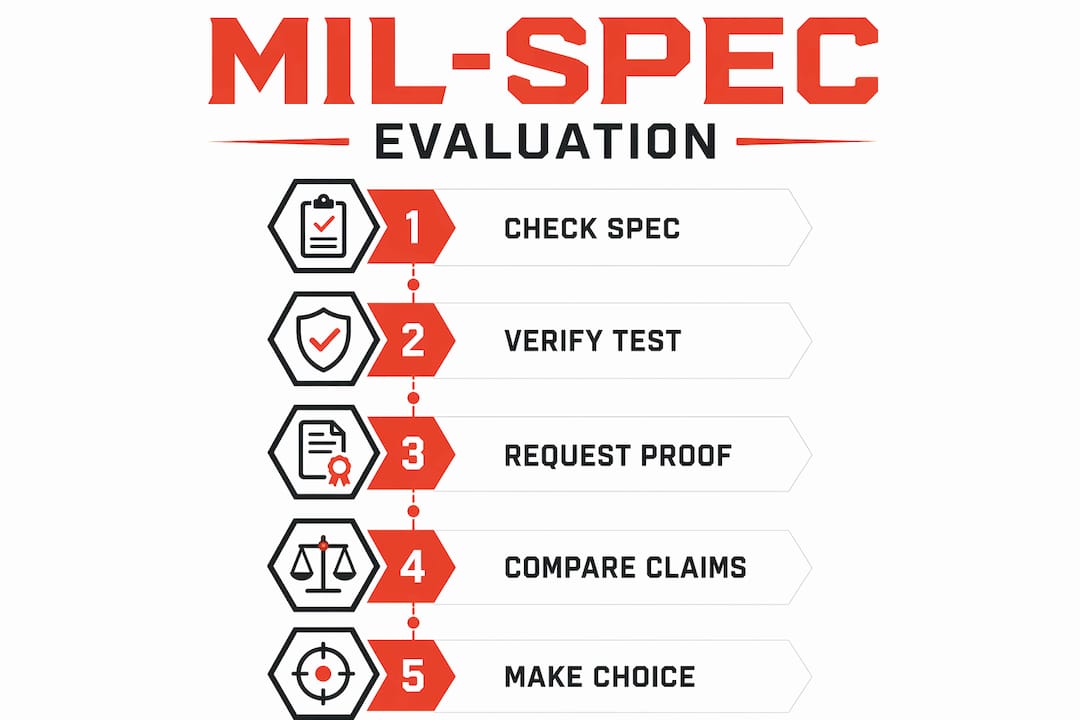
For choosing tactical gear that holds up in the field, this checklist cuts through the noise faster than any label.
When does genuine MIL-SPEC actually matter for civilians?
For most outdoor use, it doesn’t — and that’s not a knock on quality. It’s a recognition that military specifications solve military procurement problems.
Scenarios where MIL-SPEC traceability genuinely adds value for civilians include defense contractors who must deliver items under a government contract, aviation support technicians working with MIL-SPEC hardware interfaces, and anyone mounting ballistic plates or hard-mount equipment to a vehicle where interface tolerances matter.
For the majority of hunters, hikers, and survivalists, consumer-grade ruggedness from a reputable manufacturer is sufficient. A well-designed hunting kit built with high-denier fabrics, reinforced stitching, and quality hardware will outlast most field scenarios without needing a government contract behind it. The tradeoffs of true MIL-SPEC items — added weight from over-engineered components, higher cost from lot testing and formal acceptance processes, and features designed for military logistics rather than civilian carry — often work against the outdoor user.
The honest frame: MIL-SPEC is a procurement tool. High-quality construction with documented materials is a durability tool. For most survivalists and hunters, the second one is what you actually need.
How to verify a mil-spec claim and find official documents
The U.S. government makes this straightforward if you know where to look:
- ASSIST: The Acquisition Streamlining and Standardization Information System is the primary database for all active and inactive DoD specifications and standards. Search by document number or keyword. Free to use.
- DLA (Defense Logistics Agency): Manages thousands of active standardization documents and provides procurement context for how specs are applied.
- DSP (Defense Standardization Program): Explains the types of documents, their purpose, and how they’re maintained. Good starting point for understanding the system.
When a vendor cites a spec, copy the document number exactly and paste it into ASSIST. Download the document and check the scope section — it tells you precisely what the spec covers and what it doesn’t. If a vendor’s claimed spec isn’t in ASSIST, the claim is essentially unverifiable and should be treated as a marketing choice, not a compliance statement.
For tactical accessories specifically, asking for a certificate of conformance or a third-party lab report is reasonable and any serious manufacturer will provide one without hesitation.
Key Takeaways
Most consumer “military spec” claims are marketing language, not traceable DoD compliance — verify by searching ASSIST for the named standard and checking for a real test report before you buy.
| Point | Details |
|---|---|
| MIL-SPEC vs. MIL-STD | MIL-SPEC covers product characteristics; MIL-STD covers processes and methods. Neither is a consumer quality seal. |
| “Military grade” has no legal definition | Any manufacturer can use the phrase; always demand a named document number and test report. |
| Verify via ASSIST | Search the exact spec number at ASSIST (assist.dla.mil) — if it’s not indexed there, the claim is unverifiable. |
| Materials beat labels | Denier rating, bartack stitching, and hardware tensile specs are measurable; “military grade” is not. |
| Fs9tactical approach | Fs9tactical builds with ballistic fabrics and reinforced stitching — construction choices you can verify against the checklist above. |
The gap between the label and what actually holds up
There’s a version of this conversation that goes: “Just buy mil-spec and you’re covered.” After looking at how these documents actually work, that framing misses the point almost entirely.
A MIL-SPEC is a procurement document. It exists so that a contracting officer in one state can order the same item from a manufacturer in another state and get something predictable. That’s genuinely useful for government logistics. For a hunter packing out an elk in the backcountry, it’s mostly irrelevant — what matters is whether the stitching holds under load, whether the zipper survives cold and grit, and whether the fabric resists abrasion against brush and rock.
The brands that get this right aren’t necessarily the ones with the most military-sounding marketing, as explained by HTK Training | Hard to Kill Training. They’re the ones that list their materials, stand behind their construction, and have a few thousand field users willing to say so publicly. That’s a harder standard to fake than a document number on a hang tag.
Fs9tactical builds gear you can actually verify
Fs9tactical is the second-largest soft rifle case manufacturer in the U.S., with over 20,000 satisfied users and thousands of five-star reviews from hunters, shooters, and survivalists who use this gear in real conditions. The construction choices — ballistic fabrics, reinforced stitching at every stress point, quality hardware — are the same measurable indicators the checklist above asks you to look for.
The 60-in-1 Lifeline Emergency Survival Kit is built for the kind of durability that actually matters in the field: packaged for a 72-hour bug-out, designed for repairability, and backed by the same construction standards Fs9tactical applies across its full product line. Check the product page for full materials specs and current availability.
Authoritative sources for military specifications
| Source | What It Indexes | How to Use It |
|---|---|---|
| ASSIST (assist.dla.mil) | All active and inactive DoD specs and standards | Search by document number; download full spec text |
| DLA (dla.mil) | Procurement and logistics context for standardization documents | Confirms document ownership and active status |
| DSP (dsp.dla.mil) | Document types, definitions, and program overview | Start here to understand the system before searching |
| Wikipedia: U.S. Military Standard | Plain-language overview of MIL-SPEC/MIL-STD history and types | Useful orientation before reading primary sources |
When a vendor cites a specific standard, copy the exact document number and search ASSIST first. If the document is active, download the scope section to confirm what the spec actually covers. If the vendor can’t provide a document number, ask for a third-party lab report. No documentation means the “mil-spec” claim is a styling choice, not a compliance statement.
This article provides general information about military specification standards and is not a substitute for professional procurement or legal advice. Always verify current document status directly with ASSIST or DLA for your specific application.
