

Why Hunters Need Modular Gear to Move Fast and Stay Organized
Hunters need modular gear because it turns a fixed, one-size-fits-all pack into a system you rebuild for the mission in front of you, cutting search time, spreading weight where your body handles it best, and letting you swap components without repacking from scratch.
That single shift, from static compartments to interchangeable modules, changes how fast you find your kill kit in fading light, how quiet you move through timber, and how far you can carry a load before your shoulders give out.
- MOLLE and PALS webbing let you attach, detach, and reposition pouches in seconds instead of digging through one main compartment.
- Ergonomic packing guidance recommends keeping 60% to 70% of your pack’s weight in the upper-middle zone between your shoulder blades, which modular compression straps and zone pouches make achieving this distribution far easier than with a single stuffed bag.
- Companies like Fs9tactical build modular-compatible rifle cases, chest rigs, and range bags specifically so hunters can mix components without buying a whole new setup for every trip.
Key Takeaways
Modular gear works because it lets hunters rebuild their loadout for the specific mission, cutting retrieval time, reducing noise, and improving load balance compared to fixed-compartment packs.
| Point | Details |
|---|---|
| Modularity beats fixed packs | Interchangeable modules cut search time and let you rebuild a loadout for each specific hunt type. |
| Weight placement reduces fatigue | Keep 60% to 70% of pack weight in the upper-middle zone, close to your spine, on long carries. |
| Run the touch test every trip | A five-minute check for rattles, loose straps, and snags catches failures before they cost you a shot. |
| Match modules to the hunt | Treestand, spot-and-stalk, and meat-haul missions each need a different module stack, not one universal rig. |
| Fs9tactical offers ready-built modules | Their rifle cases, chest rigs, and range bags use MOLLE attachments and reinforced stitching built for repeat field use. |
Table of Contents
- Why Hunters Need Modular Gear for Faster, Cleaner Fieldwork
- What Are the Core Modules Every Hunter Should Own?
- How Do MOLLE and Quick-Attach Systems Actually Work?
- How Should You Configure Modular Gear for Different Hunts?
- Building the 5-Minute Touch Test and the 10-Minute Reset
- What Goes in Each Module? A Field-Ready Packing List
- Why Field Experts Trust Modular Systems Over Fixed Packs
- How to Choose Modular Gear That Actually Holds Up
- Modular Gear Is a System, Not a Style Statement
- Ready-Made Modular Gear Built for the Field
- Sources
Why Hunters Need Modular Gear for Faster, Cleaner Fieldwork
The core benefit is time. When your kill kit lives in the same labeled pouch every single hunt, you’re not pawing through a jumbled main compartment while a downed animal cools and daylight burns. Modular systems shorten that retrieval window because every item has one home, and that home doesn’t move.
Consider three scenarios. On a spot-and-stalk hunt, you need your rangefinder and bino harness instantly accessible without unclipping a pack. On a treestand sit, you need silence, which means no loose carabiners or Velcro pouches that rasp against bark. On a meat haul, you need to strip your day pack down to a frame and haul bag in minutes, not rebuild your whole kit at the truck. A modular hunting backpack handles all three because you’re reconfiguring, not repacking.
Modularity also solves a problem most hunters don’t name directly: cognitive load. When gear has a fixed place, you stop thinking about where things are and start thinking about the animal, the wind, and the shot. That mental bandwidth matters more than most gear reviews admit. A cluttered pack doesn’t just slow your hands. It slows your head.
Noise control is the other underrated win. Fixed-compartment packs force compromises: you either overstuff one pouch until it rattles or leave gear loose where it clanks against your rifle sling. Separate modules, cinched individually, mean your rangefinder pouch doesn’t broadcast your position to a bedded buck at 40 yards.
What Are the Core Modules Every Hunter Should Own?
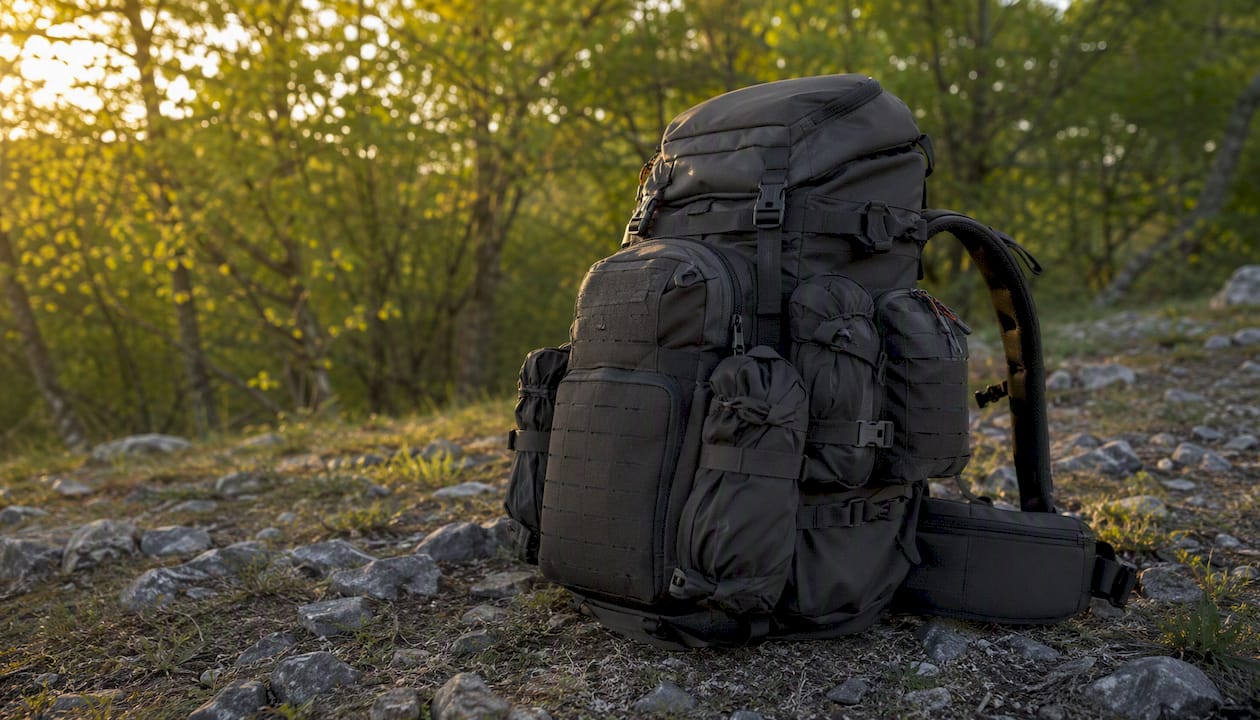
Most modular systems break down into a handful of repeatable components. You don’t need every module for every hunt, but knowing what each one does lets you build the right stack fast.
- Bino harness: chest-mounted, keeps optics glass-up and ready without fumbling a pack strap.
- Utility pouch or box: holds calls, rangefinder batteries, multi-tool, and other small items you reach for constantly.
- Rangefinder case: dedicated, padded, usually magnetic or MOLLE-mounted for one-hand access.
- Kill kit: knives, gloves, game bags, and a sharpening tool bundled in one grab-and-go pouch.
- Meat bag or haul module: quick-detach, often with drainage, designed to bolt onto a frame pack only when you need it.
- Frame conversions: let one pack body swap between a day-hunt configuration and a backcountry hauling rig.
- Hip pouches: fast-access snacks, tags, or a compact first aid kit without opening the main pack.
Attachment hardware varies. MOLLE webbing is the most common and the most durable under heavy loads. Quick-release buckles trade a little strength for speed. Magnetic docks show up on rangefinder and phone pouches where you need one-hand deployment. Buyers increasingly expect interchangeable frames, quick-detach meat bags with drainage, and heavy-rated MOLLE as baseline features, not upgrades.
Pro Tip: Color-code or label your modules with a permanent marker or colored zip ties. In low light, you’re identifying pouches by shape and feel, and a distinct color or texture cuts your search time nearly to zero.
How Do MOLLE and Quick-Attach Systems Actually Work?
MOLLE, short for Modular Lightweight Load-carrying Equipment, uses rows of horizontal webbing sewn onto a pack or vest. PALS, the weave pattern underneath it, is what lets a pouch’s straps thread through and lock in place. Once you understand that PALS rows are the grid and MOLLE straps are the attachment method, buying compatible gear gets a lot simpler.
Two attachment philosophies exist, and mixing them without thinking causes problems. Quick-release clips, like those on a bino harness or a rangefinder pouch, are built for speed. You want them where you access gear dozens of times a day. Permanent MOLLE-threaded attachment is built for security. You want it on anything carrying weight you can’t afford to lose, like a kill kit or a meat haul frame.
Interchangeable frames are where modularity really pays off. A single frame can carry a light day pack for a morning glassing session, then accept a haul bag body for the pack-out, without you owning two separate packs. That’s the same logic behind MOLLE-compatible modular systems that hunters cite as their top reason for switching away from fixed packs. Interoperability extends further, too: a modular chest rig should accept the same rangefinder pouch as your backpack’s shoulder strap, and your rifle case should clip into a truck-mounted holder or a pack frame without a dedicated adapter.
Pro Tip: Before a hunt, load every module, walk a hundred yards, and jog a short stretch. Any rattle, slip, or loose strap you hear at home will announce your presence in the woods. Fix it before the season, not during a stalk.
How Should You Configure Modular Gear for Different Hunts?
Terrain, weather, and species all change what modules earn a spot on your rig. A single universal setup rarely survives contact with real hunting conditions, because a rig built for glassing open country fails on a tight treestand sit, and vice versa.
- Deer, treestand hunting: Attach a hip pouch for calls and a rattling bag, a bino harness, and a compact kill kit. Skip bulky haul frames. Weight goes low and tight to the body since you’re stationary, not carrying.
- Elk, spot-and-stalk backcountry: Full frame pack with a detachable meat haul module, rangefinder case on the chest strap, and a separate optics module for a spotting scope. Heaviest items (water, meat bag frame) sit in the upper-middle zone, close to your spine, per standard ergonomic pack loading guidance.
- Waterfowl: Utility pouch for calls and decoy anchors, weatherproof clothing module, and minimal optics since shots are close. Concealment and quick reload access matter more than haul capacity here.
- Glassing-heavy hunts (mule deer, pronghorn): Prioritize the optics module and rangefinder case, add a lightweight tripod attachment, and leave the meat haul frame at the truck until you’ve made a decision on the animal.
- Predator hunting (coyote, fox): Setup differs sharply from big game. You need species-specific module placement built around calls, a compact blind bag, and fast movement between stands rather than a haul-focused rig.
The recurring tradeoff is timing. Add your meat-haul components after you’ve committed to a shot, not before, since carrying an empty haul frame all day adds fatigue for no reason. On the flip side, cutting optics modules to save weight only works if visibility and range don’t matter for the terrain you’re hunting.
Building the 5-Minute Touch Test and the 10-Minute Reset
Two short routines separate hunters who trust their gear from hunters who find out something’s broken mid-stalk. Neither takes long, and both should happen before you consider skipping them because you’re “already checked.”
The touch test runs about five minutes at the truck or trailhead. Grip every module attachment point and tug it. Zip and unzip every pouch once to confirm nothing snags. Do a slow walk and listen for rattle, slap, or Velcro noise. Check sight lines: make sure your bino harness or rangefinder case doesn’t block your rifle sling or bow arm.
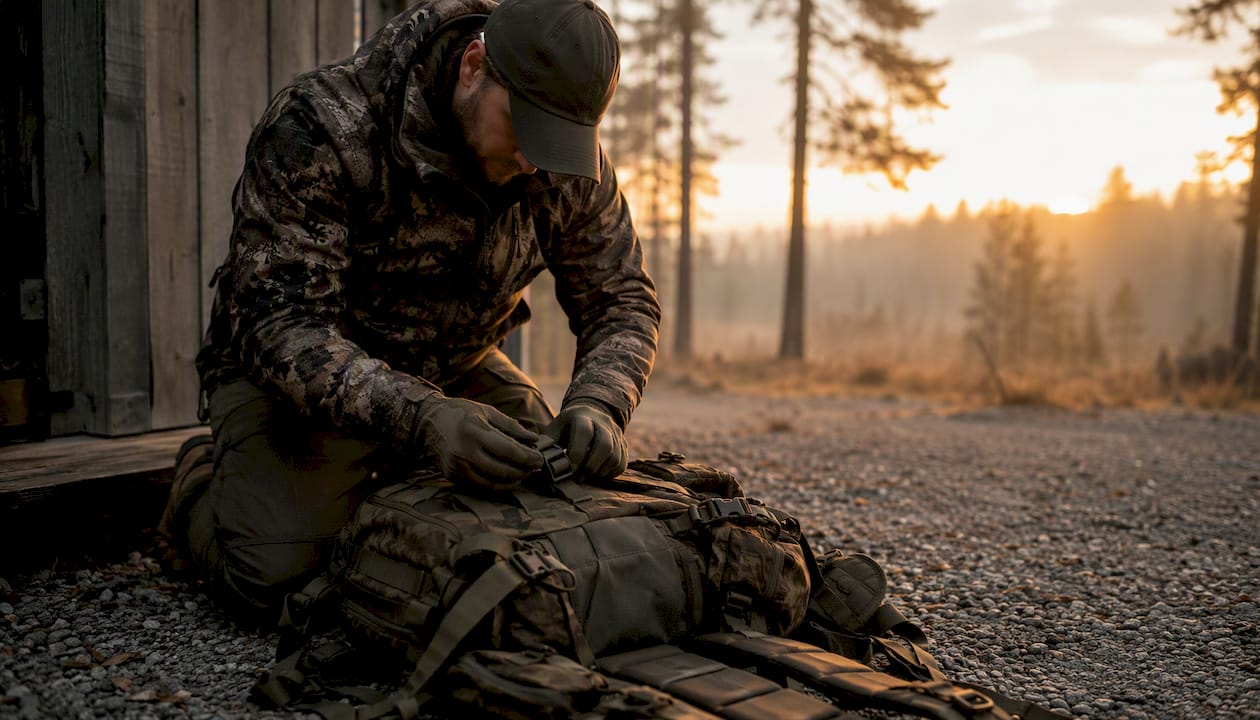
The reset SOP happens back at camp or the truck, and it takes closer to ten minutes. Inventory every module so you know instantly what’s missing before the next outing. Wipe down and dry anything wet, especially meat haul bags, before restowing them. Re-stage your kill kit so blades are clean and game bags are refolded, ready to grab without thought next time.
These routines matter because they catch problems when the stakes are low instead of when they’re high. A loose MOLLE strap found at the truck is an inconvenience. The same strap failing mid-pack-out with 60 pounds of elk quarter on your back is a real problem.
Pro Tip: Run your touch test with your eyes closed for the pouches you’ll need in low light, like your kill kit or headlamp module. If you can’t identify it by feel alone, re-label it before opening day.
What Goes in Each Module? A Field-Ready Packing List
Once your modules are chosen, filling them correctly is what makes the system work. Here’s what belongs in the most common ones, based on what actually gets used in the field rather than what looks good on a gear list.
- Kill kit: fixed-blade knife, replaceable-blade knife with spare blades, nitrile gloves, game bags, small sharpening stone, zip ties for tagging.
- Optics module: binoculars, rangefinder, spare lens cloth, small tripod adapter if glassing long distances.
- Electronics module: headlamp with spare batteries, GPS unit or backup battery pack, two-way radio if hunting with a partner.
- Clothing module: rain shell, insulating layer, spare socks, buff or neck gaiter, all compressed to save space.
- Meat-haul module: game bags (extra pair beyond the kill kit’s), rope or cordage, drainage-capable haul bag, gloves dedicated to meat handling.
Small items get forgotten more than big ones. Spare lens cloths, zip ties, and a backup headlamp battery weigh almost nothing but ruin a hunt when missing. Weight and volume priorities flip depending on hunt length: a day hunt favors leaving the meat-haul module at the truck until needed, while a multi-day backcountry trip means every module travels with you from the start. If you’re hunting in tick-heavy or humid terrain, a chemical-free protective layer pairs naturally with your clothing module without adding bulk to your main pack.
Why Field Experts Trust Modular Systems Over Fixed Packs
Modularity isn’t a trend gear companies invented to sell more pouches. It solves a real, repeatable problem: hunters who rely on one fixed setup for every trip run into failures when conditions shift, whether that’s weather, terrain, or animal behavior. Modular packing reduces what’s sometimes called operational latency, the delay between deciding you need something and having it in your hand, and dedicated modules like a kill kit or clothing bag act as protective barriers for sensitive gear.
Fs9tactical built its product line around that same principle. The brand manufactures rifle cases, chest rigs, range bags, and survival kits with ballistic fabrics, reinforced stitching, and MOLLE attachments designed to survive repeated field use, not just look rugged on a shelf. As one of the larger soft rifle case manufacturers in the U.S., with tens of thousands of customers and a strong base of five-star reviews, the brand’s track record reflects sustained use across hunting seasons rather than a single product cycle.
Hunters who’ve switched to modular setups consistently describe the same shift: less time digging through a pack, fewer forgotten items, and a rig that adapts to the hunt instead of forcing the hunt to fit the rig.
You can see this approach directly in products like Fs9tactical’s weather-resistant soft rifle cases, which integrate with pack systems rather than functioning as standalone dead weight.
How to Choose Modular Gear That Actually Holds Up
Not every product labeled “modular” earns the name. A few checks separate gear that survives a season from gear that fails at the worst moment.
Run through this before buying:
- Check attachment robustness: tug on webbing and stitching, not just the fabric.
- Confirm modular compatibility across your existing gear, not just within one brand’s ecosystem.
- Weigh the module empty and loaded; heavier isn’t always more durable.
- Ask about repairability. Can a strap or buckle be replaced, or does the whole module get thrown out?
- Look for a warranty that reflects the manufacturer’s confidence in their own stitching and fabric.
Material choice drives most durability differences. Ballistic nylon resists abrasion and punctures far better than lightweight ripstop, though it adds weight, a real tradeoff on long backcountry carries. Reinforced stitching at stress points, particularly where straps meet the pack body, is the single biggest predictor of whether a module survives repeated MOLLE attachment and removal. Water resistance matters most on meat haul bags and electronics modules, where drainage and sealed seams prevent both spoilage and gear damage. Fs9tactical’s approach to what makes hunting gear rugged covers these stress points in more depth.
| Feature Category | What to Look For | Red Flag |
|---|---|---|
| Durability | Ballistic nylon, reinforced stitching at stress points | Thin webbing, fraying at seams |
| Noise | Bonded zippers, cinch straps instead of loose buckles | Rattling hardware, Velcro on exposed pouches |
| Weight | Balanced empty weight relative to capacity | Overbuilt frames that add bulk without payoff |
| Modularity | Universal MOLLE spacing, compatible clip sizes | Proprietary attachment only that brand’s products fit |
Modular Gear Is a System, Not a Style Statement
Too many hunters treat modular gear like an aesthetic choice, tactical-looking pouches bolted onto a pack because they look serious. That misses the point entirely. The value isn’t in how the rig looks at the trailhead. It’s in whether you can find your kill kit at last light without turning your headlamp into a strobe for every animal within 200 yards.
I’d argue the biggest misconception about modular systems is that they’re for backcountry specialists chasing elk through wilderness units. In practice, a treestand whitetail hunter benefits just as much, maybe more, because a quiet, predictable, low-fumble setup matters most when you’re sitting still and a deer is already close. The gear doesn’t need to be exotic. It needs to be repeatable.
What separates hunters who trust their gear from hunters who get burned by it usually comes down to routine, not equipment budget. The touch test and reset SOP cost nothing and take fifteen minutes combined, yet they catch the failures that expensive gear alone won’t prevent. Modular systems make those routines fast enough to actually stick with, season after season. That consistency, not any single pouch or attachment point, is what saves a hunt.
Ready-Made Modular Gear Built for the Field
If you’re piecing together a modular setup from scratch, Fs9tactical already builds the components most hunters end up needing anyway: rugged range bags that double as day-hunt frames, chest rigs sized for optics and rangefinder pouches, and rifle cases engineered to clip into truck-mounted holders without an aftermarket adapter.
Before you buy anything, check compatibility against what you already carry. A chest rig with standard MOLLE spacing will accept most rangefinder and utility pouches on the market, which is exactly the interoperability this guide has walked through. For hunters who want a compact safety module to slot into an existing pack, the FS9 60-in-1 emergency survival kit fits that role directly, built with the same reinforced stitching and MOLLE compatibility as the rest of the lineup. Add it to your kit, run the touch test once at home, and you’re set for opening day.
Sources
- Hunting Backpack Organization: Zone, Modular, Compression - Dealibrium
- Modular Hunting Backpacks: Benefits & Uses | Pros & Cons
- Why One Setup Rarely Works for Every Hunt | GunWraps
