

The Role of D-Ring Tactical Accessories in Gear Setup
D-ring tactical accessories are defined as load-bearing hardware components that serve as modular attachment and pivot points across tactical and outdoor gear systems. The role of d-ring tactical accessories goes far beyond simple clip-on convenience. These small pieces of hardware directly affect how weight distributes across your body, how fast you can reconfigure your loadout, and whether your gear holds up when conditions turn brutal. Understanding their materials, placement, and structural requirements gives you a real advantage when building or upgrading any tactical setup.
What materials are used for D-ring tactical accessories?
Material choice is the single biggest factor in how a D-ring performs under load. The three main categories are nylon-based plastics, molded polymers, and metal alloys including steel and aluminum. Each material trades off weight, strength, noise, and weather resistance differently.
Nylon plastics work well for low-load applications like lace guides on boots or light pouch attachments. They are light, quiet, and resist moisture. Molded polymer D-rings step up the performance. Consumer-grade polymer D-rings carry a tensile load of approximately 300 lbs, which covers the vast majority of tactical accessory uses without adding the weight of metal. That 300 lb rating matters because it tells you the hardware can handle a fully loaded pouch, a hydration bladder, or a trauma kit without deforming.
Metal alloys, particularly steel and aluminum, deliver the highest tensile strength. Material choice directly affects load strength, rust resistance, and impact strength. Steel resists deformation under extreme loads but adds weight and can corrode in wet environments without a protective coating. Aluminum splits the difference: lighter than steel, still strong, and naturally resistant to rust.
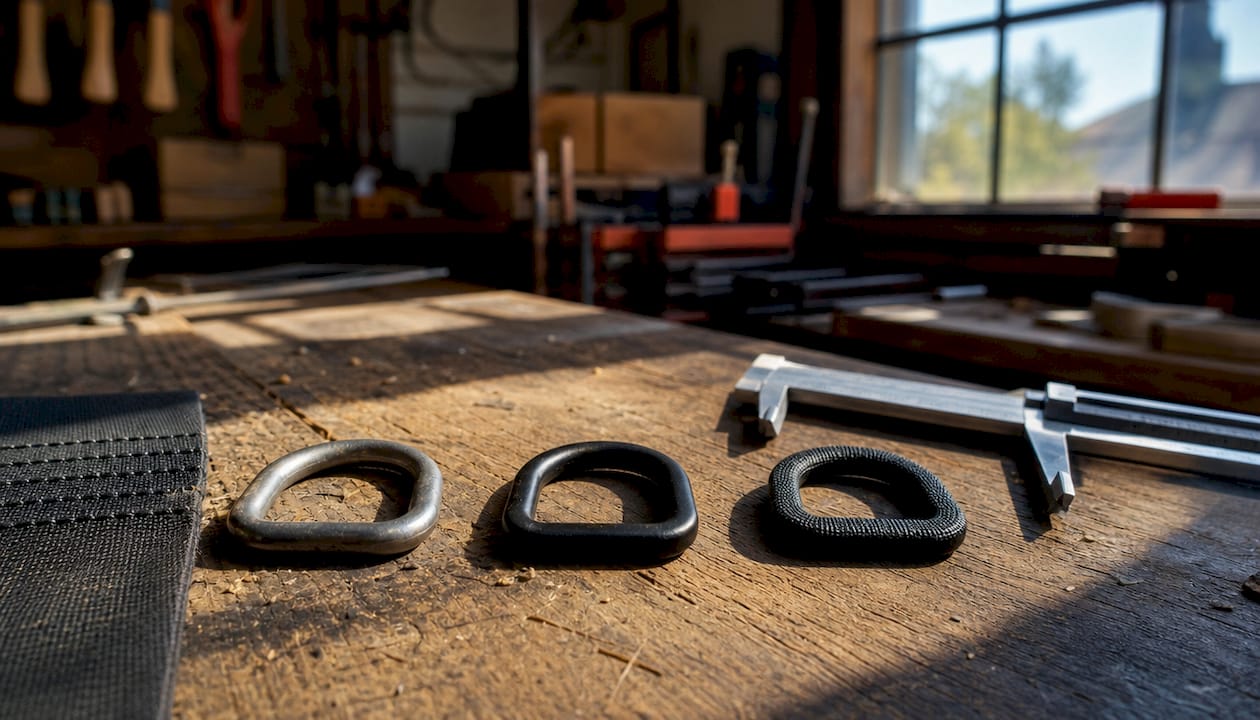
Pro Tip: Choose molded polymer D-rings for any mission profile where noise discipline matters. Metal D-rings clink against each other and against other hardware, and that sound carries farther than most people expect in quiet terrain.
The right material depends entirely on your environment and load. A hunter moving through wet brush needs rust resistance and silence. A shooter running a plate carrier needs maximum tensile strength at key attachment points. Match the material to the mission, not to what looks toughest on the shelf.
How do D-rings enhance modularity and load management?
D-rings are the backbone of modular gear systems. They function as pivot points and quick-attachment interfaces that let you add, remove, or reposition gear without tools and without replacing the base platform. MOLLE systems combined with D-ring hardware enable rapid repositioning of pouches and tools, supporting mission adaptability without replacing gear entirely. That speed of reconfiguration is what separates a functional tactical setup from one that slows you down.
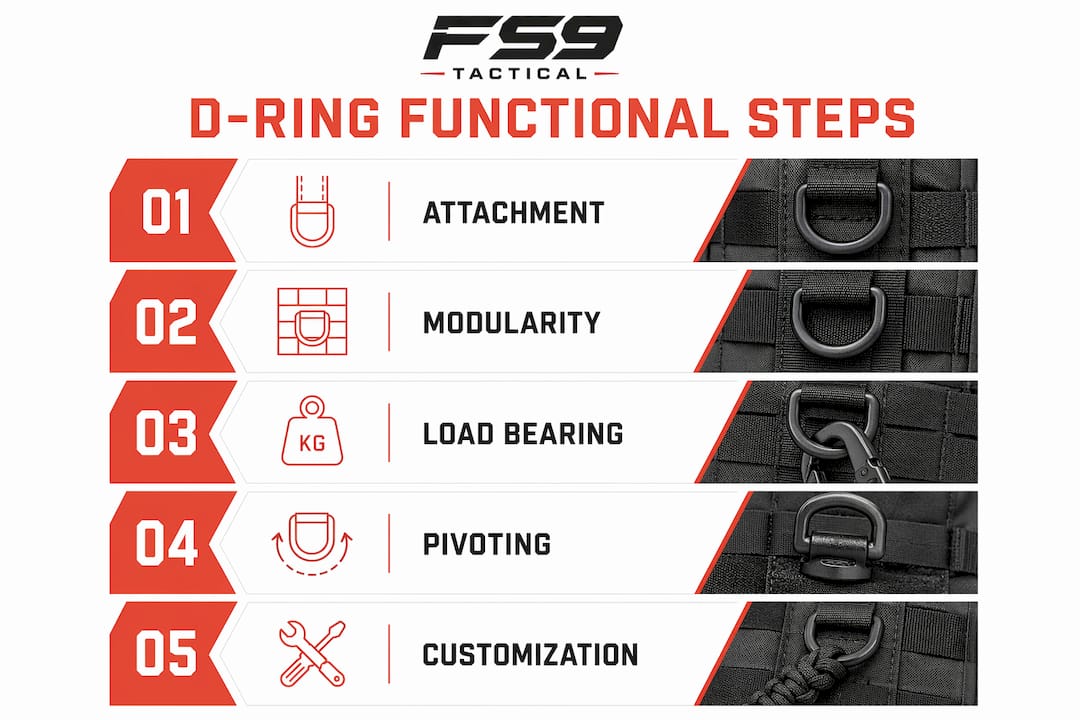
Placement of D-rings on your gear determines how load distributes across your body. Proper D-ring placement in MOLLE and load-bearing equipment optimizes both performance and user comfort. A D-ring positioned too high on a shoulder strap creates a pressure point. One placed too far to the side on a belt shifts weight off-center and causes fatigue over long carries.
The key benefits of D-ring functions in modular systems include:
- Rapid reconfiguration. You can swap a dump pouch from your belt to your pack in seconds without unthreading webbing.
- Load distribution. Multiple D-ring attachment points spread weight across a wider surface area, reducing hot spots.
- Compatibility across platforms. A single pouch with D-ring attachment works on a belt, a vest, a backpack, or a thigh rig.
- Pivot flexibility. D-rings rotate with your movement, so attached gear does not torque against the base platform during physical activity.
- Scalability. You can start with a minimal setup and add gear incrementally as mission needs grow.
The attachment points in tactical packs determine how much customization you can realistically achieve. Gear with more D-ring points gives you more options without requiring you to buy a new platform every time your needs change.
What are the common applications of D-ring accessories?
D-rings serve a wider range of functions than most outdoor enthusiasts realize. Their geometry, a flat straight edge paired with a curved outer rail, makes them ideal for any application where a strap needs to slide, pivot, or lock under tension.
-
Boot lace guides. D-rings on tactical boots distribute lace tension evenly across the foot. Uneven lace pressure causes hot spots and blisters on long patrols or hikes. The D-ring’s flat edge keeps the lace from cutting into the boot material.
-
Tent guy line tensioning. D-rings serve as tensioning points for tent guy lines, particularly in setups that need UV-resistant hardware. Polymer D-rings hold up to sun exposure better than untreated metal, which can weaken over repeated heat cycles.
-
Adjustable shoulder strap pivots. On packs and bags, D-rings act as pivot points that let shoulder straps move with your body rather than fighting against it. The modular tactical shoulder bag from Fs9tactical uses this design to allow strap adjustment without removing the bag.
-
Belt and vest accessory attachment. D-rings on duty belts and plate carriers give you fixed, reliable points to clip tools, lights, or medical gear. The flat edge of the D prevents the attached item from rotating out of position.
-
Pack and pouch organization. External D-rings on backpacks let you hang gear that does not fit inside, from trekking poles to wet gear you want to dry on the move.
Pro Tip: When running metal D-rings in a stealth context, wrap them with a small section of rubber tubing or use a dedicated silencer sleeve. Polymer D-rings and silencers eliminate metallic sounds that can give away your position.
What determines the durability and reliability of D-ring accessories?
The D-ring itself rarely fails first. The most common failure point is fabric tearing, not D-ring breakage. That means the webbing and stitching behind the ring matter more than the ring’s raw tensile rating. Bartack stitching, a dense box-and-cross pattern of thread, is the industry standard for reinforcing D-ring attachment points on tactical webbing. Without it, even a high-rated D-ring will pull free from the fabric under a sharp load.
Load direction is the second critical factor. Wrong load angles cause D-ring deformation and failure. A D-ring designed for straight-line pull will deform under a lateral load. Choosing a D-ring shape that matches the anticipated pull direction is not optional. It is the difference between hardware that lasts years and hardware that bends on its first hard use.
Key durability considerations for any D-ring setup:
- Bartack stitching density. Look for tight, overlapping stitch patterns at every D-ring anchor point.
- Backing material. A reinforcing patch of heavy nylon or Cordura behind the D-ring spreads load across a wider fabric area.
- UV and fatigue testing. Hardware from unverified sources often lacks UV resistance and fatigue testing, leading to premature cracking in field conditions. That cracking happens under load, which is the worst possible time.
- Coating integrity. On metal D-rings, check that protective coatings show no chips or gaps. Exposed metal corrodes quickly in wet environments.
- Periodic inspection. Run your thumb around every D-ring and its stitching after each field use. Catch fraying early before it becomes a failure.
Maintenance is straightforward. Rinse polymer and metal D-rings with fresh water after exposure to salt, mud, or chemical environments. Dry them before storage to prevent mold growth in the surrounding webbing. A quick visual check before every outing takes less than two minutes and catches problems before they matter.
Key Takeaways
D-ring tactical accessories function as load-bearing pivot points whose material, placement, and reinforcement determine the durability, comfort, and adaptability of any tactical gear setup.
| Point | Details |
|---|---|
| Material drives performance | Match polymer for noise reduction and rust resistance, metal alloys for maximum tensile strength. |
| Placement affects comfort | Correct D-ring positioning in MOLLE and load-bearing systems prevents pressure points and fatigue. |
| Fabric fails before the ring | Bartack stitching and backing material at attachment points prevent the most common failure mode. |
| Load angle matters | Select D-ring geometry that matches the direction of pull to prevent deformation under stress. |
| Modularity requires quality hardware | UV-tested, fatigue-rated D-rings keep modular setups functional through repeated field use. |
Why I think most people underestimate D-ring placement
Most outdoor enthusiasts spend time researching pack brands and fabric ratings, then give almost no thought to where D-rings sit on their gear. That is a mistake I have seen cost people real comfort and real money.
The position of a D-ring on a shoulder strap changes how the entire bag rides. Move it two inches forward and a loaded pack stops digging into your trapezius. Move it two inches back and the same pack feels like it is trying to pull you over. The hardware is not decorative. D-rings are critical pivot points that need to be selected based on engineering function, not looks.
I have also seen people buy cheap hardware from unverified sources and then blame the bag when a pouch tears free. The bag is usually fine. The D-ring attachment point cracked because it never went through UV or fatigue testing. Spend the extra few dollars on verified hardware. Check the stitching before you buy, not after something fails in the field.
One more thing: noise. Metal D-rings on a quiet morning hunt are louder than most people expect. Switching to polymer or adding silencer sleeves is a five-minute fix that changes how you move through terrain. The duty belt accessories guide from Fs9tactical covers this in practical terms worth reading before you finalize any belt setup.
— Cody
Fs9tactical gear built around real D-ring performance
Fs9tactical builds every piece of gear with the same principle: hardware has to work as hard as the person carrying it.
The Tactical Gear Bag features multiple reinforced D-ring attachment points built for field-ready modularity, with bartack-stitched anchor points and ballistic-grade fabric backing. For a complete modular loadout, the Military Tactical Backpack pairs high-capacity storage with D-ring pivot points across the shoulder and hip systems. Fs9tactical serves over 20,000 satisfied users and holds the position of second-largest soft rifle case manufacturer in the U.S. That track record reflects gear that performs when conditions get hard, not just when they are easy.
FAQ
What is the tensile load capacity of a polymer D-ring?
Consumer-grade molded polymer D-rings carry a tensile load of approximately 300 lbs, making them suitable for securing tactical accessories, pouches, and tools without the added weight of metal hardware.
Why do D-rings fail at the fabric rather than the ring itself?
The most common failure point is fabric tearing at the attachment point, not ring breakage. Bartack stitching and a reinforcing backing material behind the D-ring prevent this by spreading load across a wider area of webbing.
How do D-rings support MOLLE-based gear systems?
D-rings serve as quick-attachment interfaces in MOLLE systems, allowing rapid repositioning of pouches and tools without replacing the base platform or unthreading webbing.
When should I choose polymer D-rings over metal?
Choose polymer D-rings for stealth applications, wet environments, or lightweight setups. Metal alloys are the better choice when maximum tensile strength is the priority and noise or rust resistance is less critical.
How do I maintain D-ring hardware for long-term use?
Rinse D-rings with fresh water after exposure to salt, mud, or chemicals, then dry them fully before storage. Inspect the surrounding stitching after every field use and replace any hardware showing cracks, chips, or fraying webbing.
Recommended
- Duty Belt Tactical Accessories: What They Are and Why They Matter – FS9 Tactical
- Tactical Accessories in Emergency Scenarios: A Field Guide – FS9 Tactical
- Attachment Points in Tactical Packs: 2026 Field Guide – FS9 Tactical
- Organizational Hacks for Your Range Gun Bag: A Comprehensive Guide – FS9 Tactical
