

Rifle Protection Options for Deep Woods Hunters
Deep woods rifle protection is defined as any system of cases, covers, or carriers that shields a firearm from moisture, impact, and brush damage during backcountry travel. The best rifle protection options for deep woods conditions combine weather resistance, hands-free mobility, and scope protection in a single, field-tested system. Hunters who skip purpose-built protection risk scope damage, rust, and mechanical failure at the worst possible moment. Universal rifle scabbards, soft tactical cases, and modular 3D camouflage covers represent the three core categories every serious backcountry hunter should understand before stepping into the field.
1. What are the best rifle scabbards for hands-free carrying in deep woods?
Universal rifle scabbards are the top choice for hands-free transport in deep woods. A scabbard cradles the rifle stock and uses compression straps to secure the firearm directly to a frame pack, eliminating the need for a sling. That design keeps both hands free for balance on uneven terrain and reduces the chance of the rifle catching on branches.
The key advantages of a quality scabbard include:
- Frame pack compatibility: Scabbards attach to external frame packs with webbing loops, distributing rifle weight across the pack frame rather than your shoulder.
- Adjustable sizing: Most universal models accommodate rifles from compact carbines to full-length bolt actions without modification.
- Abrasion-resistant materials: Heavy-duty nylon or Cordura fabric resists the constant brush contact that destroys lesser carriers.
- Muzzle and stock protection: Closed-end designs cap the muzzle and pad the stock, preventing dings during long pack-ins.
Universal rifle scabbards integrate with frame packs for hands-free weapon carry without relying on slings. That integration is the single biggest mobility upgrade a backcountry hunter can make.
Pro Tip: Thread the scabbard webbing through your pack’s side compression straps before cinching down. Proper tensioning of the webbing through pack straps prevents rifle movement and eliminates the rattling that spooks game.
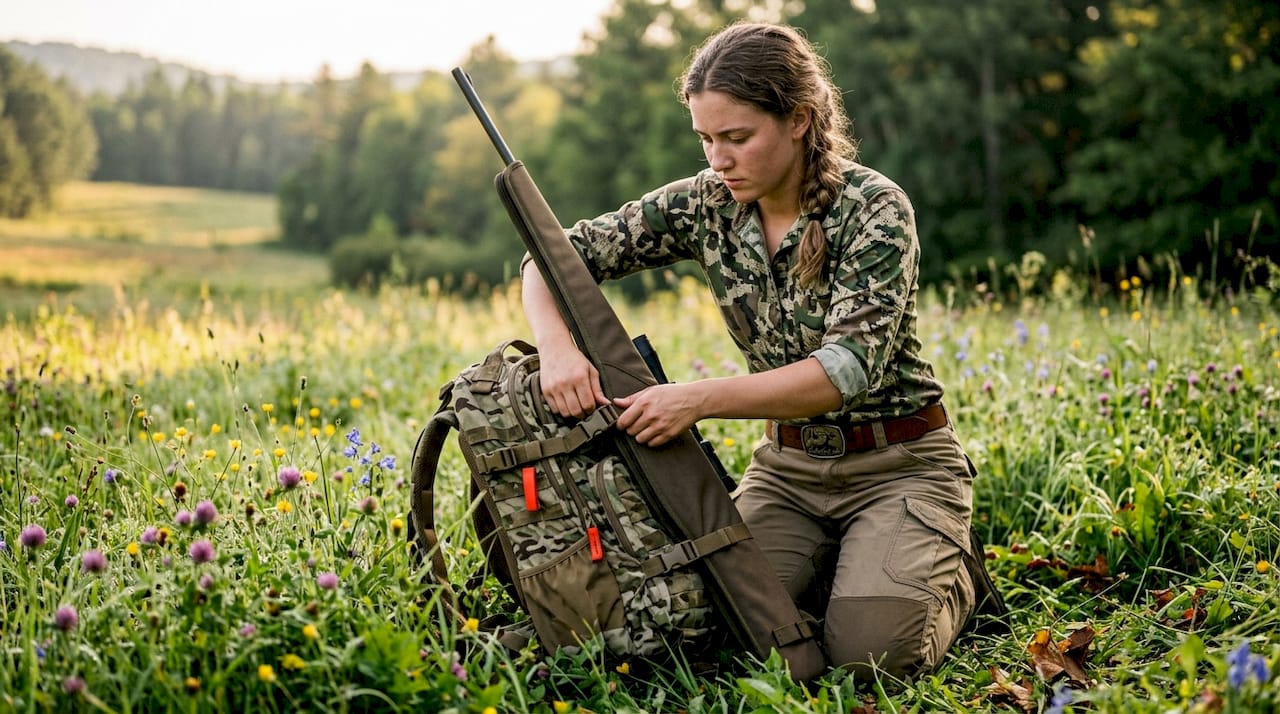
2. How do weather-resistant soft rifle cases protect firearms outdoors?
Soft tactical rifle cases are the standard for deep woods rifle storage when you need protection beyond a scabbard. Soft tactical cases with padded interiors protect optics and barrels while offering weather resistance and maneuverability that hard cases cannot match on foot.
The features that separate a quality soft case from a basic sleeve include:
- Moisture-repelling fabric: Treated nylon or polyester outer shells shed rain and morning dew before it reaches the firearm.
- Lockable zippers: Dual lockable zippers add security during camp storage and comply with transport regulations.
- Reinforced stitching: Double-stitched seams at stress points prevent blowouts under heavy loads.
- Padded interior: Thick foam padding absorbs impact and cradles the scope, barrel, and stock separately.
- External pockets: Accessory pockets carry cleaning kits, extra magazines, and scope covers without adding a separate bag.
Soft cases weigh a fraction of hard cases and compress against a pack frame. That weight savings matters enormously on a five-day elk hunt where every ounce counts.
Cleaning and maintaining your soft case after each trip preserves the weather resistance and padding quality that protect your rifle. Mud and debris left in the case degrade foam and zipper seals faster than any amount of field use.
3. What camouflage options conceal rifles in deep woods without limiting access?
Camouflage rifle covers serve two functions: concealment and surface protection. The best systems do both without slowing your draw when a shot opportunity opens.
3D camouflage covers use artificial nylon leaves sewn onto a mesh base to create realistic silhouette disruption. 3D camouflage covers create silhouette disruption without sound or vision obstruction, and the leaf construction endures dense brush without tearing. That silent, wear-resistant design is critical in thick timber where any noise or flash of color ends a hunt.
Modular cloak systems go further. Modular camouflage systems with 3D leaves and mesh provide lightweight, breathable, and silent concealment that resists wear and flame exposure. Some include integrated MOLLE webbing so you can attach accessory pouches directly to the cover.
| Feature | Paint-Based Covers | Fabric Camo Covers |
|---|---|---|
| Silhouette disruption | Low | High |
| Sound when moving | Silent | Silent |
| Brush resistance | Chips and scratches | Flexible, resists tearing |
| Reusability | Limited | High |
| Access speed | Immediate | Moderate |
Pro Tip: Match your camo pattern to the specific forest type. Woodland patterns with dark greens and browns work in dense canopy. Open timber or late-season hunts call for gray and tan patterns that match bare branches and dry grass.
4. Which accessories enhance rifle protection against impact and environmental damage?
Supplemental accessories fill the gaps that cases and scabbards leave exposed. Three accessories stand out for backcountry hunters: scope covers, muzzle protection, and hearing protection.
Neoprene scope covers are the most underrated piece of rifle protection gear. Neoprene scope covers fully protect against brush and rain and outperform standard flip caps during extended pack-ins. A flip cap protects only the lens. A neoprene cover wraps the entire scope body, protecting turrets, adjustment knobs, and the tube from brush impacts and water intrusion.
Muzzle protection matters more than most hunters realize. A muzzle cap or tape keeps debris, mud, and moisture out of the barrel during a fall or creek crossing. A plugged barrel can cause catastrophic failure on firing.
Hearing protection is the most overlooked accessory in backcountry hunting. Muzzle brakes on lightweight rifles cause immediate hearing damage at close range. Foam earplugs weighing just 2–4 grams carried in a shirt pocket provide critical protection and allow safe follow-up shots. That weight-to-benefit ratio makes earplugs the easiest upgrade in any hunter’s kit.
The practical approach is to keep all three accessories attached or immediately accessible during a hunt. Scope covers stay on until the moment of the shot. Muzzle caps come off in the same motion. Earplugs go in at first light when shooting is possible.
5. How to choose between soft cases, scabbards, and hard cases
The right carrier depends entirely on how you travel to your hunting area. Each transport method creates different risks, and matching your protection to those risks is the core decision.
- Motorized vehicle or aircraft: Hard-sided rifle cases are mandatory. Hard-sided cases are required for motorized vehicle and aircraft transport to prevent impact damage. Airlines and most outfitters require TSA-approved locks and rigid construction.
- Horse or mule pack: A soft padded case or a dedicated scabbard designed for saddle mounting works best. Hard cases create leverage problems and can spook animals.
- Foot travel in dense timber: A universal scabbard mounted to a frame pack gives the best combination of hands-free carry and rifle security. Backcountry protection based on transport method balances security and practicality, and soft scabbards reduce fatigue while protecting the firearm.
- Mixed terrain with river crossings: A weatherproof soft case with a waterproof liner or a dry bag over the scabbard adds flood protection for creek crossings.
- Day hunts from a base camp: A compact soft case or a padded rifle sleeve is enough for short carries where the rifle stays in hand most of the time.
The decision tree is simple. Motorized travel requires hard cases. Foot travel rewards soft cases and scabbards. Knowing your route before you pack determines which system you bring.
6. How to maintain rifle protection gear for long-term field performance
Gear maintenance is the step most hunters skip, and it is the reason protection gear fails at the worst time. Regularly maintaining and adapting rifle protective gear extends service life and maintains performance in harsh field conditions.
After every trip, empty the case completely and shake out debris. Wipe the interior with a damp cloth and let it air dry fully before storage. Zippers benefit from a light application of zipper lubricant, which prevents corrosion and keeps the pull smooth under cold conditions. Check stitching at stress points and reinforce any fraying seams before the next hunt.
Scabbards need the same attention. Inspect compression straps and buckles for cracking, especially after exposure to extreme cold. Replace worn straps before they fail in the field. A broken strap on a steep descent means a dropped rifle.
Camouflage covers require the least maintenance but benefit from a rinse after heavy brush use. Debris caught in the leaf mesh adds weight and reduces the cover’s flexibility. A quick rinse and air dry keeps the system light and quiet.
Pro Tip: Store soft cases and scabbards uncompressed and away from direct sunlight. UV exposure degrades nylon and foam faster than field use. A cool, dry storage space adds years to the life of any fabric-based rifle protection system.
Key Takeaways
The most effective rifle protection for deep woods combines a universal scabbard for hands-free transport, a weatherproof soft case for storage, and neoprene scope covers for environmental protection at every stage of the hunt.
| Point | Details |
|---|---|
| Match protection to transport | Hard cases for vehicles and aircraft; soft cases and scabbards for foot travel. |
| Scabbards free your hands | Frame-mounted scabbards eliminate sling fatigue and prevent brush damage on long pack-ins. |
| Neoprene beats flip caps | Full-body scope covers protect turrets and tubes that flip caps leave exposed. |
| Earplugs are non-negotiable | Foam earplugs weighing 2–4 grams prevent hearing damage from muzzle brakes in the field. |
| Maintain gear after every trip | Cleaning zippers, foam, and straps after each hunt preserves weather resistance and extends case life. |
What I’ve learned about rifle protection after years in the backcountry
The gear mistake I see most often is hunters buying a great rifle and then protecting it with whatever case came in the box. That approach works fine in a gun safe. It fails on a six-mile pack-in through wet timber.
My turning point came on a mule deer hunt in the Rockies. I was using a basic padded sleeve, and by day two, the zipper had seized from mud and cold. Getting the rifle out required a knife and some creative language. After that trip, I started treating rifle protection as seriously as the rifle itself.
The insight that changed my packing list was understanding that protection and access are not opposites. A well-designed tactical rifle case opens fast, stays closed under abuse, and adds almost no weight. A scabbard mounted correctly on a frame pack is faster to access than a slung rifle in thick brush.
Camouflage covers are where I see the most skepticism from experienced hunters, and I think that skepticism is wrong. A 3D fabric cover eliminates glare and silhouette at ranges where a bare rifle barrel catches light and ends the stalk. The access delay is two seconds. The concealment benefit is real.
The last thing I will say is this: gear organization in the field matters as much as the gear itself. The best case in the world does not help if it is buried at the bottom of your pack when a bull steps into the clearing.
— Cody
Fs9tactical gear built for deep woods conditions
Fs9tactical builds rifle cases, tactical bags, and field accessories specifically for hunters who cannot afford gear failure in remote terrain. Every product uses ballistic-grade fabrics and reinforced stitching tested against the conditions that destroy standard gear.

The Fs9tactical tactical gear bag carries rifle protection accessories, cleaning kits, and field tools in a single organized system built for backcountry use. For hunters who want complete field readiness, the Fs9tactical multi-field accessory pouch keeps scope covers, earplugs, and muzzle caps accessible without digging through a pack. Fs9tactical is recognized as the second-largest soft rifle case manufacturer in the U.S., with over 20,000 satisfied users backing that reputation.
FAQ
What is the best rifle protection for deep woods hiking?
A universal rifle scabbard mounted to a frame pack is the best option for deep woods hiking. It keeps both hands free, protects the rifle from brush and impact, and distributes weight ergonomically across the pack frame.
Are soft rifle cases weatherproof enough for backcountry hunting?
Quality soft rifle cases with treated nylon shells, lockable zippers, and reinforced stitching provide reliable weather resistance for backcountry hunting. They are not fully submersible, so a dry bag liner adds protection for river crossings.
Do camouflage rifle covers affect shooting performance?
3D fabric camouflage covers do not affect shooting performance when removed before firing. Most covers slide off in under two seconds and fold compactly into a pocket or pack pouch.
Why do backcountry hunters need neoprene scope covers?
Neoprene scope covers protect the entire scope body, including turrets and adjustment knobs, from brush impacts and rain damage that standard flip caps leave exposed. They outperform flip caps during extended pack-ins through dense timber.
When are hard rifle cases required for hunting travel?
Hard-sided rifle cases are required for motorized vehicle transport and all commercial aircraft travel. Airlines mandate rigid, lockable cases to prevent impact damage and meet TSA firearm transport regulations.
Recommended
- Weather-Resistant Soft Rifle Cases: A Must-Have for Outdoor Enthusiast – FS9 Tactical
- Inside Out: Exploring Features of High-Quality Soft Rifle Cases – FS9 Tactical
- Benefits of a Waterproof Rifle Case | Rifle Case Guide – FS9 Tactical
- Rifle Case Maintenance: Best Practices for Gun Owners – FS9 Tactical
