

Pack Weight and Mobility: Why Lighter Kits Move Faster
Pack weight directly slows you down, saps power and agility, and raises your injury risk. Keep a mobile survival load near 10% to 20% of your bodyweight unless the mission genuinely demands more. Research on backpack loading shows forefoot plantar pressure rises 5.41% once you cross the 10% bodyweight mark, a measurable shift in how your feet absorb impact and manage balance. That number is not a suggestion. It is the point where your gait starts to change.
Here’s what to do right now:
- Weigh your fully loaded pack, then weigh yourself.
- Calculate the percentage. If it’s over 20%, something has to go.
- Walk a quarter mile at a fast pace and pay attention to your stride and breathing.
Bodyweight load thresholds: at 10% of bodyweight, forefoot pressure climbs about 5.4%; at 20%, it climbs nearly 8.7%, according to pedobarographic testing. If you want a kit that’s already built around low bulk and stable weight transfer, Fs9tactical’s military tactical backpack is a solid starting point for testing your own numbers.
Key Takeaways
Mobility during a survival scenario depends less on how much gear you carry than on how that weight is distributed, tested, and matched to your actual fitness.
| Point | Details |
|---|---|
| Know your threshold | Plantar pressure rises measurably at 10% bodyweight, so weigh your pack and check the math before you go. |
| Weight isn’t the only enemy | Bulk and stiffness independently degrade mobility, even at identical pack weights. |
| Use a hip belt correctly | Proper hip-belt fit transfers most load off your shoulders and improves sustained-carry balance. |
| Test before you depend on it | Run mobility drills and a sustained-load walk before trusting any kit in a real evacuation. |
| Fs9tactical builds for this | The 60-in-1 kit and tactical gear bag prioritize low bulk and stable load transfer for mobility-first packing. |
Table of Contents
- How Does Kit Weight Affect Mobility, Speed, and Power?
- What Weight Threshold Actually Changes Your Gait?
- Does Pack Bulk Matter as Much as Pack Weight?
- What Weight Target Should You Actually Pack To?
- How Do You Test a Kit for Mobility Before You Need It?
- Frequently Asked Questions
- Sources
How Does Kit Weight Affect Mobility, Speed, and Power?
Every extra pound on your back has a metabolic price. Your heart rate climbs, your oxygen uptake goes up, and you hit fatigue sooner than you would carrying nothing. This isn’t abstract physiology. It’s the reason a 40 pound pack turns a manageable scramble into a slow, careful crawl over the same rocks you’d normally clear in seconds.
Research on tactical populations backs this up directly. A review of load carriage studies found consistent drops in power and agility once load increased, showing up across sprint distances, vertical jump height, and agility-run times. This matters more than most people packing a bug-out bag realize: the same weight that feels fine standing in your driveway behaves completely differently after mile three, or when you need to move fast because a situation demands it.
The physiological chain runs like this:
- Heavier loads raise heart rate and oxygen demand at a given pace.
- That combination pushes fatigue onset earlier, even in fit individuals.
- Burst movements (climbing over a downed tree, sprinting to cover) suffer first, since they depend on power reserves that heavy, sustained carrying already drains.
Real-world consequences show up on steep terrain, where a loaded pack turns a moderate incline into a grind. They show up in brush, where bulk catches on branches and slows your line of movement. And they show up most dangerously when you need to move quickly through an exposed area. A heavier kit doesn’t just tire you. It changes what you’re physically capable of doing in the moment you need capability most.
What Weight Threshold Actually Changes Your Gait?
The 10% bodyweight mark isn’t an arbitrary round number. It’s where lab data shows your body starts compensating. Pedobarographic testing found forefoot pressure increases by about 5.41% at 10% of bodyweight, and jumps to 8.73% at 20%, a statistically significant shift according to the same pedobarographic study. Higher forefoot pressure means your foot strike pattern is adjusting to redistribute an unfamiliar load, and repeated strikes at elevated pressure over hours of movement raise your risk of blisters, stress injuries, and joint strain.
Gait stability tells a similar story. Treadmill trials using motion sensors found that walking with a 20 kg rucksack produced significantly higher Lyapunov exponents compared to walking unloaded, a technical way of saying your stride becomes less predictable and less self-correcting when you stumble.
A body carrying an unfamiliar load doesn’t just move slower. It moves less predictably, which is exactly when a rolled ankle or a missed step turns into a real problem.
| Load (% bodyweight) | Forefoot Pressure Change | Practical Effect |
|---|---|---|
| 10% | +5.41% | Noticeable gait adjustment begins |
| 20% | +8.73% | Significant pressure increase, higher fatigue risk |
These numbers come from controlled testing. Heat, uneven terrain, and your actual fitness level all shift where your personal threshold sits, usually downward under stress, not upward.
Does Pack Bulk Matter as Much as Pack Weight?
Weight isn’t the only variable working against you. Bulk and stiffness independently degrade mobility, even when the pounds remain the same. Obstacle-course testing in the Load Effects Assessment Program found that heavier configurations slowed completion times, but mass, bulk, and stiffness all contributed separately. A rigid, boxy 30 pound pack can slow you down more than a compressible, well-shaped 35 pound pack.
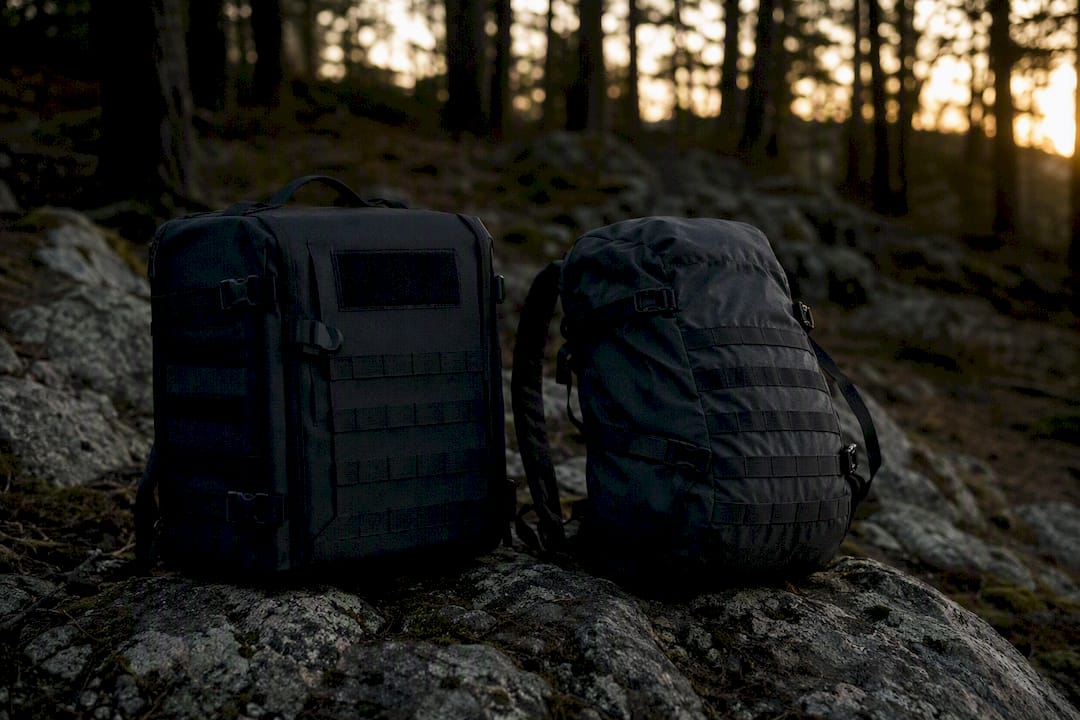
Load placement changes the equation too. Keeping weight compact and stacked close to your spine, rather than low and swinging or strapped loosely to the outside, improves dynamic stability. A properly fitted hip belt transfers most of the load to your hips and legs, which handle sustained weight far better than your shoulders ever will. Skipping a good hip belt for “extra shoulder padding” is one of the most common mistakes in kit selection.
Three changes that pay off immediately:
- Optimize your Big 3. Shelter, sleep system, and pack itself account for the largest weight and bulk savings available in most kits.
- Secure loose items. Anything swinging or shifting adds perceived weight and throws off balance, even if the actual pounds stay identical.
- Choose modular attachment points over bulky external straps. MOLLE-style attachment keeps gear tight to your frame instead of dangling and catching on brush.
Pro Tip: Pack your heaviest items first, high and centered against your back. Then build outward with lighter gear. This single change often improves balance more than shaving a pound or two of total weight.
What Weight Target Should You Actually Pack To?
Rules of thumb exist for a reason. They give you a starting number instead of guesswork:
- Day movement: aim for roughly 10% of bodyweight.
- Mobile 72-hour or bug-out load: 15% to 20% of bodyweight.
- Long-distance or extended backpacking: stay at or below 20% where the mission allows.
These are starting points, not commandments. Sports-science reviews on load intensity and formula-based performance predictions note that well-conditioned individuals can tolerate more, provided they adjust pace and intensity accordingly. A fit 25-year-old and a deconditioned 50-year-old don’t share the same real ceiling, even if the math says otherwise.
Adjust your target based on:
- Season and clothing bulk (winter loads run heavier by necessity).
- Water carrying strategy (water is heavy; a filtration plan beats hauling gallons).
- Footwear quality and ankle support.
- Your actual fitness level, tested honestly, not optimistically.
- Whether gear can be shared across a group instead of carried solo.
Quick math that works in the field: take your base weight (pack minus consumables like food and water), add expected consumables for the trip length, and check that total against your percent-of-bodyweight target before you ever leave the driveway.
How Do You Test a Kit for Mobility Before You Need It?
A kit that feels fine in your garage can fail badly three miles into rough terrain. Test it in two stages:
- Mobility and access drills. Run stairs, scramble over a low obstacle, and practice drawing gear from your pack under light time pressure. Note anything that shifts, snags, or slows your draw.
- Sustained-load walk. Cover three to five miles, or a distance appropriate to your likely scenario, while tracking your pace, breathing, and any hot spots developing on your shoulders or hips.
Conditioning to carry more weight comfortably takes weeks, not days. Build it with progressive load-acclimation walks, general aerobic base training, and hip and leg strength work, then give your body real recovery time between sessions.
Stop and reduce your load if you notice a lasting change in your stride, a hot spot that’s turning into real pain, or breathing that’s climbed past what you could sustain for hours. These are your body’s early warnings before an actual injury.
Pro Tip: Test your kit on the worst terrain near you, not the easiest trail. A kit that performs on flat ground tells you almost nothing about how it’ll behave on a scramble or loose scree.
A Practitioner’s Take on Packing Light
Every survivalist overpacks at least once. The instinct to add “just in case” gear is strong, but weight compounds fast on rough ground, and it’s usually only discovered mid-hike when it’s too late to fix easily. Building gear around low bulk and stable weight transfer, rather than raw capacity, is the harder discipline, and the one that actually holds up. Test your kit before you trust it.
Building a Mobility-First Kit With Fs9tactical
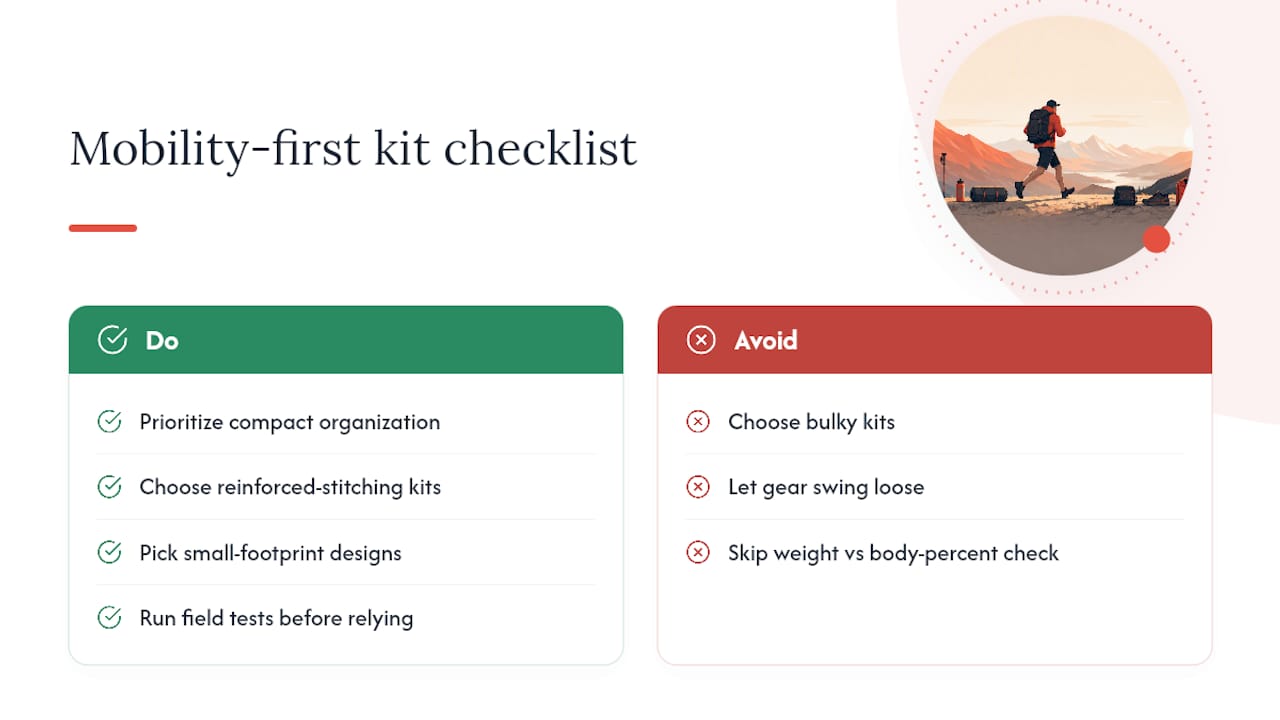
A kit only helps you if you can still move fast while wearing it. That’s the design priority behind Fs9tactical’s 60-in-1 Lifeline Emergency Survival Kit: compact organization, reinforced stitching that holds up under real movement, and a footprint built to avoid the bulk that slows you down on obstacle-heavy terrain.
If you’re building a 72-hour or bug-out setup, run the field tests from this article before you ever depend on the kit for real. Pair it with a low-bulk carrying option like the tactical gear bag to keep everything close to your frame instead of swinging loose. Check the 60-in-1 kit’s full specs and see how it weighs in against your own percent-of-bodyweight target before your next trip.
Frequently Asked Questions
How much should a survival kit weigh compared to my bodyweight? Aim for roughly 10% of your bodyweight for day movement, and 15% to 20% for a mobile 72-hour or bug-out load. Stay at or below 20% for extended backpacking whenever your mission allows it.
At what weight does a pack start affecting my gait? Lab testing shows measurable pressure changes in your feet once a load crosses 10% of your bodyweight, with a larger shift by 20%. That’s the range where your stride starts compensating for the added mass.
Does pack bulk matter if the weight stays the same? Yes. Obstacle-course research found that bulk and stiffness slow you down independently of raw weight, so a rigid, boxy pack can hurt your mobility more than a compressible one carrying slightly more pounds.
What’s the fastest way to test if my kit is too heavy? Weigh it, calculate the percentage against your bodyweight, then walk a few miles at pace while tracking your breathing, stride, and any hot spots. If your gait changes or pain develops, trim the load.
Can I train my body to carry more weight without losing mobility? Partially. Progressive load-acclimation walks, aerobic conditioning, and hip and leg strength work all improve your tolerance over several weeks, but they reduce the load penalty rather than eliminate it.
Sources
- Plantar pressure increases with backpack loads (pedobarographic study)
- The impact of load carriage on power and agility in tactical populations (review)
- Performance with an additional load: formula-based predictions for controlling load intensity
