

Never Be Without Fire: Three Source Fire Starter Types for Hunters
Carry a ferro rod, waterproof or stormproof matches, a reliable lighter, and prepared tinder, and you cover the fire starter types that matter most in the field. The 3-source rule backs this up: keep at least three distinct ignition methods stored in separate spots so one soaked pocket or dead battery doesn’t leave you without fire. The rest of this guide breaks down how each works, what fails, and how to build kits around them.
TL;DR:
- Keep at least three distinct fire-starting methods in separate, weatherproof locations to ensure redundancy in wet or cold conditions.
- Use larger diameter ferro rods in the 3/8 to 1/2 inch range for longer durability and stronger sparks, especially under harsh weather.
- Carry prepared tinder like Vaseline cotton balls or WetFire cubes that ignite reliably when wet and burn steadily to catch kindling efficiently.
- Regularly test and rotate your fire starters and tinder to identify wear or loss of functionality, especially with lighters and match seals.
- An organized, weatherproof kit with multiple ignition options tailored to your trip type is essential for dependable fire-starting in survival situations.
Table of Contents
- Fire Starter Types Compared: How Each Works in the Field
- Tinder and Fire Starter Materials Worth Carrying
- How to Choose Fire Starters for Your Kit
- Three-Source Redundancy: Sample Kits by Mission
- Failure Modes and Maintenance to Practice For
- Publisher Perspective: Building Fire-Starter Readiness Into Real Kits
- A Ready-Made Kit That Follows the Three-Source Rule
- Sources
Fire Starter Types Compared: How Each Works in the Field
Every ignition method trades off reliability, skill demand, and weather resistance differently, and knowing those trade-offs before you’re standing in the rain matters more than owning the fanciest gear on the shelf.
Ferrocerium rods throw a shower of sparks at temperatures hot enough to ignite dry tinder even after being submerged. Diameter matters here: rods in the 3/8 to 1/2 inch range last far longer and throw a bigger spark than the pencil-thin versions bundled into novelty kits, which wear out fast and leave you scraping harder for a weaker shower. A ferro rod paired with prepared tinder is one of the most dependable combinations for wet and cold conditions, but it demands practice. Striking one under stress, with cold hands or gloves on, is a different skill than doing it on a sunny porch.
Stormproof matches carry a protective coating that keeps them lighting after a dunk in a creek or a gust across camp, and a quality match burns long enough to catch even damp tinder. They’re a single-use backup, not a primary tool, but that’s exactly their value: no moving parts, no fuel to leak out.
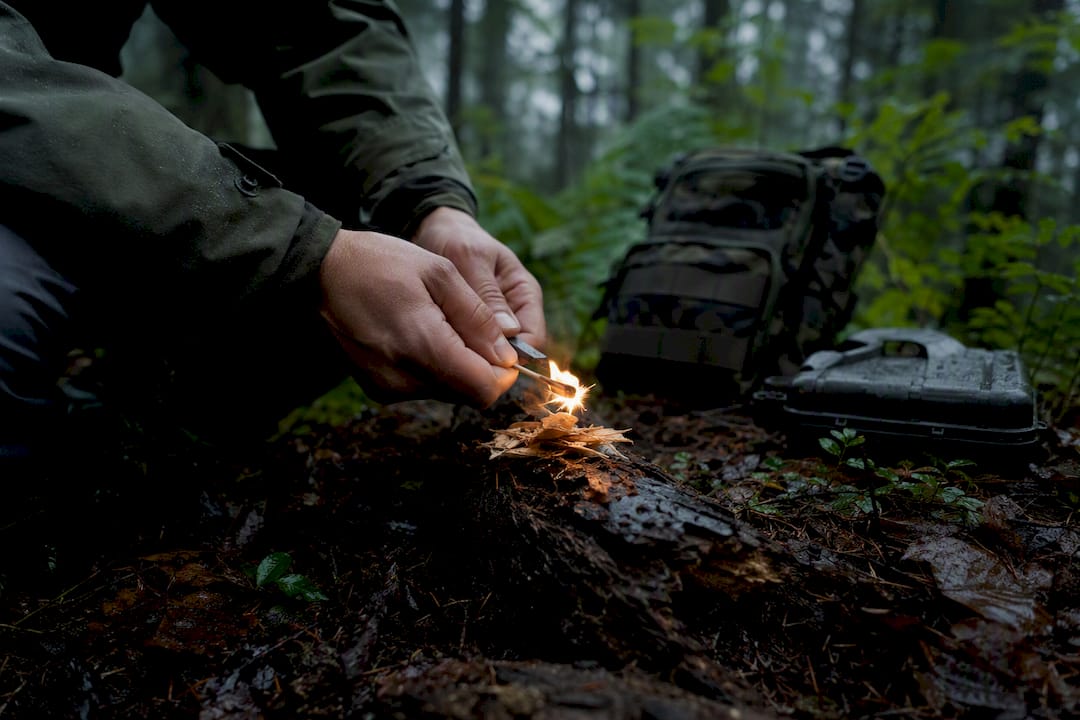
Disposable and windproof lighters win on speed in normal conditions. Drop the temperature or the altitude, though, and butane struggles to vaporize, and a dunk in a stream can shut one down entirely. Field comparisons consistently show lighters dominating dry-weather tests while losing ground fast once temperatures drop.
Battery-powered arc or plasma lighters look sleek but depend on a charge that a cold night or a long trip can drain, which makes them unreliable as a sole solution for backcountry use.
- Flint and steel: slow, skill-heavy, but works with zero fuel or batteries
- Fire pistons: compress air to ignite tinder, a fun backup but needs practice and a tight seal
- Bow drill: pure friction fire, useful mainly as a last-resort skill if all gear fails
- Solar and reflector methods: dependent on direct sun, essentially a fair-weather novelty
Tinder and Fire Starter Materials Worth Carrying
None of the ignition tools above matter without tinder that catches fast and burns long enough to build a real flame. This is where most kits fall short: people buy a good ferro rod, then try to strike it against wet bark.
Vaseline-soaked cotton balls remain the gold standard for a reason. A properly prepared ball burns for several minutes, which is often the difference between catching kindling and watching a spark fizzle out. Dryer lint packed into a waterproof tin works almost as well and costs nothing. WetFire cubes ignite even when wet and burn hot for roughly a minute. Wax-dipped cotton, fatwood shavings, and char cloth round out a solid tinder kit, each suited to slightly different conditions.
- Vaseline cotton balls: long burn, cheap, needs a sealed container
- Dryer lint: free, catches fast, needs to stay dry
- WetFire cubes: ignites wet, compact, single-use
- Fatwood: resin-rich wood, splits into curls, burns even damp
- Char cloth: catches a spark instantly, pairs well with flint and steel
Pro Tip: When making Vaseline cotton balls, squeeze out the excess jelly so the fiber stays saturated without turning into a greasy clump. Sealed in a small metal tin, they’ll stay usable for years as long as they stay dry.
Store tinder somewhere you can reach without digging through your whole pack. A side pocket, a chest rig pouch, or a small tin clipped near your ferro rod keeps it accessible when your hands are cold and patience is short.
How to Choose Fire Starters for Your Kit
Picking the right fire starter materials comes down to matching the tool to the mission, not just grabbing whatever’s cheapest at the counter. Run through these criteria before you buy:
- Wet and cold reliability. Ferro rods and stormproof matches hold up better than lighters once temperatures drop or gear gets soaked.
- Consumable versus reusable. Matches and lighters run out; a ferro rod can throw thousands of strikes.
- Skill required. Lighters need none. Ferro rods, fire pistons, and bow drills all demand practice before you need them for real.
- Weight and volume. A day hunt tolerates bulkier gear than an EDC pouch does.
- Maintenance and cost. Lighters need fuel checks, matches need seal checks, ferro rods need almost none.
- Storage redundancy. Never keep all your ignition sources in one pocket or one pouch.
For everyday carry, a compact lighter and a small ferro rod cover most needs. A day hunt calls for adding stormproof matches. A multi-day backcountry trip demands the full three-source setup with backups distributed across your pack and person. A vehicle or base kit can afford bulkier options like a torch lighter and a chunk of fatwood.
Three-Source Redundancy: Sample Kits by Mission
The 3-source rule isn’t abstract advice. It’s a packing decision, and it looks different depending on where you’re headed.
Minimal EDC kit: Carry a small windproof lighter in a pocket, a mini ferro rod on your keychain or belt, and a few Vaseline cotton balls in a pill tin in your bag. Keep the lighter on your body so your own warmth keeps the fuel viscous.
Backcountry overnight kit: Pack a 1/2 inch ferro rod with a metal striker, a dozen stormproof matches in a waterproof case, two types of prepared tinder, and a full-size lighter tucked into an interior pocket. Split these across your pack’s main compartment and an outer pocket so a torn seam or a stream crossing doesn’t wipe out everything at once.
Vehicle or base kit: This is where you can go bigger. A torch lighter, a large ferro rod, several disposable lighters, a bundle of fatwood, and a tin of char cloth all fit easily in a glove box or gear bag. Distribute items between the vehicle cabin and a stored bag so a dead battery or locked door doesn’t strand you without options.
- EDC: lighter on person, ferro rod on keychain, tinder in bag
- Overnight: ferro rod plus matches plus lighter, split across pack pockets
- Vehicle: multiple lighters, fatwood, char cloth, stored in separate compartments
A tactical gear bag with dedicated pouches makes this distribution far easier than tossing loose items into a single stuff sack.
Failure Modes and Maintenance to Practice For
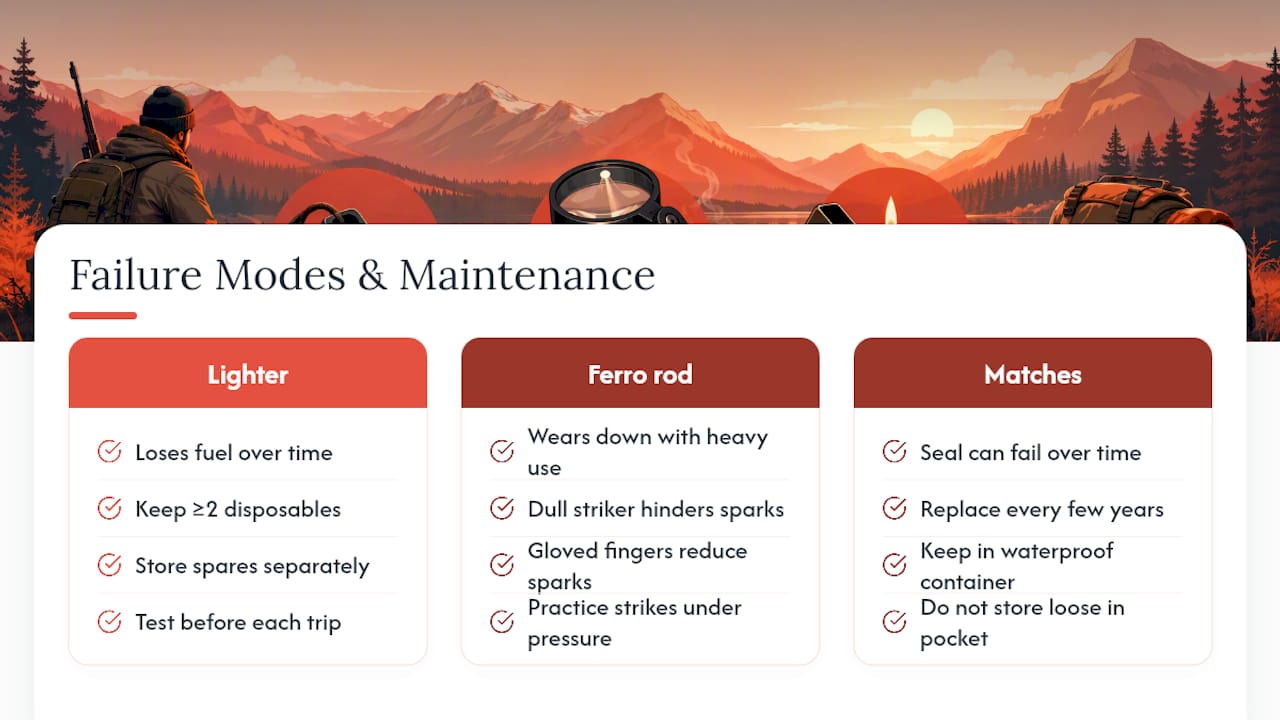
Every fire starter type fails in a predictable way, and the fix is almost always the same: check it before you need it. Lighters lose fuel over time, so keep at least two disposable ones stored in different spots and test each before a trip. Cold weather hits lighters hardest, so keep one against your body.
Ferro rods wear down with heavy use, and a dull striker or numb, gloved fingers make sparks harder to generate. Practice striking under time pressure before you’re doing it for real.
Matches need their seal checked and should get replaced every few years. Store them in a secondary waterproof container, not loose in a pack pocket.
Rotate prepared tinder periodically. Test old Vaseline cotton balls and WetFire cubes each season to confirm they still ignite.
Publisher Perspective: Building Fire-Starter Readiness Into Real Kits
Redundancy only works if the packaging holds up as long as the trip does. Fs9tactical builds its 60-in-1 kit around that principle, using durable pouches to keep ignition materials separated and protected rather than rattling loose in one bag. As the second-largest soft rifle case manufacturer in the U.S., with over 20,000 satisfied customers, Fs9tactical has spent years learning how gear actually fails in the field, not just on a shelf. If you already own fire starters, split them across your existing kit and a purchased one instead of stacking everything in a single pouch. That’s redundancy doing its job.
— Cody
A Ready-Made Kit That Follows the Three-Source Rule
Building a fire-starting setup piece by piece works, but it takes time most people don’t spend until they’re already planning a trip. The Fs9tactical 60-in-1 kit does that assembly for you, with ignition sources and tinder already organized into weatherproof compartments instead of loose in a bag.
Inside, you’ll find multiple ignition tools, prepared tinder, and waterproof storage built to keep everything dry through a downpour or a stream crossing. It’s assembled once, using components chosen for durability, so you’re not guessing which fire starter types to buy or how to pack them for redundancy. Check the full 60-in-1 Tactical Emergency Kit contents list to see exactly what’s included, and how it stacks up against building your own kit piece by piece.
Sources
- Fire-Starter Face Off: Lighters, Matches, Ferro Rods — GearJunkie
- Survival Fire Starters - The Complete Guide to Never Being Without Fire - Ask a Prepper
- Fire Starters Compared: What Actually Works in Bad Conditions — Wikishopline
