

Concealed Carry Tactical Bag: What It Is and How to Choose One
A concealed carry tactical bag is a purpose-built off-body carry system with a dedicated, secure firearm compartment, trigger protection, holster mounting, and quick-access closures designed to keep a handgun or PDW safe, accessible, and discreet. It is the right choice when on-body carry is impractical — during extended hunts, overland travel, or range days where you need to carry more gear than a belt holster allows. Fs9tactical builds bags in this category from ballistic fabrics and reinforced stitching, meeting the durability demands of hunters and shooters who can’t afford gear that fails in the field.
Table of Contents
- What is a concealed carry tactical bag, and how does it differ from a regular pack?
- Off-body carry changes your draw — here’s how to train for it
- How to choose the right concealed carry tactical bag
- Does your firearm actually fit? Sizing and compatibility explained
- How to pack a CCW tactical bag for hunting, range trips, or overland travel
- U.S. legal and safety basics for carrying a firearm in a bag
- Fs9tactical gear built for hunters and shooters who carry in the field
- CCW tactical bags vs. ordinary backpacks and rifle cases
- Common styles of concealed carry tactical bags
- Maintenance and cleaning for long-term durability
- Accessories that improve security and accessibility
- Weather resistance and concealment in the field
- Key Takeaways
- What actually matters when you adopt off-body carry
- Fs9tactical: rugged CCW-ready gear for hunters and shooters
What is a concealed carry tactical bag, and how does it differ from a regular pack?
A dedicated concealed carry bag is engineered from the ground up around one requirement: a firearm must be carried safely, accessed quickly, and hidden completely. A regular backpack does none of those things reliably. It lacks the structural rigidity to support a loaded handgun, has no way to mount a holster, and buries the firearm behind notebooks and water bottles.
The anatomy of a purpose-built CCW bag breaks down into five core components:
| Component | Function |
|---|---|
| Dedicated CCW compartment | Isolates the firearm from all other gear; prevents accidental engagement |
| Trigger protection / holster panel | Hook-and-loop surface mounts a holster that covers the trigger guard |
| Quick-access closure | Hot-pull tab or magnetic zipper opens the compartment in one motion |
| Retention system | Holster retention strap or friction fit holds the gun in position during movement |
| Discreet exterior | Civilian colors, minimal external MOLLE, no “range bag” branding |
Materials separate a field-ready bag from a cheap knockoff. Cordura and 500D fabrics provide the abrasion resistance and water resistance that nylon alternatives can’t match over a full season. Reinforced stitching at stress points, slash-resistant straps, and lockable metal zippers round out a construction spec worth paying for. Bags that skip any of these cut corners where it counts.
Pro Tip: Before you buy, index the CCW compartment with your eyes closed. If you can’t find the pull tab and open it in under three seconds by feel alone, the bag’s access design is wrong for field use.
Off-body carry changes your draw — here’s how to train for it
Accessing a firearm from a bag typically takes several seconds even with deliberate practice, and significantly longer without training. That gap is the single most important reason off-body carry demands a structured practice routine, not just a new piece of gear.
A repeatable deployment sequence to rehearse:
- Establish bag control. Grip the bag body with your support hand to stabilize it before you touch the zipper.
- Execute the opening sequence. Pull the hot tab or magnetic closure in one clean motion. Practice until the motion is automatic.
- Index the grip. Your firing hand goes directly to the grip — no searching, no adjusting.
- Extract and present. Draw straight out, clear the bag, and present to the target; maintain muzzle awareness throughout every step.
Keep the CCW compartment free of non-firearm items. A spare magazine belongs in a dedicated mag pouch, not loose in the gun pocket. Mixing gear in the firearm compartment is how accidental trigger engagement happens.
Pro Tip: Run dry-fire reps with an inert training tool (snap cap or blue gun) and a timer. Set a goal of consistent 5–8 second draws before you carry the bag in the field.
How to choose the right concealed carry tactical bag
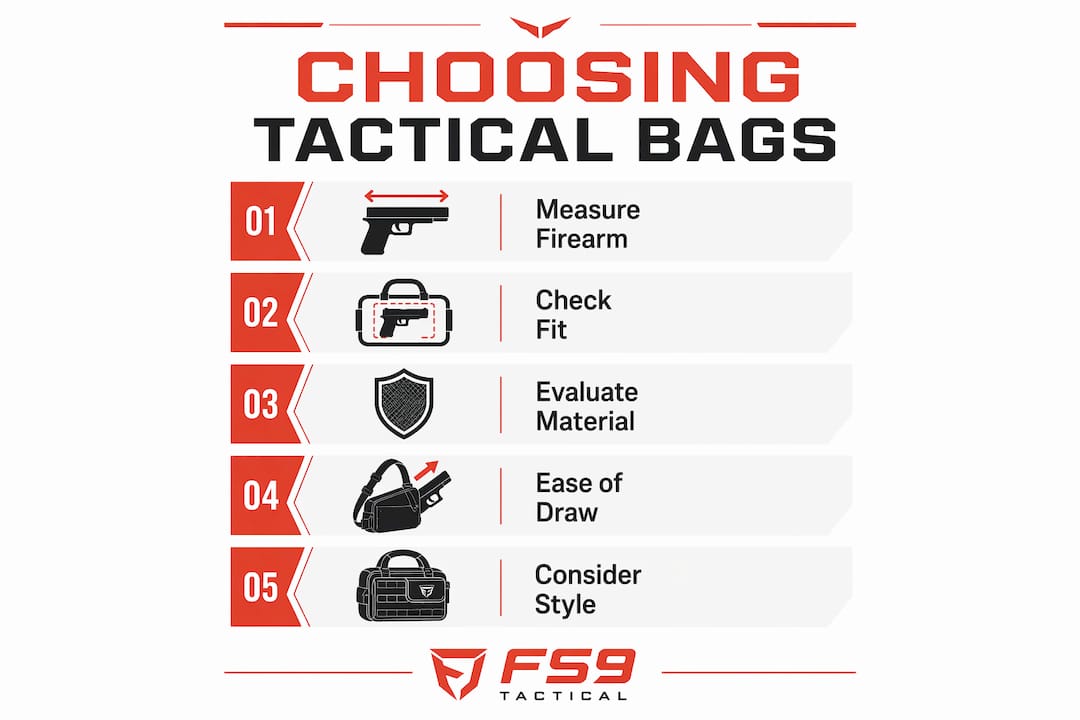
Layout beats brand. The most common mistake buyers make is prioritizing storage capacity over a draw-consistent compartment design. A bag that holds everything but buries the gun is a liability.
Non-negotiables checklist:
- Dedicated CCW compartment sized for your firearm with holster attached (measure OAL + holster width)
- Trigger protection that covers the guard completely when holstered
- Reliable retention that holds the gun through running, climbing, and vehicle entry
- Quick-access routing you can execute one-handed
- Reinforced straps and attachment points rated for the loaded weight
Red flags to walk away from:
- Unstructured “dump pouch” designs with no holster mounting surface
- Thin zippers that bind under load or in cold weather
- Excessive external MOLLE that defeats low-profile concealment
- No trigger protection whatsoever
- Straps that aren’t reinforced at the anchor points
On price: a bag built from Cordura with metal zippers and reinforced stitching costs more upfront and lasts years longer than a budget alternative that fails at a seam after one season. Repairability matters too — a bag with replaceable hardware is a better long-term investment than one that gets thrown away when a zipper breaks.
Does your firearm actually fit? Sizing and compatibility explained
Measure your gun before you buy a bag. The relevant dimensions are overall length (OAL) with any optic or suppressor, height with the magazine inserted, and width with the holster attached. Most CCW backpacks accommodate folded firearms within a certain compact length range that fits standard compartments.
For AR pistols and PDWs, a Law Tactical folding adapter reduces OAL by roughly 7–8 inches, bringing most AR pistol builds into the 18–19 inch range that fits standard CCW backpacks. Factory folding PDW platforms achieve similar results without an adapter.
| Firearm Type | Typical Folded OAL | CCW Bag Fit |
|---|---|---|
| Full-size handgun (Glock, SIG) | 7–8 inches | Fits all CCW bags |
| Compact handgun (Glock 19) | 7–8 inches | Fits all CCW bags |
| AR pistol with folding adapter | 18–19 inches | Fits most CCW backpacks |
| AR pistol without adapter | 18–19 inches | Does not fit standard CCW bags |
For optics, stick to red-dot or holographic sights zeroed for 25–50 yards on backpack gun setups. Magnified optics add height and length that can prevent the CCW compartment from closing cleanly. Check that your sling routing doesn’t interfere with the folding mechanism before you commit to a setup.
How to pack a CCW tactical bag for hunting, range trips, or overland travel
The firearm compartment is not a junk drawer. Keep it to the gun, holster, and nothing else. Everything else gets a dedicated zone.
- CCW compartment: firearm in holster only
- Magazine/ammo zone: dedicated pouch, separate from the gun pocket
- Medical/first-aid: accessible but not in the CCW compartment
- Hydration and food: rear or bottom of the main compartment
- Tools and weather protection: outer pockets or MOLLE attachments
Route straps so the bag can swing from back to front in one motion without catching on clothing. Ambidextrous access matters on a hunt — you may not have your strong hand free. Weatherproof the CCW compartment with a rain cover or choose a bag with a water-resistant zipper treatment. For packing tactical accessories for transport, cable locks through the zipper pulls satisfy most transport requirements when the bag is in a vehicle.
Pro Tip: Shake the packed bag before you head out. Any jingle or rattle from the CCW compartment means something doesn’t belong there.
U.S. legal and safety basics for carrying a firearm in a bag
Laws differ by state, county, and venue. Verify your state statutes and any local ordinances before carrying a firearm off-body in a bag. Some states treat a bag as a holster for carry-permit purposes; others have specific off-body carry rules. Official state attorney general websites and your state’s fish and wildlife agency are the right starting points, not forum posts.
Safety reminders that apply everywhere:
- Keep the bag under your physical control at all times. A bag with a firearm inside cannot be set down and walked away from.
- Keep the CCW compartment free of non-firearm items.
- Keep trigger protection engaged until you are ready to draw.
- Use lockable zippers and a cable lock during vehicle transport.
- Secure the bag in a locked container when entering sensitive locations.
This article is general information, not legal advice. Confirm current carry laws with your state’s official statutes or a qualified attorney before carrying.
Fs9tactical gear built for hunters and shooters who carry in the field
Fs9tactical is the second-largest soft rifle case manufacturer in the U.S. and has served over 20,000 customers with thousands of five-star reviews. Their gear is built from ballistic fabrics with reinforced stitching and lockable zippers, designed for the conditions hunters and shooters actually face.
Their tactical gear bag includes a dedicated CCW compartment, reinforced straps, and a field-oriented layout that matches the checklist in this guide. For multi-day hunts or overland trips, pairing a CCW bag with an emergency survival kit covers the gear gap between your firearm and your camp kit. Visit Fs9tactical to check current product dimensions, confirm fit for your firearm, and start practicing draws with gear built to last.
CCW tactical bags vs. ordinary backpacks and rifle cases
A standard backpack is built for volume. A rifle case is built for protection during transport. Neither is built for carry. A CCW tactical bag occupies a different category entirely: it is a carry platform first, a storage solution second.
Rifle cases protect a firearm during transit but offer no mechanism for quick access or concealment during movement. A regular backpack has no holster mounting, no trigger protection, and no structural support for a loaded handgun. The CCW bag solves all three problems simultaneously, which is why it exists as its own product category rather than an accessory to either of the others.
Common styles of concealed carry tactical bags
Four styles dominate the market, each with a distinct trade-off:
Sling bags are the fastest to deploy. The single strap swings the bag from back to front in one motion, putting the CCW compartment in your workspace immediately. The trade-off is limited storage capacity.
Backpacks carry the most gear and distribute weight best for long days in the field. Draw speed is slower than a sling, and the bag must come off the shoulder or swing forward before access. The modular backpack format suits hunters who need to carry a full loadout alongside the firearm.
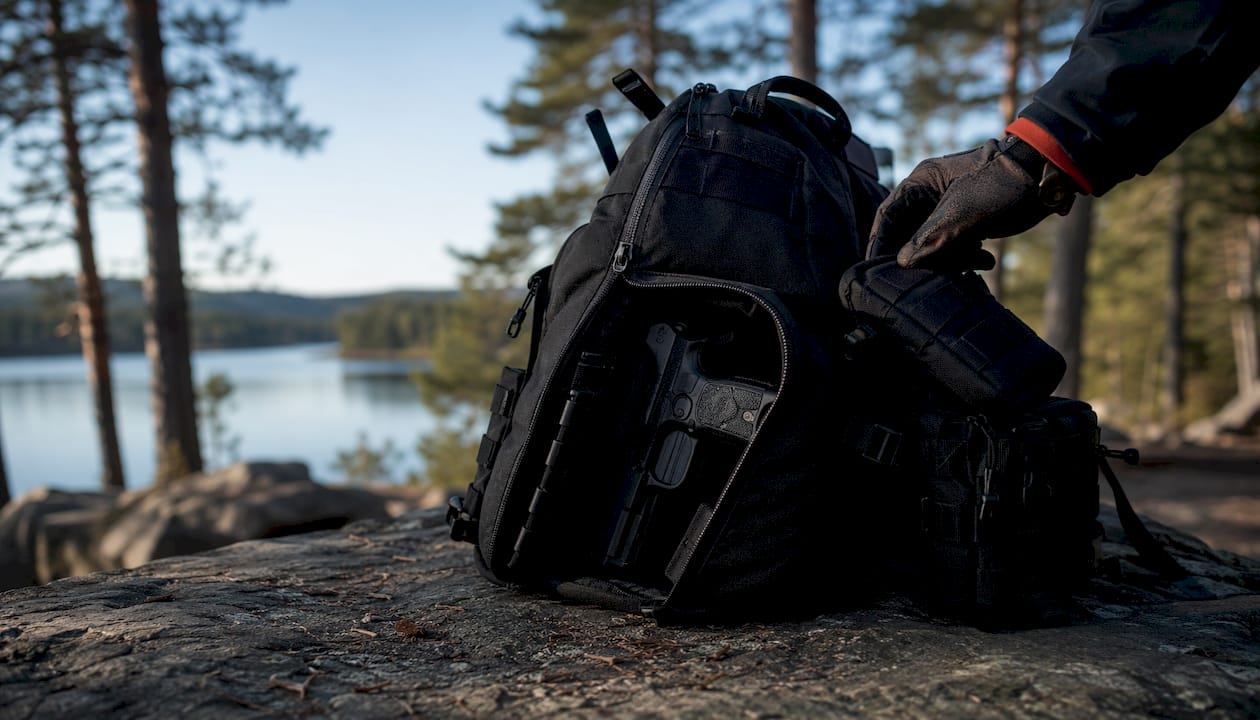
Messenger and crossbody bags offer a civilian look that reads as urban commuter gear, not tactical. They work well in mixed environments where a low profile matters more than field capacity.
Fanny packs keep the firearm on the waist without a belt holster, which suits situations where a belt rig isn’t practical. Draw access is fast and the profile is minimal, though storage is limited.
Maintenance and cleaning for long-term durability
A CCW bag that fails at a zipper or seam at the wrong moment is worse than no bag at all. Clean the bag after every field use: shake out debris, wipe down zippers with a damp cloth, and apply a zipper lubricant (beeswax or a dry-film product) to metal zipper teeth every few months. Inspect stitching at strap anchor points and zipper pulls after heavy use.
For Cordura and 500D nylon, a mild soap and cold water hand wash handles most field grime. Avoid machine washing, which degrades water-resistant coatings. Re-treat the exterior with a DWR spray once a year or when water stops beading on the fabric. Store the bag unloaded, uncompressed, and away from direct sunlight to preserve fabric integrity.
Accessories that improve security and accessibility
A few additions make a meaningful difference:
- Small padlock: threads through metal zipper pulls on the CCW compartment for transport security
- Cable lock: secures the bag to a fixed point in a vehicle or at camp
- Weapon light: a compact light (Streamlight TLR-7 Sub or similar) improves low-light access without adding significant holster bulk
- Spare magazine pouch: a dedicated MOLLE-mounted mag pouch keeps reloads accessible without cluttering the CCW compartment
- Sling attachment point: a QD sling swivel on the bag allows rifle deployment without removing the bag entirely
For clothing that works with off-body carry, military-inspired apparel with reinforced shoulders and adjustable fits helps stabilize a sling bag during movement without printing.
Weather resistance and concealment in the field
Rain, mud, and temperature swings are standard conditions for hunters and outdoor shooters. A bag with a DWR-treated exterior and water-resistant zipper treatment handles light rain without a cover. For sustained rain or stream crossings, a separate rain cover over the bag protects both gear and the CCW compartment.
Concealment under clothing is rarely practical with a backpack-style CCW bag. The better approach is gray-man aesthetics: civilian colors (black, gray, olive drab), no external patches or tactical branding, and a profile that reads as a normal commuter or day pack. A bag that looks like range gear announces its contents before anyone opens it. Pair the bag with layering apparel that doesn’t print the bag’s profile against your body during movement.
Key Takeaways
A concealed carry tactical bag requires a dedicated CCW compartment, trigger protection, and consistent draw practice to function safely as an off-body carry system.
| Point | Details |
|---|---|
| Dedicated CCW compartment | The firearm compartment must be isolated, holster-mounted, and free of non-firearm items at all times. |
| Draw practice is mandatory | With training, bag draws typically reach 5–8 seconds; without practice, draws can take 15 seconds or longer. |
| Materials determine longevity | Cordura/500D fabric, reinforced stitching, and metal lockable zippers are the minimum build spec for field use. |
| Measure before you buy | Match your firearm’s OAL and holster width to the CCW compartment’s dimensions; folding adapters reduce AR pistol OAL by roughly 7–8 inches. |
| Fs9tactical for field-ready gear | Fs9tactical’s bags are built from ballistic fabrics with lockable zippers and reinforced straps, backed by 20,000+ customers. |
What actually matters when you adopt off-body carry
Most people shopping for a CCW tactical bag spend too much time on color and brand and not enough time on whether the bag indexes the same way every single time they reach for it. That consistency is the whole game. A bag that opens differently depending on how it’s sitting on your back, or one that shifts when you swing it forward, introduces a variable you cannot train out.
The three things worth doing before you carry in the field: measure your firearm with the holster attached and confirm it fits the compartment with room to draw cleanly, run 50 dry-fire reps at home until the opening sequence is automatic, and then carry the bag empty on a hike to learn how it moves on your body. Buy the bag that passes the checklist, not the one that looks the best in a product photo.
Fs9tactical: rugged CCW-ready gear for hunters and shooters
Hunters and shooters who need gear that holds up through a full season don’t have to choose between durability and a purpose-built CCW layout. Fs9tactical delivers both. As the second-largest soft rifle case manufacturer in the U.S., with over 20,000 customers and thousands of five-star reviews, the brand has a track record that speaks for itself.
Their bags are built from ballistic fabrics with reinforced stitching, lockable zippers, and field-oriented compartment layouts that match every item on the checklist above. Whether you’re pairing a CCW bag with a multi-use range bag for range days or adding a 60-in-1 survival kit for multi-day hunts, Fs9tactical has the gear to complete the loadout. Check current product dimensions on the Fs9tactical website, confirm your firearm fits, and get your draw practice started with gear built to last.
