

What Is a Get Home Bag? A Survivalist's Field Guide
A get home bag (GHB) is a compact emergency kit built for one job: getting you from wherever you are, a workplace, a car, a train platform, back to your home on foot if normal transportation and infrastructure fail. It is not a bunker kit. It is not a 72-hour bug-out pack. It is a lean, grab-and-go bridge between “something just went wrong” and “I made it home.”
Three things worth knowing right away:
- Core purpose: a GHB covers a single gap: the hours or day you’re away from home when disaster hits.
- How it differs from a bug-out bag (BOB): a bug-out bag is built for 72-plus hours of mobility away from home; a GHB carries less weight and is meant to last under 24 to 48 hours.
- When it matters most: commute gridlock, a regional power outage, an earthquake during your shift, or a transit system that just stopped running.
Ready.gov’s own emergency kit guidance and survival instructors alike agree on one point: the bag only works if it’s actually with you when things go sideways, not sitting in a closet at home.
Key Takeaways
A get home bag works because it stays light, stays accessible, and matches the specific route and risks of your daily commute.
| Point | Details |
|---|---|
| GHB vs BOB | A get home bag covers under 24 to 48 hours; a bug-out bag is built for 72-plus hours away from home. |
| Weight target | Keep total pack weight under about 15 pounds so hours of walking stay realistic. |
| Pack size | 20 liters fits commuter needs without drawing attention. |
| Customize, don’t copy | Base contents on your route, climate, and physical ability, not a generic checklist. |
| Ready-made option | Fs9tactical’s 60-in-1 kit gives a tested baseline you can still customize and rotate. |
Table of Contents
- What Is a Get Home Bag Versus a Bug-Out Bag?
- What Should You Pack in a Get Home Bag?
- How Big Should a Get Home Bag Be?
- How Do You Customize a Get Home Bag for Your Life?
- How Do You Test and Maintain a Get Home Bag?
- Why a Get Home Bag Earns Its Place in Your Trunk
- Want a Ready-Made Starting Point Instead of Building From Scratch?
- Sources
What Is a Get Home Bag Versus a Bug-Out Bag?
A get home bag and a bug-out bag solve different problems, even though they get lumped together constantly. A GHB is small, light, and mission-specific: get you home. A BOB is heavier, more self-sufficient, and built to sustain you for days if home itself becomes unsafe. Confusing the two means either carrying too much weight on your commute or not having enough gear if you actually need to leave home behind.
Think about when a GHB earns its keep:
- You’re stuck downtown when a quake knocks out transit and cell service, and walking twelve miles is your only option.
- Highway gridlock strands you overnight in your car during a winter storm.
- A regional flood cuts off your usual route home and you need backup navigation and dry socks, not a tent.
The U.S. State Department’s guidance on go bags draws the same line: a go bag is for quick mobility, a stay bag is for sheltering in place. A GHB is the domestic version of that go bag, built for the specific trip between “away” and “home.”
What Should You Pack in a Get Home Bag?
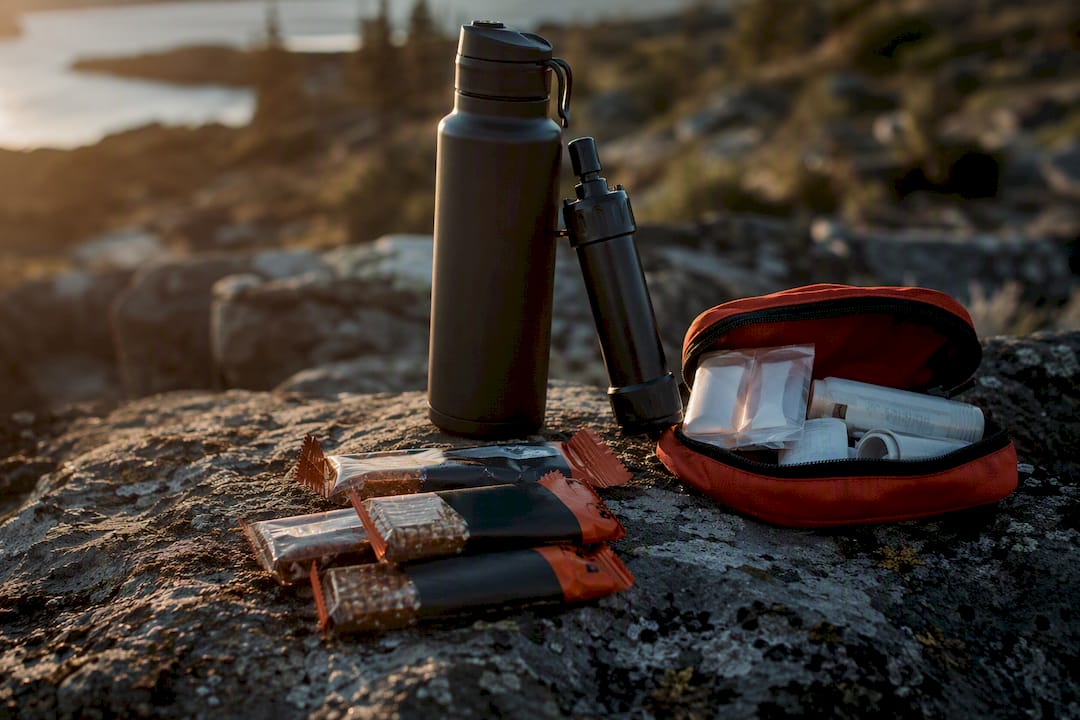
Priorities matter more than a long list. A GHB that tries to cover every possible scenario becomes too heavy to actually carry twelve miles, so rank items by what keeps you moving and alive first.
Must-haves:
- Water and a compact filter or purification tablets
- Calorie-dense, lightweight food (bars, freeze-dried meals)
- Broken-in walking shoes or a spare pair of socks and insoles
- Basic first aid kit plus any personal medications
- Paper map and compass as navigation backup
- Headlamp or flashlight with spare batteries
- A phone power bank
- One warm/weather layer suited to your climate
- Copies of ID and emergency contact info
- A multitool and duct tape
Nice-to-haves: a whistle for signaling, cash in small bills, a dust mask, work gloves.
Ready.gov’s guidance puts real numbers behind hydration: plan for one gallon of water per person per day if you’re stationary, though a GHB usually carries less volume paired with a filter since you’re moving, not sheltering. Rotate perishable food and check batteries every six months so nothing in the bag has quietly expired.
One legal note: some items marketed for “survivalist” or defensive use, certain blades, pepper spray formulations, or fixed-blade knife lengths, are restricted by state or municipal law. Check your local statutes before packing anything beyond a standard multitool, especially if your GHB rides in your vehicle across state lines.
How Big Should a Get Home Bag Be?
Size and weight decide whether your GHB is something you’ll actually carry or something that ends up in the trunk collecting dust. Most commuter-focused kits are sized to fit essentials without looking like a tactical loadout on your morning train.
Weight matters even more than volume. A widely cited rule of thumb keeps total pack weight under about 15 pounds for most commuters, since you may be walking that weight for hours on pavement, not trail. Longer commutes or rural distances can justify a slightly heavier load, but only if you’ve actually tested carrying it that far.
Where you store the bag matters as much as what’s in it:
- At the office: under your desk or in a locker, not buried in a supply closet.
- In your car: trunk-mounted, ideally with a truck rifle holder or similar mount keeping it accessible if you also carry a firearm.
- Daily carry variant: a slimmer, low-profile version you keep on you if your commute changes daily.
A low-profile pack beats a MOLLE-covered tactical rig here. You want something that reads as a normal backpack, not a target for questions or attention during a chaotic evacuation.
How Do You Customize a Get Home Bag for Your Life?
Survival instructors are blunt about this: there is no single perfect GHB checklist that fits everyone. Your bag needs to match your actual commute, environment, and body, not a generic list copied from a forum.
Start with a threat assessment specific to where you live and work:
- Weather extremes (heat, cold, flooding) along your route
- Wildfire smoke or air quality issues in your region
- Transit outages or infrastructure that fails predictably during storms
- Civil unrest or crowd density near your workplace
From there, map your route. Identify two or three alternate paths home, mark known water sources and safe rest points, and set a rally point at home your family already knows. Urban commuters tend to prioritize masks for smoke and cash for transit alternatives, while rural commuters need stronger navigation tools and more thermal protection for longer, exposed walks.
Personal factors change the math too: medications, kids or pets you might need to account for, and your own fitness level all cap how much weight you can realistically carry.
Pro Tip: Build your GHB with swappable modular pouches instead of a fixed layout. A pouch built for winter cold can rotate out for a summer heat pouch in ten minutes, so you’re not repacking the whole bag every season.
How Do You Test and Maintain a Get Home Bag?
A bag you’ve never opened since packing it is a bag full of assumptions. Field practitioners recommend testing gear under real conditions, not just checking it off a list.
- Rotate perishable food, medications, and batteries every six months.
- Inspect clothing layers and waterproof seals for wear or mildew.
- Run a timed grab-and-go drill: how fast can you actually get the bag and leave?
- Walk a portion of your planned route wearing the loaded pack to find fit problems or missing gear.
- Log the date of each check and swap in a small notebook kept inside the bag.
Skipping the walk test is the most common mistake. A bag that feels fine standing in your living room can chafe badly by mile four.
Starter Get Home Bag Checklist
Copy this baseline and adjust for your climate and commute:
- Water bottle plus filter/tablets
- Calorie-dense food (2 to 3 servings)
- Broken-in shoes or spare socks
- First aid kit and personal medications
- Paper map and compass
- Headlamp with spare batteries
- Phone power bank
- One weather-appropriate clothing layer
- Copies of ID and emergency contacts
- Multitool and duct tape
- $20 to $40 in small bills
Target under 15 pounds total, and keep the bag at work or in your vehicle, not at home. Screenshot this list or print it and store it with your family emergency plan.
Why a Get Home Bag Earns Its Place in Your Trunk
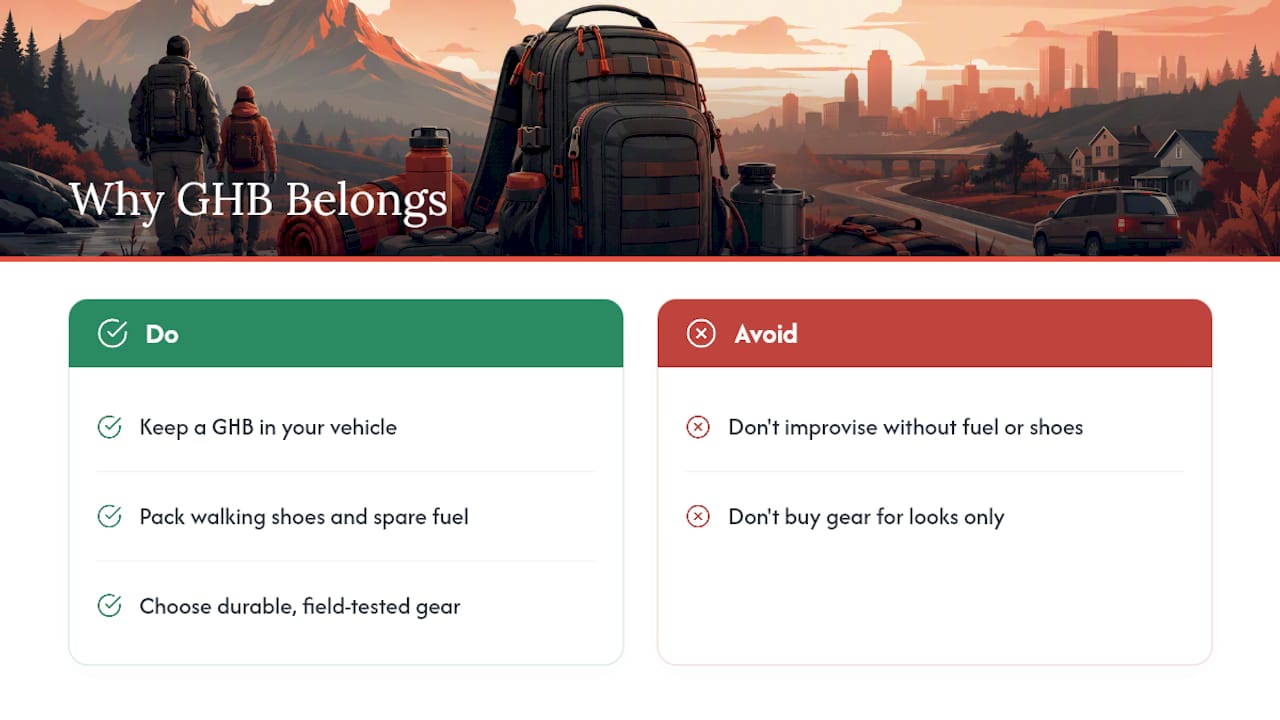
I keep a GHB in my truck year-round, not because I expect a specific disaster, but because the one time gridlock or a downed line strands me somewhere, I don’t want to be improvising with an empty gas tank and no walking shoes. The bag has sat unopened for months at a stretch. Then, it earned its weight the one week ice storms shut down half the roads near me.
Gear that survives real use matters more than gear that looks good on a shelf, which is part of why I trust Fs9tactical’s rifle cases and packs for anything that has to hold up outdoors.
Want a Ready-Made Starting Point Instead of Building From Scratch?
If assembling a GHB item by item sounds like a project you don’t have a weekend for, Fs9tactical built the 60-in-1 Tactical Emergency Kit as a preassembled baseline covering first aid, tools, and emergency basics in one pack.
It’s a starting point, not a finished product. A kit like this covers the core categories fast, but it doesn’t replace the customization your specific commute and route demand, and it definitely isn’t a substitute for a full bug-out bag if you need multi-day sustainment away from home. Rotate the perishables, test the fit on a real walk, and swap in gear suited to your climate the same way you would with a bag built from zero. For a durable pack to carry it all, the tactical gear bag in olive drab is a solid, low-profile option worth checking out today.
Sources
Recommended
- Defensive Gear Survivalist Kit: What You Need to Know – FS9 Tactical
- 60-in-1 Tactical Emergency Kit | Bug Out Kit | 72-Hour Survival | FS9 – FS9 Tactical
- Tactical Organizer + 60-in-1 Survival Kit Bundle | FS9 Sentinel – FS9 Tactical
- 35-in-1 Bug Out Kit | Compact Emergency Survival Kit | FS9 Tactical
