

What Rifle Case End Caps Actually Protect You From
End caps take the first hit, seal out water and dust, and stop your rifle from sliding around during transport. That’s the whole job in one sentence. Skip them or buy a case with flimsy ones, and you’re trusting your barrel, muzzle device, and optic zero to whatever the baggage handler decides to do with your case today.
Here’s how it works: the end cap sits at the terminus of the case, backed by foam and sealed against the shell with a gasket. A drop, a crush from stacked cargo, a shove into an overhead bin all channel force into that cap instead of your rifle’s stock or muzzle crown. When the cap and gasket are built right, that same junction also blocks rain, dust, and grit from reaching your finish and glass.
The end cap isn’t a cosmetic bumper. It’s the structural and environmental seal that decides whether your rifle survives a rough trip in usable condition.
- Impact protection: absorbs and redirects force away from the muzzle and stock
- Sealing: works with gaskets to block water and dust intrusion
- Structural support: reinforces the case shell at its weakest, most exposed points
When end caps are undersized, glued instead of molded, or missing a gasket entirely, they become the first thing to fail on a trip, not the last line of defense.
Key Takeaways
End caps function as a system with the gasket and foam cradle, and a case’s real-world durability depends on how well those three parts work together rather than any single component.
| Point | Details |
|---|---|
| End caps absorb and seal | They redirect impact force away from the muzzle and stock while sealing against dust and water at the gasket line. |
| Material choice matches use case | Rubber overmolds suit rough terrain; metal-reinforced composite suits frequent shipping and air travel. |
| IP67 is the benchmark | Look for a continuous gasket and pressure release valve to confirm a genuine IP67 rating. |
| Foam cradle reduces end-cap load | A snug foam fit with at least two inches of clearance stops shifting before it becomes an impact. |
| Fs9tactical reinforces the wear point | Fs9tactical builds reinforced stitching and ballistic fabric overlays into end panels as standard construction, not an upgrade. |
Table of Contents
- The Role of End Caps in Rifle Cases: How They Actually Protect Your Rifle
- What Materials Are Rifle Case End Caps Made From?
- What Do IP Ratings Mean for End Caps and Gaskets?
- How Do End Caps Hold Up During Shipping and Air Travel?
- Are Suppressor End Caps the Same as Rifle Case End Caps?
- Why the Foam Cradle Matters as Much as the End Caps
- How Do You Know When End Caps Need Repair or Replacement?
- What Should You Look for in End Caps Before You Buy a Case?
- How Fs9tactical Designs End Caps That Hold Up
- Heavy Duty or Lightweight: My Take After Years Around This Gear
- If You Want a Ready Solution: Fs9tactical Recommended Cases
- Frequently Asked Questions
- Sources
The Role of End Caps in Rifle Cases: How They Actually Protect Your Rifle
Every rifle case takes hits at the ends first. Set it down too hard, stack a duffel bag on top, or watch it tumble off a baggage cart, and the force lands on the shortest, most exposed surfaces of the case, which are the end panels. The role of end caps in rifle cases comes down to managing that force before it ever reaches your barrel, action, or optic.
A well-designed end cap doesn’t just block the blow. It spreads it. Think of it like a car bumper: the cap flexes or compresses slightly, transferring energy into the surrounding shell material and the foam packed behind it, rather than letting a sharp point of impact travel straight through to the rifle. Cheap caps skip this step. They’re rigid, thin, and poorly bonded to the shell, so an impact that should have been absorbed gets passed almost directly to whatever is sitting closest, usually the muzzle crown or a mounted scope.
The second function is sealing. On hard cases, the end cap edge meets a rubber or foam gasket that compresses when the lid closes, creating a barrier against water and dust. On soft cases, reinforced end panels combined with weather-resistant zippers and flaps do similar work, just with less absolute protection. Either way, the interface between cap and gasket is where leaks start if the fit is loose or the material has degraded.
Structural support is the quieter third job. End caps often tie into the case’s internal frame or ribbing, which keeps the shell from flexing or bowing under sustained pressure, like being crushed under other luggage for hours on a cargo hold. A case with weak end caps can develop a permanent bow at the ends over time, which throws off internal foam alignment and creates gaps where the rifle can shift.
Common failure modes to watch for:
- Seam failure where the end cap meets the shell, usually from repeated flexing or a factory bond that was never strong enough
- Gasket compression set, where rubber loses its memory after months of being squeezed shut and no longer seals tightly
- Hairline cracks in molded plastic caps from cold-weather brittleness or a hard drop
- Loosened rivets or screws at cap attachment points after repeated latch cycling
Pro Tip: Before you trust a case with an expensive rifle, press firmly on each end cap and flex it by hand. If it feels hollow, creaks, or shows visible give at the seam, that’s the spot that will fail first in the field. Also run a finger along the gasket line with the case closed. You should feel even, continuous contact, not gaps or thin spots.
Picture the cross section: outer shell, then the end cap forming the terminal wall, a gasket ring compressed between cap and lid, then the foam cradle holding the rifle itself. Each layer does a different job, but they only work as a system. A great gasket can’t compensate for a cracked cap, and thick foam can’t fix a seal that’s letting rain in from the start.
What Materials Are Rifle Case End Caps Made From?
End caps aren’t one-size-fits-all, and the material choice tells you a lot about what a case is actually built to survive. Four constructions dominate the market: injection-molded polymer, metal-reinforced composite, rubber or TPR overmolds, and sewn or padded soft-case end panels.
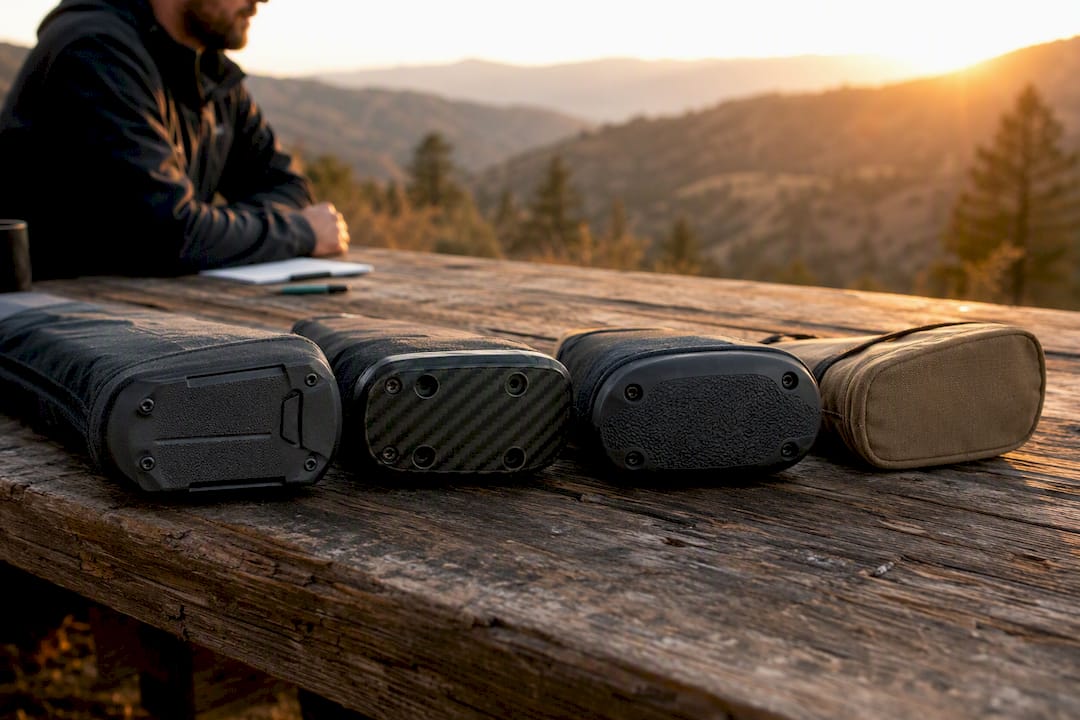
Injection-molded polymer is the standard on most hard cases because it’s light, cheap to produce, and resists impact reasonably well when the wall thickness is generous. The catch is consistency. A thin-walled polymer cap flexes too much under sustained pressure and can crack in cold weather, while a thick, well-ribbed one holds up for years.
Metal-reinforced composite caps add an aluminum or steel insert at the stress points, usually near hinge and latch attachments. This costs more and adds weight, but it solves the single biggest complaint with pure polymer caps: cracking at the fastener holes after repeated use.
Rubber and TPR (thermoplastic rubber) overmolds show up as a layer bonded over a rigid core, giving you the shock absorption of rubber with the structural backbone of hard plastic underneath. This hybrid approach shows up on premium hard cases and does the best job of both absorbing shock and sealing tightly against a gasket.
Sewn or reinforced soft-case end panels work differently since there’s no rigid cap at all. Instead, extra layers of ballistic fabric, foam padding, and bar-tacked stitching reinforce the end where the case naturally takes the most abuse from being set down or stacked. Soft-case ends are a documented frequent wear point, which is exactly why reinforcement there matters more than almost anywhere else on the case.
| Material | Pros | Cons | Best Use |
|---|---|---|---|
| Injection-molded polymer | Lightweight, low cost, decent impact resistance | Can crack in cold, wall thickness varies by brand | Range trips, everyday hard-case use |
| Metal-reinforced composite | Very strong at fastener points, long-term durability | Heavier, higher cost | Airline travel, frequent shipping |
| Rubber/TPR overmold | Excellent shock absorption, seals well against gaskets | Adds bulk and weight | Rough-field use, hunting in brush |
| Sewn/reinforced soft-case panel | Flexible, lighter overall case weight, easy to repair | Less crush protection than rigid caps | Short-distance transport, storage at home |
Which material fits your situation:
- Weekend range trips in a vehicle: standard injection-molded polymer is plenty
- Checked airline baggage or courier shipping: metal-reinforced composite or rubber overmold
- Hunting trips through brush, mud, and rough terrain: rubber/TPR overmold for shock absorption
- Home storage or short walks to the truck: a reinforced soft-case end panel works fine and saves weight
What Do IP Ratings Mean for End Caps and Gaskets?
If a hard case advertises an IP67 rating, that number tells you exactly two things: the first digit (6) means it’s fully dustproof, and the second digit (7) means it can survive brief submersion in water, typically up to one meter for around 30 minutes. This rating has become the industry gold standard for hard-side rifle cases, and it’s not a marketing throwaway number. It reflects a real pass/fail test.
End caps are half the reason a case earns that rating in the first place. The gasket does the sealing, but it only works if the end cap geometry holds it in the right position under even pressure across the entire perimeter. A warped cap, a shell that doesn’t sit flush, or a gasket channel that’s too shallow all create weak points where water finds its way in, usually right at the corners near the end caps rather than along the flat sides where pressure is easiest to maintain.
Many hard rifle cases on the market now pair IP67 waterproofing with pre-cut foam layers and pressure-equalization valves, which help the case equalize pressure changes during air travel without breaking the seal.
An IP67 rating on the box means nothing if the end caps don’t hold the gasket in constant, even contact around the entire seam.
How to verify a waterproofing claim before you buy:
- Look for a continuous gasket channel that runs the full perimeter, not a segmented one with gaps near the corners
- Check for a pressure release valve, since a sealed case without one can be difficult to open after altitude changes and may indicate a case that wasn’t designed with air travel in mind
- Test the latches by closing them and checking for even compression across the lid, not just tightness at one or two points
- Ask whether the rating was independently tested or is a self-reported spec, since not every manufacturer tests to the same standard
How Do End Caps Hold Up During Shipping and Air Travel?
Checked baggage gets stacked, dropped, and run through conveyor systems that weren’t designed with fragility in mind. Crush forces on a rifle case are rarely a single dramatic impact. More often it’s sustained weight from other bags piled on top for hours, combined with repeated smaller impacts as the case moves through sorting systems. This is exactly the scenario where reinforced end caps matter most, since hard cases with strong end caps are built specifically to survive this kind of handling, while soft cases are better suited to short-distance, everyday range transport where crush forces are minimal.
A case that survives being carried by hand can still fail on a conveyor belt, where sustained crush weight and repeated small impacts do damage that a single drop never would.
Packing checklist for travel or shipping:
- Add extra foam padding at both ends of the case, even if the factory foam looks adequate
- Keep the muzzle and stock away from direct contact with the end cap surface itself, floating them in foam instead
- Use internal tie-down straps to prevent the rifle from sliding forward and striking the end cap during a sudden stop or drop
- Pack accessories like bipods and slings separately so they don’t concentrate weight against one end
- Label the case clearly and use a courier or airline service that allows tracking for high-value shipments
A common real-world failure: a rifle with a suppressor mounted gets packed nose-first with only an inch of foam clearance at that end. A rough baggage drop compresses the foam, the suppressor tip strikes the end cap, and the impact transfers straight back into the barrel threads. That inch of missing clearance is the difference between a scuffed case and a bent thread.
Are Suppressor End Caps the Same as Rifle Case End Caps?
No, and mixing these up causes real confusion. A suppressor end cap is a performance component, either the front or rear cap of the suppressor itself, that affects sound reduction, gas flow, and baffle configuration. A rifle case end cap is a protective component on the case that has nothing to do with how your suppressor performs.
Do suppressor end caps make a difference to sound and function? Yes, but that’s a separate topic entirely from case protection. Suppressor manufacturers note that end caps change sound and performance characteristics, which is a mechanical and acoustic question, not a storage or transport one. If you’re researching suppressor end caps for performance reasons, you’re solving a different problem than the one this guide covers.
Where the two topics do intersect: if you transport a rifle with a suppressor attached, you need to measure the total length including the suppressor and make sure the case’s internal end cap clearance accounts for it. A rifle case sized for a bare barrel won’t leave enough room once a suppressor adds several inches to the overall length, and that mismatch is exactly what leads to muzzle strikes against the case’s end cap during handling.
Common questions on this topic:
Does a suppressor end cap protect the case? No. It’s a performance part on the suppressor, not a protective part on the case.
Can I ship a suppressed firearm in a standard rifle case? Where legal, yes, but you need extra internal clearance at the end cap to account for the suppressor’s added length.
Should I remove the suppressor before shipping? Many shooters do, both for length management and because some couriers have separate rules for firearms versus accessories. Check your carrier’s policy directly.
Why the Foam Cradle Matters as Much as the End Caps
End caps stop impacts at the ends. The foam cradle stops your rifle from moving at all, and movement is what actually causes most cosmetic and mechanical damage during transport. A rifle that’s free to shift inside the case will find every bump in the road and turn it into a scuff, a knocked-loose scope ring, or worse.
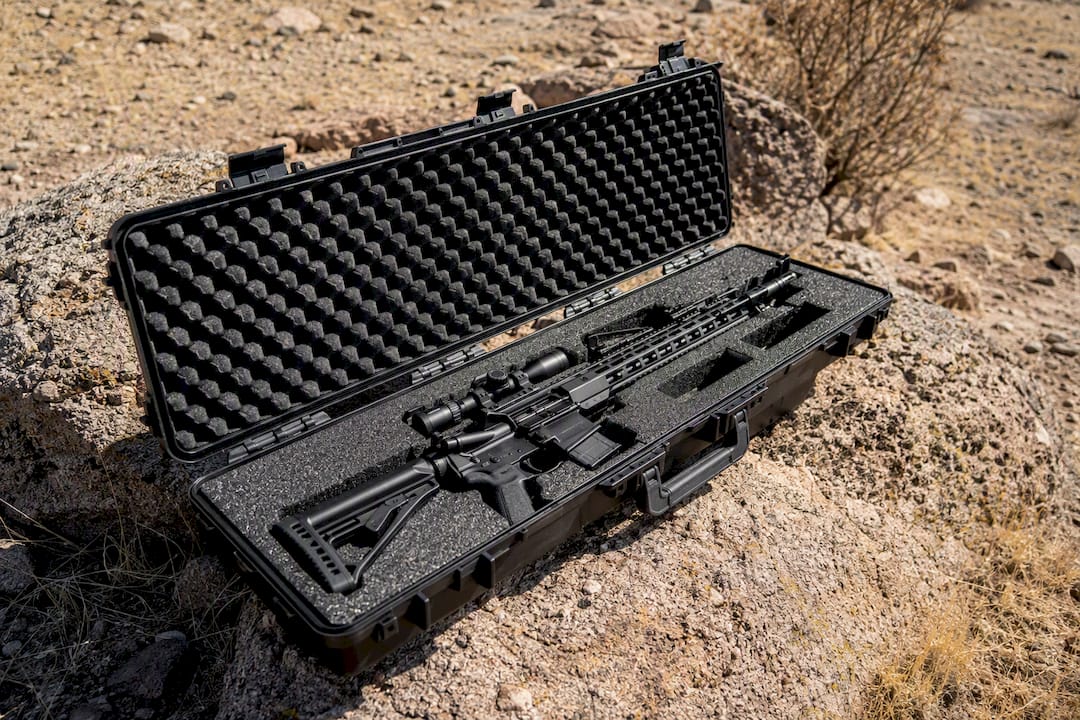
Two foam systems dominate the market. Pick-and-pluck foam comes pre-scored in a grid pattern so you pull out cubes to shape a custom cavity by hand. Custom CNC-cut foam is pre-shaped to your exact rifle and accessories, which fits tighter but costs more and locks you into one configuration. For a bolt-action hunting rifle with a fixed scope setup, CNC-cut foam is worth the investment. For shooters who swap optics or accessories often, pick-and-pluck offers more flexibility.
Building a secure cradle, step by step:
- Lay the rifle in the case and trace its outline, including any mounted optic or bipod
- Remove foam only where the rifle actually sits, leaving as much surrounding foam intact as possible for cushioning
- Test fit the rifle and check for lateral or vertical play, since even a quarter inch of gap allows shifting
- Add a thin foam layer or divider between the rifle and any accessories packed in the same case
- Close the lid and gently shake the case to confirm nothing shifts before you trust it with a real trip
Foam density guidance by setup:
- Standard bolt-action rifles: medium-density foam, roughly 1.7 to 1.8 pounds per cubic foot
- Rifles with mounted optics: higher-density foam around the scope area to prevent crushing the lens housing
- Multi-gun or accessory-heavy setups: layered foam systems with dividers between components
A tight foam cradle actually reduces the load your end caps have to absorb. When the rifle can’t move, it can’t gain momentum during a drop, and less kinetic energy reaches the end cap in the first place. The cradle and the end cap work as one system, not two separate features, and choosing a case with at least two inches of interior clearance around your rifle’s full length gives the foam room to do its job properly.
How Do You Know When End Caps Need Repair or Replacement?
End caps wear out quietly. There’s no single dramatic failure most of the time, just a slow accumulation of small compromises until one trip finally exposes the weakness. A regular inspection routine catches problems while they’re still cheap and easy to fix.
Run through this checklist every few months, or before any major trip:
- Check stitching around soft-case end panels for loose threads or separated seams
- Press on hard-case end caps and listen for creaking or feel for flex that wasn’t there when the case was new
- Inspect the gasket for flat spots, cracks, or a permanent compressed shape that no longer springs back
- Look at attachment points, screws, rivets, or bonded seams, for any sign of loosening or gap formation
A worn gasket that’s lost its spring needs replacement, not a patch. Compression set is permanent once rubber loses its memory, and no amount of adjustment brings the seal back. A cracked polymer cap is a similar line in the sand. Small surface scratches are cosmetic, but any crack that runs through the material compromises the structural job the cap is supposed to do.
Field repairs exist for emergencies, not long-term fixes. Duct tape or a zip tie can hold a loose end panel together long enough to finish a hunting trip, but treat that as a signal to replace the part the moment you’re home. Shooters and case owners regularly search forums for replacement end-cap parts, which tells you repair demand is real and manufacturers who offer replacement parts have an edge over ones who don’t.
Pro Tip: Store your case upright or flat, never with heavy items stacked directly on the end caps for extended periods. Compression over months, not just single impacts, is what flattens gaskets and deforms caps before their time.
What Should You Look for in End Caps Before You Buy a Case?
Buying a case without checking the end caps closely is like buying a car without checking the brakes. Here’s what actually separates a case that protects your rifle from one that just looks like it will.
Run through this checklist at the point of purchase:
- Reinforced rims where the end cap meets the shell, not a thin, single-layer bond
- A continuous gasket running the full seal perimeter, with no visible gaps at the corners
- Over-molded end panels on soft cases, or metal reinforcement inserts on hard cases at stress points
- Foam cradle compatibility, meaning enough interior clearance for your specific rifle and any mounted accessories
Questions worth asking the seller or checking on the product page:
- What IP rating does the case carry, and was it independently tested?
- What foam type and density comes standard, and is it replaceable?
- Does the warranty cover cracked end caps or failed gaskets specifically?
- What materials make up the end cap: solid polymer, reinforced composite, or overmolded rubber?
A case that skips detail on its end-cap construction on the product page is usually a case where that detail wouldn’t help the sale.
Red flags that should make you walk away:
- Thin panels that flex noticeably under light hand pressure
- Seams that appear glued rather than stitched, molded, or riveted
- No visible gasket at all on a case marketed as weatherproof
- No pressure release valve on a fully sealed hard case, which often means it wasn’t tested for altitude changes
Weighing trade-offs comes down to your actual use case. A hunter working rough terrain in variable weather should prioritize protection and sealing over shaving a pound of weight. A range shooter making short trips from the truck to the firing line can prioritize lighter materials and accept a slightly lower crush rating. Neither choice is wrong, but neither is universal either. For a deeper side-by-side on when a rigid shell earns its weight versus when a padded soft case is the smarter call, this hard versus soft case buying guide walks through the trade-offs in more depth.
How Fs9tactical Designs End Caps That Hold Up
Fs9tactical builds end caps around one principle: the end of the case takes more abuse over its lifetime than any other part, so it gets treated as a stress point from the design stage, not an afterthought bolted on at the end of production. That means reinforced stitching at every seam near the end panels, ballistic fabric overlays where the case is most likely to be set down or dropped, and gasket seating that’s checked for even compression before a case ships.
Foam compatibility factors into every configuration decision Fs9tactical makes. An end cap that’s structurally sound but paired with foam that lets the rifle shift is still a failure, since the two systems only work together. That’s why Fs9tactical designs its interior cradles and end reinforcement as one connected system rather than two separately engineered parts.
Reinforced stitching and ballistic fabric overlays at the ends aren’t upgrades. They’re the baseline, because that’s where a case fails first if it fails at all.
Different use cases call for different configurations. Hunters working brush and rough terrain benefit from heavier abrasion-resistant overlays at the ends. Range shooters making frequent short trips can lean toward lighter builds without sacrificing much real-world durability. Anyone flying with a rifle should prioritize the most reinforced end-cap configuration available, since airline baggage handling is the single roughest environment most cases ever face.
Pro Tip: Ask about warranty coverage on stitching and end-panel seams specifically, not just the case as a whole. A manufacturer confident in its end-cap construction will back it explicitly, not just bundle it into a vague general warranty.
Heavy Duty or Lightweight: My Take After Years Around This Gear
Most shooters overcorrect in one direction or the other. They either buy the heaviest, most armored case available for a rifle that never leaves the truck, or they go ultralight on a case meant for airline travel and regret it the first time a bag gets stacked on top.
My rule: match the end cap to the worst realistic scenario, not the average one. If you fly with your rifle even once a year, buy the reinforced case. You’ll use that protection exactly when you need it most and won’t remember the extra weight the other 51 weeks. If your rifle lives in a truck rack and the case only sees a soft ride to the range, don’t pay for armor you’ll never test.
The one field-tested habit that’s saved me real money: check the gasket seating every single time before a trip, not just when something feels off. A gasket that’s shifted half a millimeter out of its channel looks fine at a glance and fails completely the first time it rains.
If You Want a Ready Solution: Fs9tactical Recommended Cases
Fs9tactical builds soft rifle cases with reinforced end panels and ballistic fabric overlays specifically because that’s where cases fail first, not as an added feature you pay extra for. If everything in this guide has you rethinking whether your current case actually protects the ends where it matters, that’s the exact gap Fs9tactical’s construction closes.
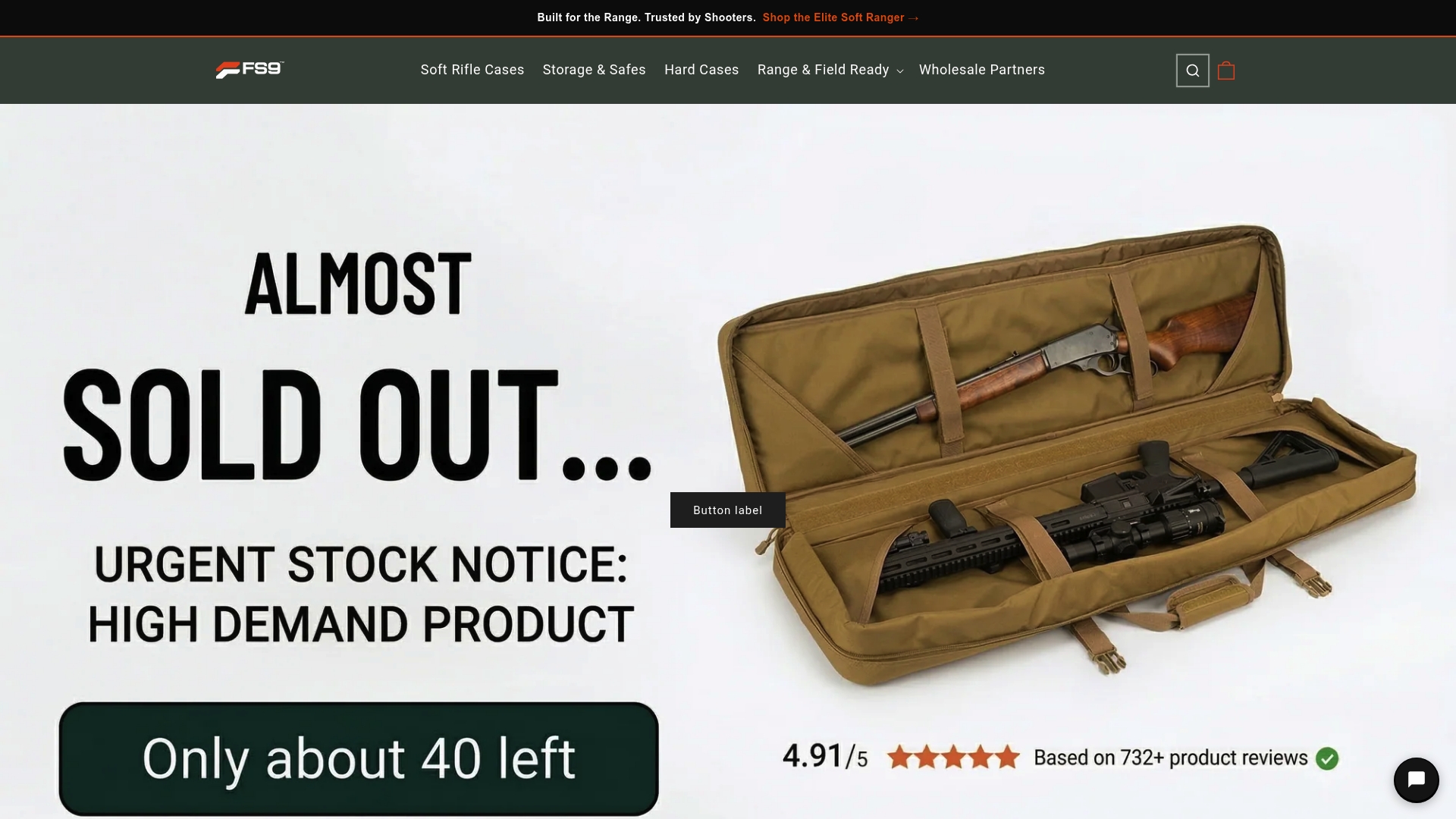
For range trips and everyday transport, a padded soft case with reinforced stitching at the ends handles the job without the extra weight of a hard shell. If you’re also organizing range gear, ammo, and accessories alongside the rifle itself, a tactical gear bag built with the same reinforced construction keeps everything protected in one system rather than scattered across mismatched bags. Check current sizing and configuration options on the product page, and pick the setup that matches how often you’re actually on the move with your rifle.
Frequently Asked Questions
Do end caps really matter on a soft rifle case, or just hard cases? They matter on both. Soft-case end panels take the same repeated impact and setting-down abuse as hard-case caps, just without a rigid shell to spread the force, which is why reinforced stitching there matters even more.
Can a cracked end cap be repaired instead of replaced? A minor surface crack that doesn’t run through the material can sometimes be reinforced temporarily, but any crack compromising structural integrity means the cap needs replacement, not a patch.
Does an IP67 rating apply to soft rifle cases too? No, IP ratings are almost exclusively used for hard-shell cases with sealed gaskets. Soft cases rely on water-resistant fabric treatments and flap design instead, which offer less protection than a true sealed rating.
How often should I inspect my case’s end caps? Check them before any major trip and at least every few months during regular use, paying close attention to gasket seating and any new flex or cracking in the cap material.
Are suppressor end caps relevant to rifle case buying decisions? Only indirectly. If you transport a suppressed rifle, you need extra internal length clearance in the case, but the suppressor’s own end caps are a separate performance component unrelated to the case’s protective features.
Sources
- How do you choose the right rifle case for your firearm? - HUSK Cases %
- End caps FAQ | Silencer Shop
- Soft Rifle Cases And Custom Rifle Bags For Brands
Recommended
- Anatomy of a Perfect Soft Rifle Case: Safeguarding Your Firearm in Sty – FS9 Tactical
- Inside Out: Exploring Features of High-Quality Soft Rifle Cases – FS9 Tactical
- Rifle Case Maintenance: Best Practices for Gun Owners – FS9 Tactical
- Hard vs. Soft Rifle Cases: Pros, Cons & Buying Guide | FS9 Tactical
