

How to Organize Multiple Rifles in One Case
The best way to organize multiple rifles in one case is a purpose-built multi-rifle hard case with precision-cut closed-cell foam sized to each rifle’s overall length and optics clearance. That combination protects finishes, prevents contact between guns, and survives airline handling without drama.
Pros:
- Optics and finishes stay protected from contact and shock
- Everything travels as one organized, lockable unit
Con: Hard multi-rifle cases run heavy and take up real trunk space.
Budget or stationary alternative: A double soft rifle case or a safe retrofit system works well for range trips and home storage where airline-level protection isn’t needed.
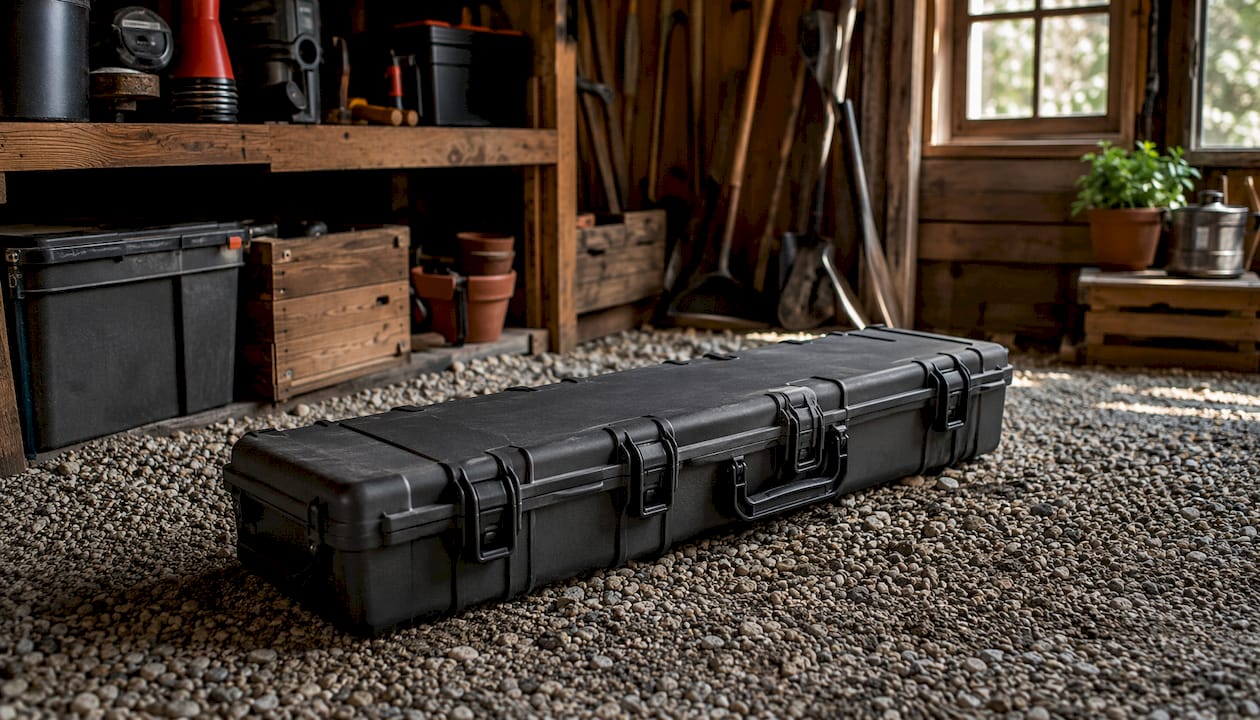
Table of Contents
- What type of case should you use for multiple rifles?
- How do you measure rifles to pick the right case size?
- Which foam type actually protects your rifles and optics?
- How to pack multiple rifles in one case without damage
- DIY and budget approaches: what works and what doesn’t
- What are the best stationary storage alternatives for multiple rifles?
- U.S. transport and security basics for multiple rifles in one case
- How to prevent rust and moisture damage in a shared rifle case
- Why Fs9tactical multi-rifle cases solve the problems above
- Key Takeaways
- The case most shooters overlook
- Fs9tactical has the right case for your rifles
- Useful sources and further reading
What type of case should you use for multiple rifles?
Two case classes dominate the multi-rifle market: hard-shell cases and soft multi-gun bags. Choosing between them comes down to how you’re moving the rifles and what you’re protecting.
Hard-shell multi-rifle cases use injection-molded shells, IP67-rated waterproofing, pressure equalization valves, and custom foam to lock rifles in place. They’re built for airline checked baggage, long-haul shipping, and any situation where the case might get thrown, stacked, or rained on. If you’re flying with scoped rifles, this is the only sensible choice.
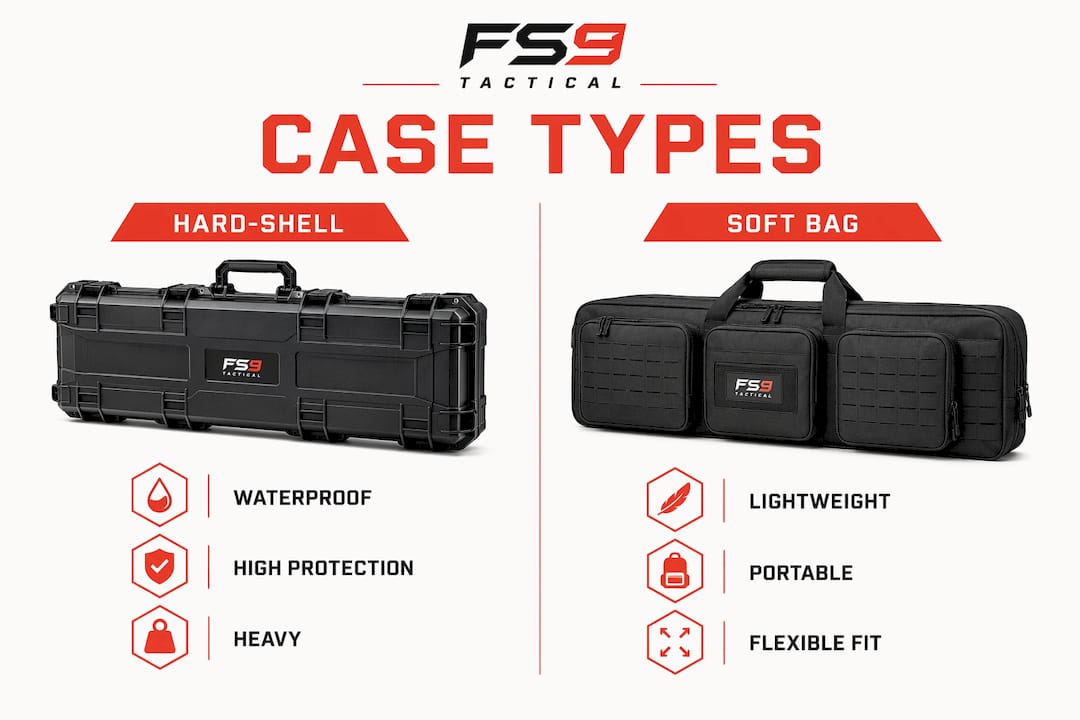
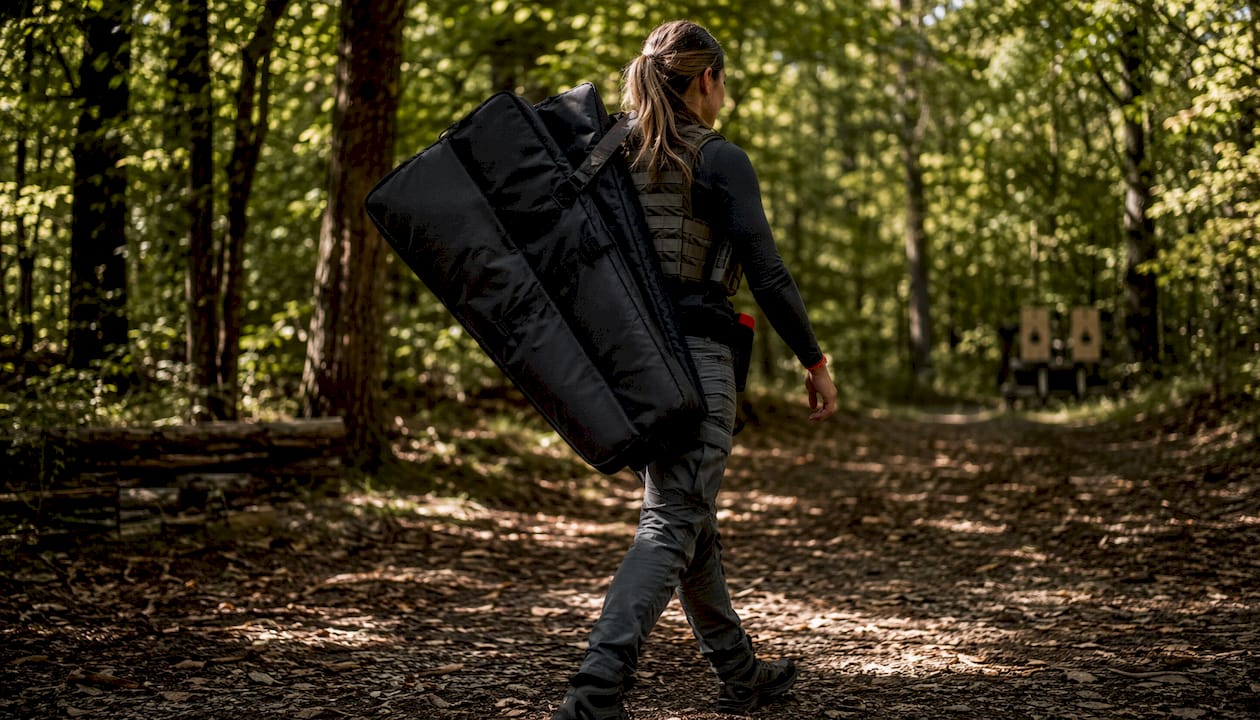
Soft multi-gun bags are lighter, easier to carry over a shoulder, and fit behind a truck seat or in a range bag pile. They sacrifice crush resistance for convenience. The weather-resistant construction on quality soft cases handles rain and dust well, but they won’t protect against a hard drop the way a molded shell does.
A quick decision guide:
| Situation | Best case type |
|---|---|
| Airline travel with optics | Hard-shell, IP-rated |
| Range day with two rifles | Double soft case |
| Long-term vehicle storage | Soft case or hard case |
| Institutional / armory use | Steel rack or modular system |
For most shooters flying or shipping rifles, a hard case wins. For two rifles headed to the range, a quality double soft rifle case is faster and lighter.
How do you measure rifles to pick the right case size?
Barrel length alone will get you a case that won’t close. The measurement that matters is overall length (OAL), which includes everything attached to the rifle.
- Measure OAL with muzzle device installed. Run a tape from the muzzle brake or suppressor mount to the end of the butt plate. That’s your minimum interior length requirement.
- Add clearance for each rifle. Allow 1–2 inches beyond OAL for muzzle devices and buffer. For the longest rifle in the case, measure first and build the rest of the layout around it.
- Measure optic height. Run a tape from the bore centerline to the top of the highest point on the optic (usually the objective bell or a tall scope cap). Add 0.5–1 inch of clearance above that.
- Check folded vs. extended stock dimensions. Folding-stock rifles pack shorter but may be wider at the hinge. Note both dimensions.
- Record accessory clearances. Bipods, angled foregrips, and extended charging handles all add width or height. Measure them before ordering foam.
Product pages for multi-rifle cases list interior dimensions like a 41.50" interior length — verify your longest rifle fits with room to spare before buying. A case that’s 1 inch too short is useless.
Which foam type actually protects your rifles and optics?
Not all foam is equal, and the difference shows up fast when a scoped rifle gets dropped in transit.
Pluck foam (the grid-scored blocks common in budget cases) lets you pull out cubes to shape a rough cavity. It’s fast and cheap. The problem: irregular edges create contact points, and open-cell foam absorbs moisture and oil, which accelerates corrosion on metal surfaces over time.
Pick-and-pluck foam is a refined version with smaller, more precise cubes. Better fit than standard pluck foam, but still open-cell and still prone to moisture retention in sealed cases.
Precision-cut closed-cell polyethylene (CPE) foam is the standard for serious transport. Manufacturers specify closed-cell foam for long-term protection because it resists moisture and oil, won’t abrade finishes, and absorbs impact without compressing permanently. Custom-cut cavities cradle each rifle exactly, leaving clearance for scope turrets and muzzle devices without contact.
| Foam type | Moisture resistance | Abrasion risk | Impact absorption | Longevity |
|---|---|---|---|---|
| Standard pluck foam | Low | Medium | Medium | 2–3 years |
| Pick-and-pluck foam | Low–Medium | Medium | Medium | 3–4 years |
| Closed-cell CPE foam | High | Very low | High | — |
Pro Tip: Place a reusable desiccant canister in a corner cavity of the foam, not loose in the case. Loose desiccant rattles against rifles. A foam pocket keeps it stationary and positioned where moisture collects.
How to pack multiple rifles in one case without damage
A consistent packing sequence prevents the contact damage that happens when you just lay rifles in and close the lid.
- Start with the longest rifle. Place it in the lowest or primary cavity first. Every other rifle and accessory gets arranged around it.
- Orient muzzles in alternating directions when packing two or more rifles side by side. Muzzle of rifle 1 toward the hinge, muzzle of rifle 2 toward the latch side. This balances weight and reduces optic-to-optic interference.
- Use foam wedges or padded separators between rifles. No two guns should touch metal to metal. A 0.5-inch foam strip between receivers is enough.
- Secure with internal straps or tie-downs. Most quality cases include straps that cross the stock and forend. Cinch them snug but not tight enough to stress a folding stock.
- Place magazines and accessories in dedicated cavities. Loose magazines rattling against a scope is a fast way to scratch glass. Cut or designate separate foam pockets for mags, cleaning kits, and optics.
- Verify all firearms are unloaded before packing. Check the chamber visually and physically on every rifle. This isn’t a reminder for experienced shooters — it’s a non-negotiable step before closing any case.
Pro Tip: Before your first trip, do a dry run: pack the case, close it, pick it up, and shake it gently. If you hear movement, something isn’t secured. Find it before the airline does.
For more on safe soft-case handling, Fs9tactical’s guide covers carry technique and weight distribution in detail.
DIY and budget approaches: what works and what doesn’t
Low-cost solutions can work for short local transport. They fall apart fast in anything more demanding.
Common DIY approaches:
- Blanket roll with tie-downs: Wrap each rifle in a moving blanket, roll them together, and secure with ratchet straps. Works for a 20-minute truck ride. Provides zero crush protection and no accessory separation.
- Pluck-foam retrofit in an existing hard case: Pull the stock foam, buy sheet pluck foam, and cut cavities by hand. Inexpensive and functional for rifles without tall optics. Moisture retention is the main long-term risk.
- Sheet foam pockets: Cut inexpensive closed-cell sheet foam (available at hardware stores) into rifle-shaped strips and layer them as separators inside a large soft case.
Risks and limits:
- Poor impact absorption in blanket rolls means a single hard bump can shift a rifle into another
- Open-cell foam traps moisture in sealed cases, especially during temperature swings
- No accessory separation means magazines and cleaning kits contact rifle finishes
- DIY setups rarely meet airline or carrier requirements for firearm transport
DIY is acceptable for short local transport and temporary home storage. Avoid it for airline shipping, long-haul transport, or any case holding high-value optics. The cost of a scratched scope or a dented receiver exceeds the cost of proper foam every time.
What are the best stationary storage alternatives for multiple rifles?
When rifles live in one place, a travel case is the wrong tool. Fixed-location storage prioritizes capacity, access speed, and security over portability.
Retrofit systems for safes and cabinets are the fastest upgrade. Rifle-rod-style systems and hook-and-loop stabilizers can increase long-gun capacity by up to 50% by eliminating the angled wasted space that standard safe racks create. Rifles stand upright, non-abrasive supports protect finishes, and you can fit multiple rows in a cabinet that previously held half as many guns.
Modular steel racks serve institutional and armory needs. Swing-gate and expandable weapon racks use all-welded steel construction, multi-point locking, and can be bolted to floors or walls. They stack side-to-side and back-to-back, making them the right answer for police stations, ranges, and secure rooms that need to store dozens of rifles with controlled access.
Fast-access secure storage trades some containment depth for retrieval speed. Systems like the SecureIt Fast Box store up to four rifles in a cradle-grid layout optimized for immediate access. These are built for defensive readiness, not long-term archival storage.
Pro Tip: For a home setup that covers both bases, pair a fast-access cradle system for your two most-used rifles with a retrofit-equipped safe for the rest. You get quick retrieval where it matters and organized long-term storage for everything else.
U.S. transport and security basics for multiple rifles in one case
Moving multiple rifles across state lines or through an airport adds a layer of requirements that the case itself can’t handle for you.
Locking options matter more than most buyers realize. Hard cases need padlocks through the latch holes. TSA-accepted locks are required for airline checked baggage — TSA agents can open them without destroying the lock. Standard padlocks work for vehicle and ground transport. Integrated latch locks on some cases add convenience but don’t replace padlocks for airline compliance.
Airline transport basics: Declare firearms at check-in, unloaded and in a locked hard case. Most carriers impose weight limits on checked bags (typically 50 lbs), and a loaded multi-rifle case with optics can approach that limit fast. Weigh the packed case before you leave home. Ammunition must be in a separate, manufacturer-approved container — it cannot share the rifle case.
State-to-state transport: Federal law under the Firearm Owners Protection Act provides a safe-harbor provision for interstate transport, but individual states impose their own rules on how firearms must be stored in a vehicle. Some states require the case to be in the trunk, inaccessible to the driver. Others have magazine-capacity restrictions that apply the moment you cross the border. Check the destination state’s laws before you leave, not after you arrive.
A case label that says “TSA compliant” or “airline approved” is a marketing claim, not a legal guarantee. Verify requirements directly with your carrier and the destination state’s statutes.
How to prevent rust and moisture damage in a shared rifle case
Sealed waterproof cases are excellent at keeping water out. They’re equally good at trapping moisture inside, which is a problem when temperature changes cause condensation on cold metal surfaces.
Desiccant placement: Use reusable silica gel or calcium chloride canisters, not loose packets. Place one canister per rifle cavity, positioned in a foam pocket away from metal contact. Recharge or replace them on the schedule the manufacturer specifies — a saturated desiccant does nothing.
Routine maintenance checklist:
- Wipe down all metal surfaces with a lightly oiled cloth before packing
- Inspect bores after any storage period longer than two weeks
- Check optic lenses for fogging or moisture intrusion
- Store cleaning kits in a separate foam cavity, not loose against rifle finishes
Pro Tip: When you arrive at your destination after a flight or long drive, open the case and let it breathe for 15–20 minutes before handling the rifles. Temperature changes during transit create condensation on cold metal. Airing the case before you reach into it prevents moisture from transferring to your hands and then to the rifles.
Why Fs9tactical multi-rifle cases solve the problems above
Fs9tactical builds its multi-rifle cases around the exact problems this guide covers: OAL fit, foam quality, carry options, and lockability.
- Interior length options: Fs9tactical offers 36" and 48" soft double cases sized for standard and long-barreled rifles, with interior dimensions listed on each product page so you can verify fit before buying.
- Foam and padding: Cases use high-density padding and closed-cell foam construction that resists moisture and protects finishes without abrasion, consistent with the CPE foam standard covered earlier.
- Lockable zippers and latches: Every case includes lockable zipper pulls or latch points compatible with standard padlocks, meeting the basic requirement for vehicle and ground transport security.
- Carry features: Padded shoulder straps, reinforced handles, and MOLLE-compatible exteriors let you configure carry for range trips, vehicle stowage, or foot movement.
- Hard-case option: The IP67-rated hard case with pre-cut foam and wheels covers airline transport and long-haul shipping with pressure equalization and dust-tight construction.
Fs9tactical’s buyer’s guide for double rifle cases walks through fit, foam, and carry decisions in detail, making it a useful companion to the steps in this guide.
Key Takeaways
A purpose-built multi-rifle case with closed-cell foam, verified OAL measurements, and desiccant control is the most reliable way to transport and store multiple rifles safely.
| Point | Details |
|---|---|
| Measure OAL, not barrel length | Include muzzle devices, fixed stocks, and optic height before choosing any case. |
| Choose foam by use case | Closed-cell CPE foam protects finishes and resists moisture; avoid open-cell pluck foam for long-term storage. |
| Pack with separators and straps | No two rifles should touch metal to metal; use foam wedges and internal straps to prevent movement. |
| Control moisture actively | Place reusable desiccant canisters in foam pockets and air the case at your destination after transit. |
| Fs9tactical case options | Fs9tactical’s 36"/48" soft double cases and IP67 hard case cover range, vehicle, and airline transport needs. |
The case most shooters overlook
Most multi-rifle packing mistakes aren’t about the case. They’re about the measurement step that gets skipped. Shooters buy a case based on barrel length, pack it, and discover the muzzle brake adds 2 inches they didn’t account for. The case won’t close, or it closes with the muzzle device pressing against the foam wall with no clearance.
The second mistake is treating foam as a one-time decision. Pluck foam degrades, absorbs oil, and starts holding moisture against metal surfaces within a couple of years. Swapping to closed-cell CPE foam is a $30–$60 upgrade that extends case usefulness by years and actually protects a $1,500 optic the way it should be protected.
For most shooters who want one case that handles range days and occasional travel, a quality double soft case with lockable zippers and padded dividers covers 90% of real-world use. Reserve the hard-shell IP67 case for airline travel and long-haul shipping where the case will be handled by people who don’t know what’s inside. Fs9tactical’s lineup covers both ends of that spectrum without overbuilding for the use case you actually have.
Fs9tactical has the right case for your rifles
Carrying two or more rifles used to mean improvising with blankets and bungee cords. Fs9tactical’s purpose-built multi-rifle cases eliminate that entirely. The tactical gear bag handles accessories and range kit, while the double soft cases and IP67 hard case cover every transport scenario from a local range day to checked airline baggage.
The IP67 hard case ships with pre-cut foam, wheels, and lockable latches ready for airline declaration. The 36" and 48" soft double cases fit most standard and long-barreled rifle configurations with room for optics and accessories. Both are built with ballistic fabrics, reinforced stitching, and the kind of hardware that doesn’t fail on the third trip. Browse Fs9tactical’s full rifle case lineup and check interior dimensions against your OAL measurements before you buy.
Useful sources and further reading
- IEC IP ratings reference — Defines IP67 and related waterproof/dust-tight standards referenced in the hard-case section.
- Multi-rifle case interior dimensions example — Shows how manufacturers present interior length and OAL fit data; supports the measurement section.
- Closed-cell foam and optic protection — Product-level example of closed-cell polyethylene foam specifications and moisture resistance claims.
- Rifle-rod retrofit systems for safes — Source for the up-to-50% capacity increase claim in the stationary storage section.
- Dasco modular steel armory racks — Institutional swing-gate and expandable rack specifications cited in the stationary storage section.
- SecureIt Fast Box fast-access storage — Source for cradle-grid, mission-ready retrieval design referenced in the stationary storage section.
- Fs9tactical double rifle case buyer’s guide — Fs9tactical’s own guidance on fit, foam, and carry decisions for two-rifle setups.
- Fs9tactical IP67 hard rifle case — Product page with specifications for the hard-case option recommended in this guide.
