

TSA Approved Gun Case Locks: What You Actually Need
TSA-approved locks are not legally required for firearm cases. What the law actually demands is a locked, hard-sided container that cannot be opened during transit, with the passenger keeping the key or combination. Most experienced travelers skip the Travel Sentry padlocks entirely on their gun cases and go straight to heavy-duty keyed locks with hardened shackles. The logic is simple: Travel Sentry locks give TSA a master key, and for a firearm case, exclusive access control is the whole point.
The short version: Lock your hard case with one heavy-duty padlock per latch, declare the firearm at the ticket counter, keep every key on your person, and never put keys in checked luggage. Travel Sentry locks are allowed but not required — and for most firearm travelers, non-TSA locks are the smarter call.
Quick actions before you read further:
- Confirm your case is hard-sided and cannot be pried open
- Install one lock per latch (keyed, heavy-duty)
- Keep all keys or combinations in your carry-on or on your person
- Declare the firearm at check-in before the bag goes to the belt
Key Takeaways
TSA requires a locked, hard-sided container with the passenger retaining the key — not a Travel Sentry lock — making heavy-duty non-TSA padlocks the preferred choice for most firearm travelers.
| Point | Details |
|---|---|
| Legal requirement | A locked, hard-sided container with passenger-held key or combination — Travel Sentry branding is not required by law. |
| Lock strategy | Use one heavy-duty keyed padlock per latch; non-TSA locks give you exclusive access control. |
| Case matters as much as the lock | A pry-resistant hard case with strong latch points is the foundation; a strong lock on a weak case fails. |
| Declaration is mandatory | Declare the firearm at the ticket counter before check-in; never attempt kiosk check-in with a firearm. |
| Fs9tactical case option | Fs9tactical’s lockable rifle cases feature reinforced lock points and foam interiors designed to work with standard padlocks and mono-shaft locks. |
This article is general information, not a substitute for advice from a qualified lawyer. Consult a qualified legal professional about your own circumstances before acting on anything here.
Table of Contents
- What do TSA rules actually require for transporting firearms?
- Are Travel Sentry locks required or recommended for gun cases?
- Which lock types work best for gun cases?
- How to lock and check your firearm at the airport
- How to choose the right case and lock together
- Common mistakes that cause problems at the airport
- How to verify a lock is genuinely TSA-certified
- Have TSA policies on firearm transport changed recently?
- What experienced travelers with firearms actually do
- Fs9tactical cases are built for exactly this kind of travel
- Sources
What do TSA rules actually require for transporting firearms?
TSA requires that all firearms travel unloaded, in checked baggage only, inside a locked hard-sided container. The container must stay locked throughout transit, and only the passenger should retain the key or combination unless TSA specifically requests access. That last clause matters more than most travelers realize.
For ordinary checked luggage, Travel Sentry locks are the norm because TSA agents can open and relock them without cutting. Firearm cases flip that dynamic. The regulation explicitly keeps access control with the passenger. TSA may request your key or combination to inspect the case, but the default expectation is that you hold it exclusively.
What TSA can and cannot do at inspection:
- TSA may ask you to open the case or provide the combination for inspection
- If you are present, you can supervise the inspection and relock the case yourself
- If TSA cannot access a locked firearm container and you are unavailable, they may cut the lock
- After inspection, TSA will relock the case if the lock allows it; Travel Sentry locks make this easier, non-TSA locks may be cut if TSA cannot open them
Statistic callout: According to TSA guidance, the container used at the time of purchase may not be adequate for checked transport. A case that came with your firearm from the manufacturer is not automatically compliant.
Airlines layer their own rules on top of TSA’s. Check your carrier’s policy on ammunition, case dimensions, and declaration procedures before you fly. Some airlines charge a fee for declared firearms; others do not.
Are Travel Sentry locks required or recommended for gun cases?
No. Travel Sentry locks are permitted, not required. The law says “locked hard-sided container” — it says nothing about the Travel Sentry logo. USCCA advises using a hard-sided lockable case that cannot be pried open, and notes that many firearm owners specifically prefer non-TSA locks so only the passenger retains access.
Pros of Travel Sentry locks on a gun case:
- TSA can open and relock without cutting, reducing damage risk during unsupervised inspections
- Useful when you cannot be present at inspection
- Widely available and inexpensive
Cons of Travel Sentry locks for firearms:
- TSA master keys exist and have leaked publicly in the past, meaning the lock is not truly exclusive
- Cut resistance is generally lower than heavy-duty gun-case padlocks
- Undermines the access-control principle that firearm transport rules are built around
The decision rule: If you can supervise every inspection and want maximum control, use non-TSA heavy-duty locks. If you are worried about TSA cutting your lock during an unsupervised inspection, Travel Sentry locks reduce that risk — but pair them with a genuinely strong case, because the lock alone is not the security.
Pro Tip: A practical middle path: use a heavy-duty non-TSA keyed lock on each primary latch, and if your case has an auxiliary attachment point, a small Travel Sentry lock there can signal cooperation to TSA without surrendering primary access control.
Which lock types work best for gun cases?
Four categories cover most situations. Each has a different trade-off between cut resistance, TSA compatibility, and fit with common gun-case latch designs.
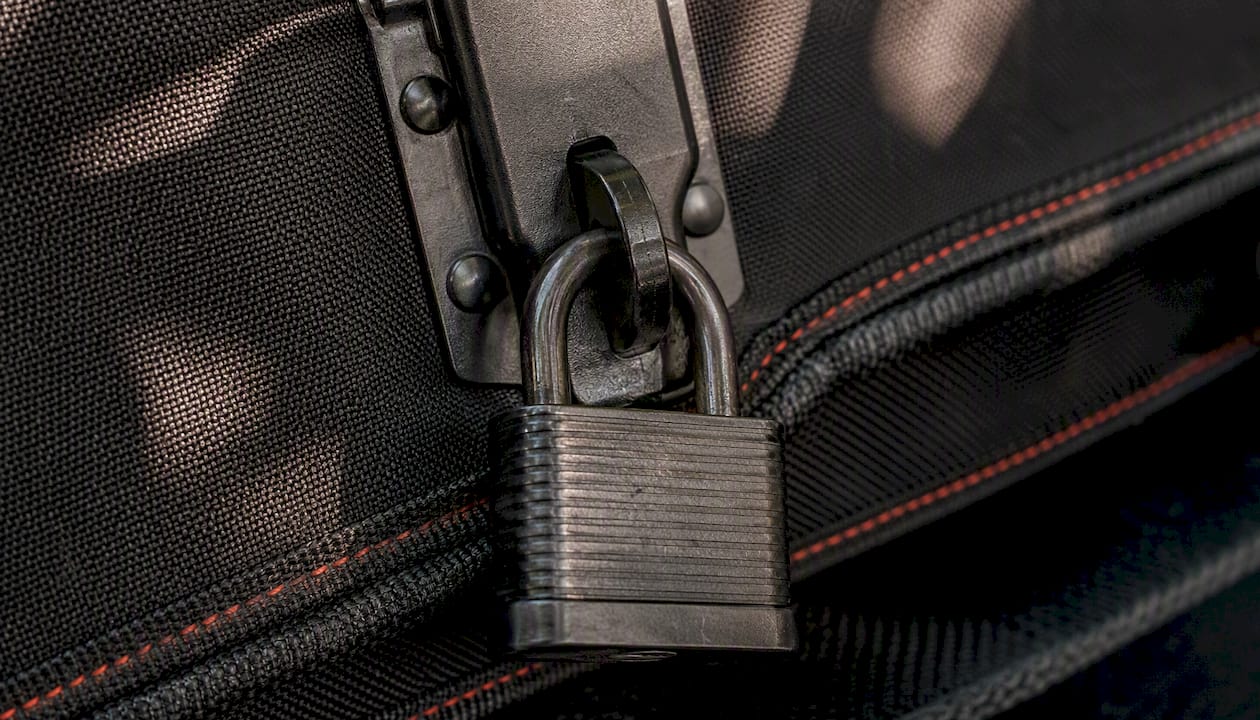
Heavy-duty keyed padlocks are the most common choice among experienced travelers. Look for a hardened steel shackle at least 5/16 inch (8mm) in diameter, boron carbide or hardened steel construction, and a double-locking mechanism. These offer the best cut resistance and keep access exclusively with you.
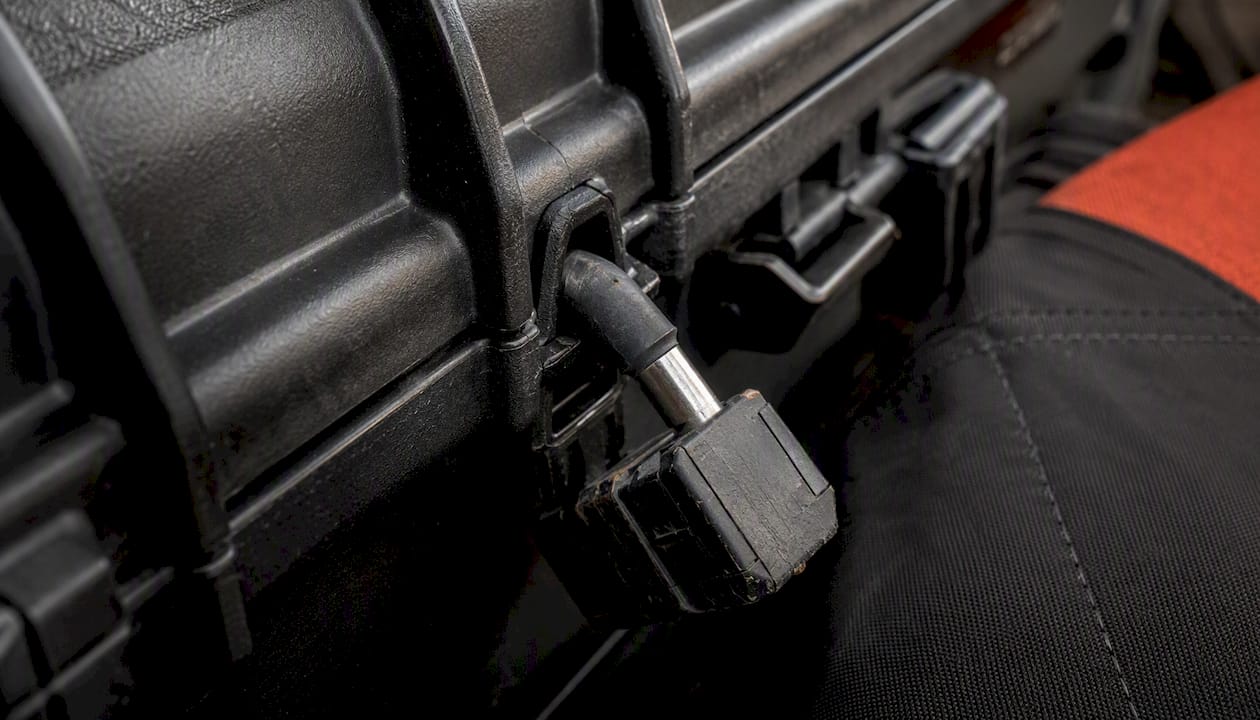
Mono-shaft (single-shaft) padlocks are designed specifically for gun cases with a single lock hole rather than a U-shaped shackle slot. The shaft slides directly into the case latch hole. Retail listings for mono-shaft gun-case locks show hardened steel shafts with protective rubber sleeves to resist cutting and impact. Measure your case’s hole diameter before buying — a loose fit defeats the purpose.
Built-in case locks come factory-installed on some hard cases. Quality varies widely. Treat them as a baseline, not a final solution, and add external padlocks at any additional latch points.
Compact lock boxes with TSA-recognized locks serve a different purpose: securing a handgun inside a larger bag or as a standalone transport container. The Hornady TrekLite lock box uses dual 4-digit TSA-recognized combination locks, impact-resistant polycarbonate, foam lining, and includes a security cable. Hornady recommends verifying your firearm’s dimensions against the interior before relying on it for transport.
Evaluation dimensions at a glance:
| Lock category | TSA acceptance | Cut resistance | Case compatibility | Access control | Notes |
|---|---|---|---|---|---|
| Heavy-duty keyed padlock | No (non-TSA) | High (hardened shackle) | U-shackle fits most latches | Key only, passenger holds | Best for exclusive control |
| Mono-shaft padlock | Varies by model | High (hardened shaft) | Single-hole latch required | Key or combo | Measure hole diameter first |
| Travel Sentry padlock (e.g., Master Lock 4696D) | Yes | Moderate | Extended shackle fits equipment cases | Combo, TSA master key exists | Reduces cut risk; not exclusive |
| Compact lock box (e.g., Hornady TrekLite) | Yes (TSA combo) | High (polycarbonate shell) | Handguns and compact firearms | 4-digit combo, TSA master key | Verify interior dimensions |
Always check shackle diameter, shackle length, and shaft diameter against your specific case before travel. Manufacturer spec sheets are the reliable source for these numbers.
How to lock and check your firearm at the airport
Follow this in order. Skipping steps is where most problems start.
Before you leave home:
- Unload the firearm completely and verify the chamber is clear
- Confirm your case is hard-sided, latches securely, and cannot be pried open
- Pad the firearm inside the case so it cannot shift during handling
- Install one padlock per latch — do not leave any latch point unsecured
- Pack ammunition separately in its original factory packaging or a manufacturer-approved container; keep it in the same checked bag (most airlines permit this) or a separate checked bag per airline policy
- Put all keys and combinations in your carry-on bag or on your person
At the airport:
- Go directly to the ticket counter — do not attempt to check a firearm at a kiosk
- Declare the firearm verbally to the airline agent before the bag is tagged
- Complete any written declaration form the airline provides and place it inside the case if required
- Present the locked case for inspection if asked; keep your keys accessible
- Do not surrender keys to baggage handlers — only to TSA or airline security personnel in an official inspection context
If TSA requests access:
- Offer to open the case yourself and supervise the inspection
- Photograph the case contents before closing if you have any concern about condition
- Relock the case yourself after inspection when possible
- If a lock is cut without your presence, document it immediately: photograph the damage, get an incident reference number from the airline or TSA, and file a claim if property was damaged
After landing:
- Check locks and case integrity at baggage claim before leaving the airport
- Replace any cut or damaged lock before your return flight
For larger rifles and AR-platform firearms, the FS9 Tactical guide to flying with an AR-15 covers airline-specific declaration steps and case sizing in more detail.
How to choose the right case and lock together
The lock is only as strong as the case it secures. USCCA’s guidance makes this explicit: a flimsy case will be defeated even with a strong lock. Pry resistance, latch strength, and interior retention all matter independently of what padlock you choose.
Case features that matter:
- True hard-sided construction (aluminum, ABS plastic, or reinforced polymer)
- Robust latch points with defined lock holes or hasp slots
- Interior foam or padding that holds the firearm in place without movement
- Crush and impact resistance rated for airline baggage handling
Lock compatibility checks:
- Measure the latch hole diameter if you plan to use a mono-shaft lock
- Check shackle clearance on U-shackle padlocks — a shackle that is too short will not close through the latch; too long creates leverage for cutting
- Verify factory-installed locks are serviceable and not purely decorative
Fs9tactical’s heavy-duty lockable rifle cases are built with reinforced stitching and defined lock points designed to accept common padlocks and mono-shaft locks. The detachable foam interior keeps the firearm stationary during transport. State-specific transport rules — California, for example, adds requirements beyond TSA — are worth checking separately; the FS9 Tactical California transport guide covers those nuances.
Common mistakes that cause problems at the airport
Most check-in problems and damaged locks trace back to a short list of avoidable errors.
Mistakes to avoid:
- Using a Travel Sentry lock on primary latch points when you want exclusive access control
- Leaving keys or combinations in the checked bag with the firearm
- Packing a loaded firearm — this is a federal violation, not just a TSA inconvenience
- Assuming the case the firearm came in from the manufacturer meets airline requirements
- Using a single lock on a multi-latch case and leaving other latches unsecured
- Relying on a soft case for air travel — TSA requires a hard-sided container
Red flags when evaluating locks and cases:
- Shackle diameter under 5/16 inch on a padlock marketed for gun cases
- Latch points that flex or bend under hand pressure
- Mono-shaft holes with visible play when the lock is installed
- Travel Sentry branding that looks printed rather than stamped or molded — counterfeit locks exist
If something goes wrong at the airport:
- Ask to supervise any TSA inspection before the case is opened
- Document staff names, badge numbers, and actions if your lock is cut without your presence
- Request an incident reference number from the airline if property is damaged
- File a claim with the airline and TSA if a lock is cut improperly
How to verify a lock is genuinely TSA-certified
Counterfeit Travel Sentry locks are a real problem. A lock with a fake Travel Sentry logo will not open with TSA master keys, which means TSA will cut it — and you will have no recourse because the lock was never certified.
How to verify authenticity:
- Buy from established U.S. retailers (major hardware chains, sporting goods stores, or the manufacturer’s direct website)
- Check the Travel Sentry website (travelsentry.org) for a list of licensed manufacturers; Master Lock is on it
- Look for a stamped or molded Travel Sentry logo, not a sticker or printed label
- Verify the model number on the manufacturer’s own product page before purchasing
- Avoid unmarked or unbranded locks sold only through third-party marketplace listings with no manufacturer identification
The Master Lock 4696D, for example, is documented on Master Lock’s own site as a Travel Sentry-recognized model with an extended shackle for equipment cases. That kind of direct manufacturer documentation is the standard to look for.
Have TSA policies on firearm transport changed recently?
The core TSA framework for firearm transport has been stable for years: unloaded, hard-sided, locked, checked baggage only, passenger retains key. That baseline has not changed.
What does shift periodically is airline-specific policy layered on top of TSA rules. Individual carriers adjust fees for declared firearms, update their ammunition packaging requirements, and occasionally change which bag types qualify as “hard-sided.” Delta, American, and United each maintain their own firearms transport pages that are updated independently of TSA.gov.
The practical advice: check TSA.gov directly before every trip, then check your specific airline’s current policy. Do not rely on what the rules were on your last flight — airline policies in particular can change without broad announcement. If you travel frequently for competitions or training, building a pre-trip verification habit is worth the five minutes it takes.
What experienced travelers with firearms actually do
Most frequent flyers with firearms land on a consistent setup after a few trips: a quality hard case, one heavy-duty keyed padlock per latch, all keys on a carabiner clipped to a carry-on strap. The Travel Sentry debate tends to resolve itself once someone has actually been through an inspection.
The travelers who stick with non-TSA locks do so because they have learned to ask for supervised inspections and have never had a lock cut. The ones who add a Travel Sentry lock at an auxiliary point usually do it after a trip where they could not be present at inspection and got nervous. Both approaches are defensible. What is not defensible is a single flimsy padlock on a multi-latch case, or keys in the checked bag.
A few habits worth adopting: photograph the packed firearm before closing the case, keep a spare padlock and its key in your carry-on, and label the case with your name and phone number on the outside. If the case gets separated from your checked bag tag, that label is how it finds you.
For shooters traveling to competitions, the broader physical preparation that goes into those trips is worth thinking about systematically. The HTK Training guide on injury prevention for tactical athletes covers the physical side of high-frequency travel and training.
Fs9tactical cases are built for exactly this kind of travel
If you are shopping for a case that meets the criteria this guide lays out, Fs9tactical’s heavy-duty lockable rifle storage case is worth a direct look. It is built with reinforced stitching, validated lock points that accept standard padlocks and mono-shaft locks, and a detachable foam interior that keeps your firearm stationary through airline baggage handling. The lock points are not afterthoughts — they are part of the case design, sized and positioned to work with the lock types this guide recommends.
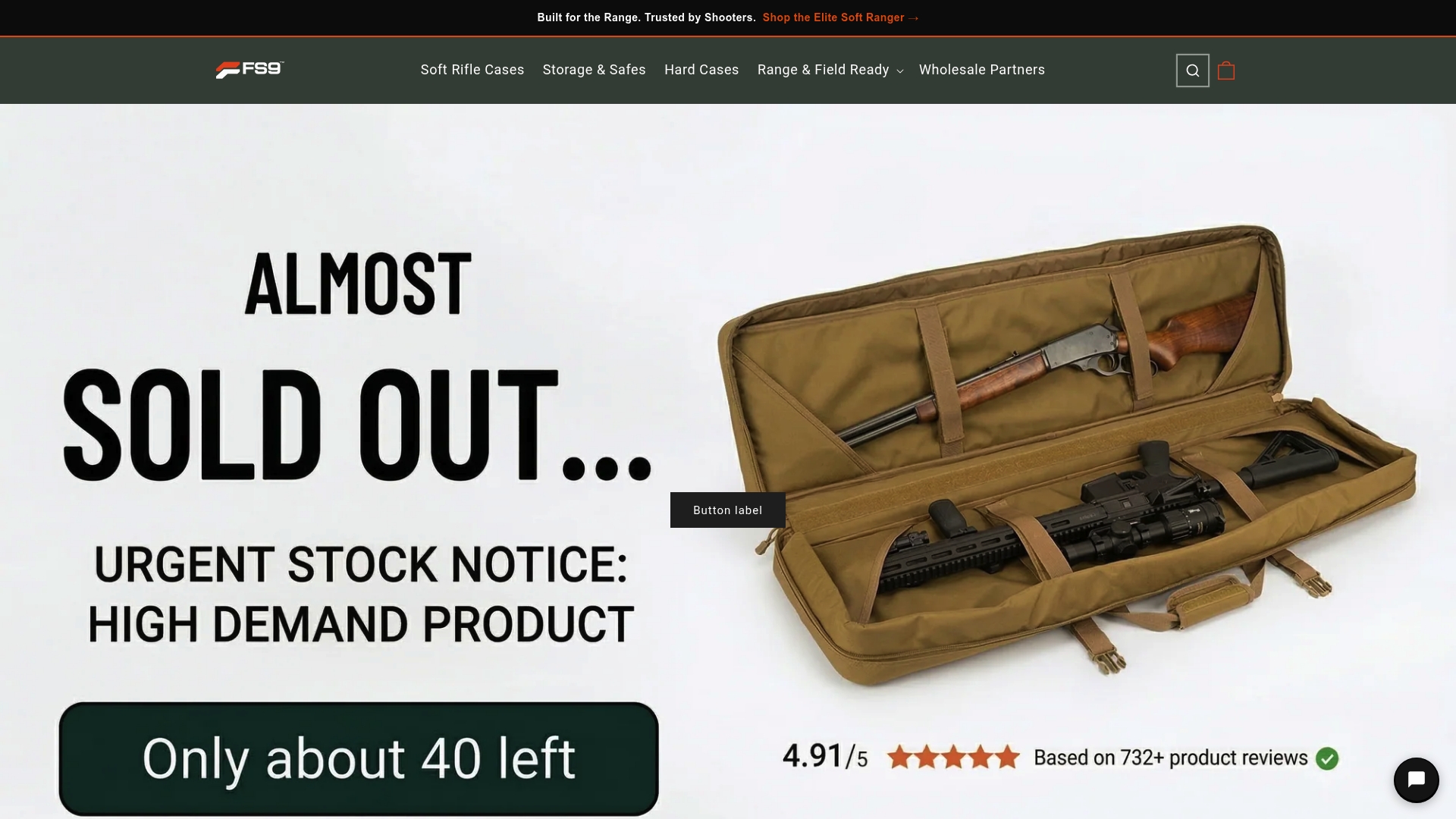
Fs9tactical also offers the Pro-Max scoped gun case for longer or optic-equipped rifles, with the same lock-point engineering and high-density padding. Both cases are available directly through the Fs9tactical store. Browse the full lineup, check the specs against your firearm’s dimensions, and order the case that fits your travel setup before your next flight.
Sources
- Transporting Firearms and Ammunition | Transportation Security Administration
- How to Travel With a Firearm: TSA Rules, State Laws & Safe Transport
- 4696D Combination Lock | Master Lock
- TrekLite® Lock Box with TSA Combination Lock - Hornady Manufacturing, Inc
